


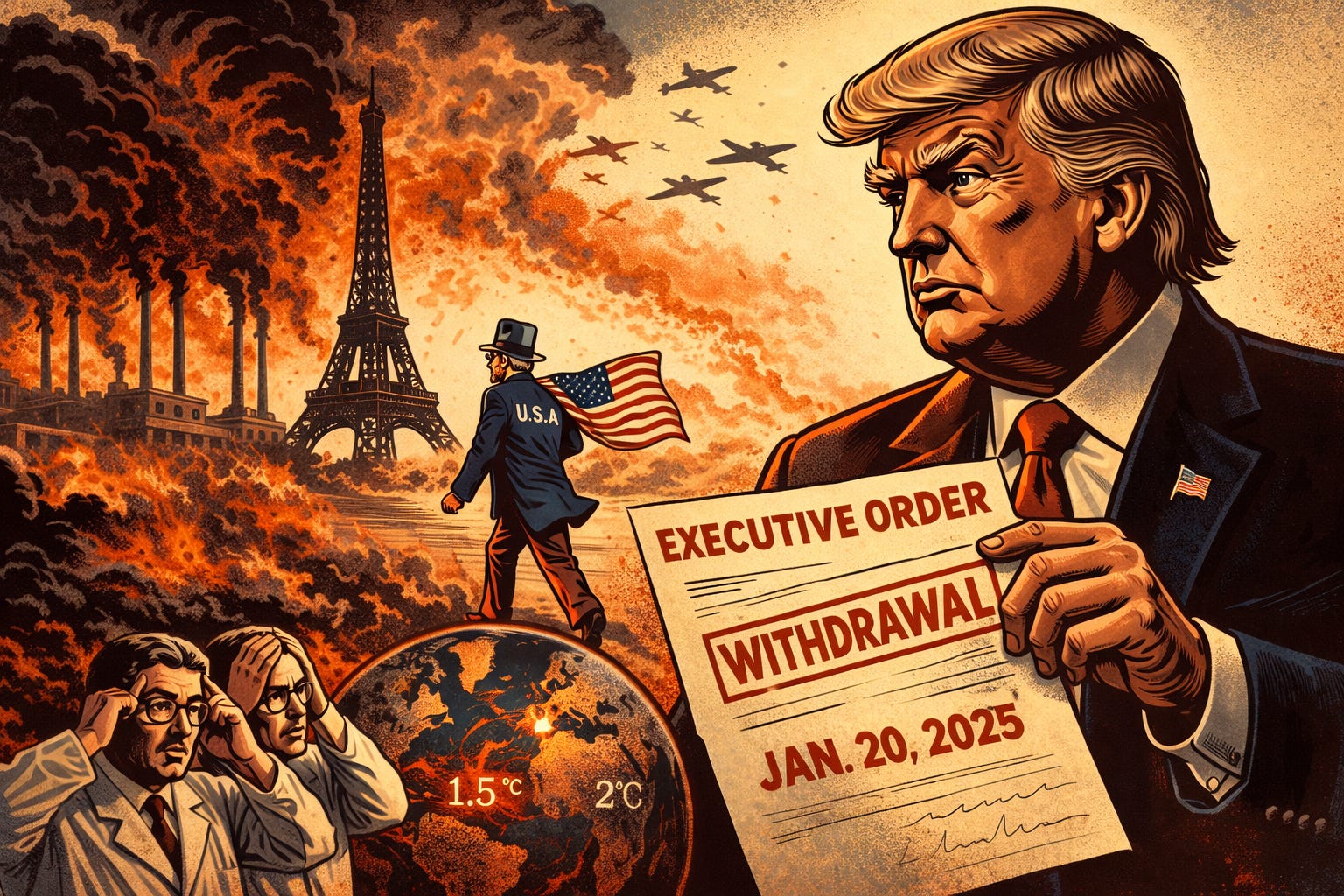
The headlines today sound alarming. The United States has officially withdrawn from the Paris Climate Agreement. If you’re seeing this on the news and feeling a knot in your stomach, you’re not alone.
Here’s the thing, though, this was announced a year ago. We’ve known it was coming since January 2025, when President Trump signed the executive order on his first day back in office. The Paris Agreement requires a 12-month waiting period before withdrawal takes effect. That clock ran out today.
This is also the second time it’s happened. Trump withdrew the US during his first term, with that withdrawal taking effect in November 2020. President Biden rejoined on his first day in office in January 2021. Now Trump has pulled out again.
The headlines are new. The pattern isn’t. Which raises the question… should we actually be worried? And what does this agreement even do?
What is the Paris Agreement?
In 2015, representatives from 196 countries gathered in Paris and reached an unprecedented deal. For the first time, virtually every nation on Earth agreed to work together on climate change.
The goal was to keep global warming below 2°C compared to pre-industrial temperatures, and try to limit it to 1.5°C. Scientists had determined these were the thresholds beyond which climate impacts become increasingly dangerous and potentially irreversible.
The mechanism is simpler than you might think. Every country sets its own targets for reducing emissions. These are called Nationally Determined Contributions, or NDCs. Every five years, countries must update these targets, and they’re expected to make them more ambitious each time.
There’s no international climate police. No fines for missing targets. The system runs on transparency and peer pressure. Everyone submits their plans, everyone reports their progress, and the world watches.
This might sound weak. It was actually a breakthrough. Previous climate treaties had failed because they tried to impose targets from above. The 1997 Kyoto Protocol required cuts only from developed nations, leaving out China and India. The US never ratified it. Paris succeeded because it asked every country to participate while acknowledging that wealthier nations bear greater historical responsibility.
Why does the US matter so much?
Two reasons. What America emits now, and what it emitted in the past.
Today, the US is the world’s second-largest emitter after China. According to the European Commission’s EDGAR database, it accounted for approximately 12% of global greenhouse gas emissions in 2024.
Climate change isn’t caused by what we emit this year, though. Carbon dioxide lingers in the atmosphere for centuries. The warming happening now is the result of everything humans have pumped into the sky since the Industrial Revolution began.
By that measure, no country comes close to the United States. According to Carbon Brief’s analysis published this month, America has released 542 billion tonnes of CO2 since 1850, around 20% of everything humanity has ever emitted. That’s more than China (336 billion tonnes) and Russia (185 billion tonnes) combined.
To put it another way, at China’s current annual emission rate, it would take roughly 15 years to match America’s historical contribution.
The US built the world’s largest economy on more than 150 years of burning fossil fuels. It industrialised while the atmosphere could still absorb the damage. Now, having benefited more than any nation from carbon-intensive development, it’s walking away from the global effort to address the consequences.
So should we panic?
Honestly? No, but we shouldn’t be complacent either.
The Paris Agreement won’t collapse without the US. The framework remains intact for 195 other parties. The economic case for clean energy now stands on its own. According to the International Energy Agency, global investment in clean energy reached $2 trillion in 2024, outpacing fossil fuel investment by roughly two to one. Electric vehicles account for approximately 20% of new car sales worldwide. Renewables made up more than 90% of new electricity generation capacity added globally in 2024.
These trends have momentum that no single country’s withdrawal can reverse. The technology is cheaper, the investment is flowing, and most of the world’s major economies remain formally committed to the Agreement.
So why does it matter?
Because momentum isn’t the same as success.
Current national commitments still put the world on track for roughly 2.6–3.1°C of warming by 2100, according to the UN Environment Programme’s Emissions Gap Report. That’s well above the danger threshold. Every fraction of a degree we add means more extreme weather, more failed harvests, more displaced people, more dying ecosystems.
The uncomfortable truth, however, is that even the countries staying in Paris aren’t doing enough.
China is the world’s largest annual emitter, responsible for roughly 30% of global greenhouse gas emissions. At the World Economic Forum in Davos last week, Vice Premier Ding Xuexiang stated that ‘no matter how the international landscape may evolve, China’s determination and action for proactive climate response will not change.’ China has invested heavily in renewable energy and dominates global solar and battery manufacturing.
It is also building more new coal power capacity than the rest of the world combined. Its 2035 climate pledge commits to reducing emissions just 7-10% below peak levels, a target critics argue is insufficient to meet Paris temperature goals. When Trump first withdrew in 2017, China did not step into the leadership vacuum with increased ambition. Its emissions accelerated. Between 2017 and 2023, Chinese CO2 output rose from just under 10 billion tonnes annually to over 12 billion tonnes. Whether that pattern repeats remains to be seen.
India, the world’s third-largest emitter, presents a similar tension. At the COP30 climate summit in 2025, Environment Minister Bhupender Yadav reaffirmed India’s commitment to ‘strengthening the implementation of the Paris Agreement.’ India, the world’s third-largest emitter, presents a similar tension. At the COP30 climate summit in November, Environment Minister Bhupender Yadav reaffirmed India’s commitment to ‘strengthening the implementation of the Paris Agreement.’ India has met its renewable energy capacity targets five years early, yet coal still accounts for roughly 75% of electricity generation. It has also missed two deadlines to submit its updated 2035 climate targets.
The EU has strengthened its targets, pledging 55% emissions cuts by 2030 compared to 1990 levels. It remains the most ambitious major economy on paper, though implementation has faced political headwinds.
The honest assessment? The US walking away makes a difficult situation worse. It removes pressure, eliminates climate finance, and signals that commitments are optional. It does not transform a success story into a failure, because the story was already struggling.
The bigger picture
This isn’t just about one agreement. On 7 January 2026, the White House issued a presidential memorandum announcing US withdrawal from more than 65 international organisations and agreements, citing them as ‘wasteful, ineffective, or harmful.’
The climate-related exits include:
The UN Framework Convention on Climate Change (UNFCCC), the 1992 treaty that serves as the parent agreement for Paris and the foundation of international climate diplomacy. The US contributes roughly 22% of its secretariat budget.
The Intergovernmental Panel on Climate Change (IPCC), the scientific body that synthesises climate research and produces the assessments that inform global policy. During Trump’s first term, other countries stepped up when US contributions were cut.
The Green Climate Fund, the world’s largest multilateral climate fund, which channels money from wealthy nations to help developing countries adapt to climate impacts and transition to clean energy.
This is a systematic dismantling of American participation in international climate architecture. The pattern across more than 65 bodies suggests coordinated strategy rather than isolated decisions.
What this means for the ocean
For those of us focused on marine systems, the implications are concrete.
The Green Climate Fund has committed over $400 million to Pacific Island nations over the past decade. Just last month, it approved a $107 million grant to help 14 Pacific Island countries manage their tuna fisheries as warming oceans shift fish distributions. These nations are custodians of one-third of the world’s tuna catch. Their economies depend on fishing access fees that fund healthcare, education, and disaster preparedness.
Climate projections show tuna stocks moving away from Pacific Island waters toward the high seas as temperatures rise. Without adaptation support, some nations face losing a significant portion of their government revenue by 2050.
The IPCC's work is equally critical for ocean governance. Its Special Report on the Ocean and Cryosphere, and the ocean chapters of its Assessment Reports, provide the scientific foundation for marine protection policies worldwide. The research that informs coral reef conservation targets, fisheries management under warming conditions, coastal adaptation planning, and responses to ocean acidification all flows from IPCC assessments. As oceans absorb CO2 from the atmosphere, they become more acidic, threatening shellfish, coral, and the base of marine food webs. The science tracking this process depends on the international research infrastructure that US withdrawal now undermines.
Pulling funding and participation from these bodies doesn’t just affect abstract diplomatic processes. It affects whether Pacific Island states can adapt their fisheries before the fish move. It affects whether coastal communities in the Global South can build defences before the storms intensify. It affects whether the science that should inform ocean policy continues to be produced and synthesised.
These are the nations and communities least responsible for climate change and most exposed to its consequences.
Where does this leave us?
Climate change is not a problem that gets solved or unsolved by any single decision. It’s a slow-motion crisis that unfolds over decades, shaped by millions of choices made by governments, companies, and individuals.
The US withdrawal is a setback. It is not a death blow.
The Paris Agreement was always a floor, not a ceiling. It was a starting point for action, not a guarantee of success. It created a framework for increasing ambition over time. That framework remains intact for 195 other parties.
The question now is whether other major emitters use this moment as permission to slow down or as a reason to step up. Whether the economic logic of clean energy continues to outpace political backsliding. Whether voters and consumers in every country keep demanding action.
The US has chosen to walk away from its historical responsibility. The atmosphere doesn’t care about politics. The physics of warming continues regardless of who signs which agreement.
What matters now is what everyone else does next.
In the coming weeks, I’ll be reporting on what US withdrawal means specifically for ocean governance, from Antarctic fisheries to Pacific Island climate finance to the science that underpins marine protection. If you want those investigations when they drop, become a paid subscriber.
One can make a direct impact to fight climate change by choosing more plant based options — whether Whole Foods or Comfort Foods — just choose plant based. May sound silly but animal agriculture is highly destructive and wasteful; it is polluting and killing our planet. We need to stop ignoring the elephant in the room. 🚨🆘🐘
The US Is moving backwards in climate protection. I appreciate your facts and figures. I will keep talking to family and friends armed with actual numbers.