


Several things converge this year.
That’s how I summed up a (very) long investigation for Oceanographic Magazine earlier this year.
NORI’s exploration contract was approaching the end of its original 15-year term, the International Seabed Authority (ISA) was investigating questions around companies it regulates, the rules governing commercial mining were unfinished, and in the United States, companies were beginning to use a separate permitting system established by a law passed over 40 years ago.
Most of the dates I was keep an eye out for have since arrived, and a whole lot has changed.
NORI has five more years to explore, more companies are appearing in the US application system, more governments are calling for commercial mining to wait, the International Seabed Authority has finished another round of negotiations, TMC’s most advanced US application is now in public review.
In a nutshell, this is where things stand.
The ISA is still dealing in exploration
Nauru Ocean Resources Inc, usually shortened to NORI, is a subsidiary of The Metals Company, or TMC. It signed its exploration contract with the International Seabed Authority, or ISA, on 22 July 2011 for a term of 15 years.
On 20 July this year, the ISA Council approved a five-year extension taking effect from 22 July 2026, so that keeps NORI exploring, but it still doesn’t give the company permission to mine commercially.
I covered the extension separately at the time, along with the legal dispute (which is still running) involving NORI, Tonga Offshore Mining Limited (TOML), and the ISA.
On 18 July, the Seabed Disputes Chamber of the International Tribunal for the Law of the Sea ordered provisional measures while the cases continue. It required the ISA to follow the relevant legal procedures in its inquiry, make clear what procedures and questions the companies were being asked to respond to, and give them a reasonable opportunity to answer.
The judges haven’t decided the underlying cases. NORI, TOML and the ISA are due to report back by 31 August 2026 on how they have complied with the orders.
The larger question of commercial mining remains unresolved too.
The ISA already has regulations covering prospecting and exploration, but what it still doesn’t have is a completed set of exploitation regulations governing commercial mining of the international seabed.
UN ocean law calls that seabed the Area. It means the seabed and ocean floor beyond any country’s national jurisdiction, along with the ground beneath them.
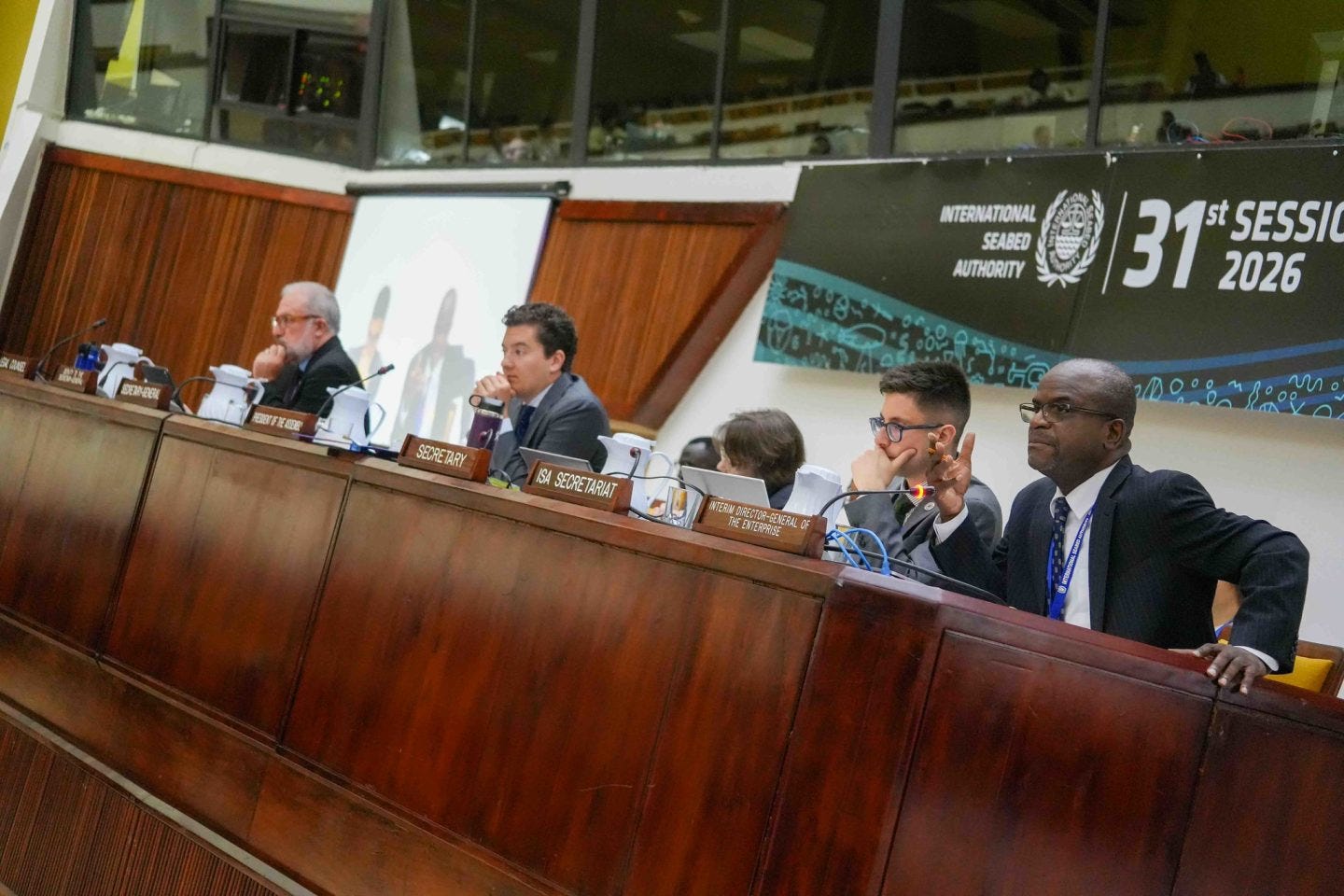
On 24 July, the ISA Council adopted another timetable for negotiations, and it repeated its position that commercial mining in the Area should not begin before the necessary rules and procedures are ready.
The ISA Secretariat has until 31 October 2026 to produce a draft plan for the next round, and Governments then have until 31 December to comment. Council meetings follow in March and July 2027, with the Assembly later that month.
One other decision made involved four companies, holding ISA exploration contracts, that all applied for observer status at the Assembly. They are Global Sea Mineral Resources NV, NORI, TOML and UK Seabed Resources Ltd.
Observer status would have given commercial contractors a formally recognised position at Assembly meetings even though they are not ISA member governments, but the Assembly did not grant it. However, the four companies will be allowed to attend public meetings next year in their individual capacity as contractors. They will be able to make oral statements if invited by the Assembly President and approved by the Assembly, although the decision explicitly says that this arrangement “should not be construed as the granting of observer status”, we shall have to wait and see what that looks like in practice.
How meaningful that distinction becomes will depend partly on what happens next year: who attends, who is invited to speak and how often the Assembly approves those requests.
The July meetings also failed to begin the second periodic review of the international seabed regime, a broader assessment of how the system has operated in practice.
China, Japan, India and Russia argued that starting the review now would divert staff, time and money away from completing the commercial mining rules. Germany said both jobs could happen at the same time. Canada and the UK supported further discussion of an independent and transparent review.
A larger group wanted the review to begin, including the African Group of ISA members, Belgium, France, Costa Rica, Switzerland, Finland, Greece, Malta and Australia.
Assembly President Oliver Whitehead recorded that there was no agreement, and there has therefore been plenty of procedural movement at the ISA. NORI has its extension. Negotiations have another timetable. Contractors have an interim route into public Assembly meetings. The tribunal cases continue.
What the ISA still doesn’t have is agreement on the rules that would allow commercial exploitation to begin.
