


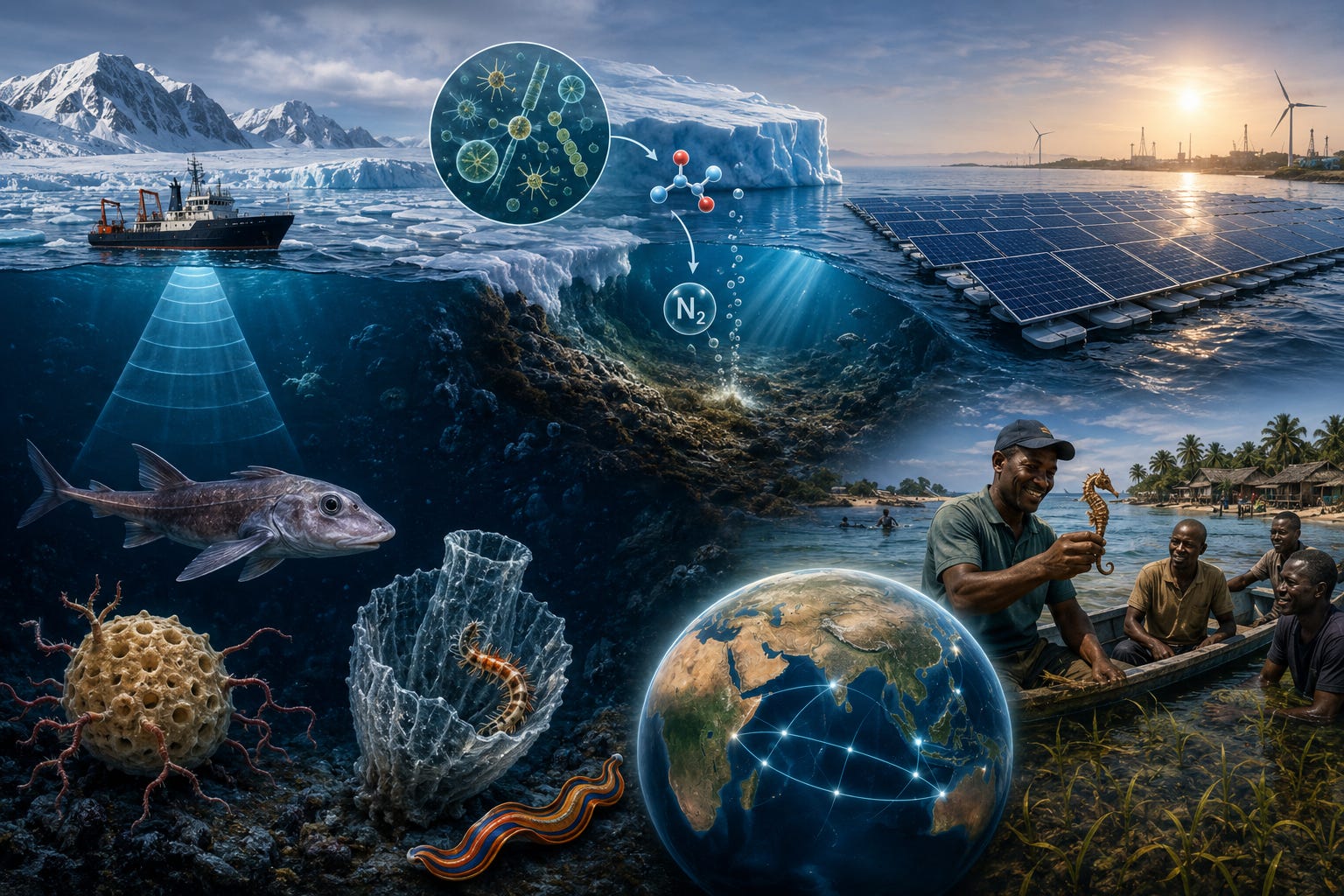
Last week, this newsletter covered a study that found the deep basins of the central Arctic Ocean almost empty of fish. Echo sounders returned near-silence. Trawl nets came up with almost nothing. The researchers called it a biological desert beneath the ice.
This week, a separate team has published a study that may explain why. Twenty years of data from the Fram Strait, the narrow passage between Svalbard and Greenland, where Arctic water drains into the North Atlantic, show that the chemical foundations of the Arctic food chain crossed a tipping point around 2009, and the researchers say it is unlikely to reverse.
That story leads a Deep Brief that also covers the discovery of more than 1,100 previously unknown marine species in a single year, and the first direct evidence that floating solar farms on the ocean generate significantly more electricity than solar panels on land. Three deep dives. Three quick hits. One hard truth from the sea.
Deep Dives
The Arctic Ocean has crossed a chemical tipping point.
The Arctic food chain depends on nitrate, a dissolved form of nitrogen that phytoplankton, the microscopic algae at the base of the food web, need to grow. Without nitrate, phytoplankton cannot photosynthesise in sufficient quantities to feed the zooplankton, fish, seabirds, and marine mammals above them. Nitrate in the Arctic is the fertiliser that makes everything else possible.
A study published this week in Communications Earth & Environment by an international team led by Professor Raja Ganeshram, at the University of Edinburgh’s School of GeoSciences, has found that nitrate concentrations in Arctic surface waters dropped sharply around 2009 and have not recovered. The shift, they argue, represents a regime change: the Arctic Ocean has moved from a system limited primarily by light, where the ice cover prevented photosynthesis by blocking sunlight, to a system limited by nutrients, where the ice has retreated, but the nitrate needed to fuel growth is being destroyed faster than it can be replenished.
The mechanism is a process called benthic denitrification. When sea ice retreats, sunlight reaches the shallow continental shelves that underlie nearly half of the Arctic Ocean. More light means more photosynthesis, which means more organic matter sinking to the seafloor. Microbes in the sediment consume that organic matter and, under the low-oxygen conditions that result, convert nitrate into nitrogen gas. Nitrogen gas is useless to most marine plankton. It escapes into the atmosphere and is, from the food web’s perspective, permanently lost.
The team analysed 20 years of oceanographic data collected from the Fram Strait, where polar surface water flows out of the Arctic and into the North Atlantic. They tracked nitrate concentrations and the ratio of silicon to nitrogen in those outflowing waters. After 2009, fixed nitrogen concentrations fell sharply while silicon-to-nitrogen ratios rose, a signature consistent with accelerated denitrification on the shelves. Combining these observations with modelled denitrification rates and tracking the paths that water takes across the Arctic shelves, the researchers identified the Chukchi Sea and the East Siberian shelf as the primary zones of nitrogen loss, removing approximately 12 teragrams of nitrogen annually, enough to offset a substantial portion of the nutrients entering the Arctic from the Pacific Ocean through the Bering Strait.
“The changes we report suggest that the Arctic Ocean ecosystem passed a tipping point around 2009,” Ganeshram said. “Once the sea-ice melts and the balance between nutrient supply and removal shifts, the original conditions can’t recover, even if ice were somehow restored.”
The consequences flow upward through the food chain. With less nitrate available, the Arctic may shift toward supporting smaller, less nutritious species of plankton. These smaller organisms transfer less energy to the fish, birds, and mammals that depend on them. The study also raises concerns about the Arctic’s capacity to absorb carbon dioxide: phytoplankton pull CO2 from the atmosphere during photosynthesis, and fewer phytoplankton means less carbon drawn down.
For readers who followed last week’s Deep Brief, this study completes a picture. The empty Arctic basins documented by the Norwegian Polar Institute were biologically vacant. The Edinburgh team’s work suggests that the chemical conditions needed to support life in those waters are actively deteriorating. The emptiness is not a baseline waiting to be filled as the ice retreats. It is a consequence of the retreat itself.
Scientists have identified more than 1,100 previously unknown marine species in a single year.
Ocean Census, a global initiative led by Japan’s Nippon Foundation and the UK-based ocean exploration institute Nekton, announced on 19 May that 1,121 previously unknown marine species were identified across 13 expeditions and 9 species discovery workshops in 2025. The figure represents a 54 per cent increase over the 728 new species recorded the previous year and involves more than 1,000 researchers working across 85 countries.
The discoveries came from depths as great as 6,575 metres and from some of the planet’s least explored marine environments. Among the species announced: a chimaera, commonly called a ghost shark, found at roughly 800 metres in the Coral Sea Marine Park off Queensland, Australia. Chimaeras are ancient cartilaginous fish that diverged from a common ancestor with sharks and rays nearly 400 million years ago, predating the dinosaurs. Their smooth, scaleless skin and reflective eyes give them an appearance that earned them their common name.
Near the South Sandwich Islands in the south Atlantic, at nearly 3,600 metres depth, researchers found a carnivorous sponge belonging to the genus Chondrocladia. Unlike typical sponges, which filter food passively from the water, this species traps small crustaceans using microscopic hooks on its surface, earning it the nickname “death ball” among the team that found it.
On volcanic seamounts in Japan, scientists discovered a bristle worm living inside the translucent chambers of a glass sponge, a structure built from crystalline silica, the same material used to make glass. The worm and the sponge share a symbiotic relationship: the worm gets shelter, and the sponge likely benefits from the worm’s feeding activity. In Timor-Leste, a ribbon worm just an inch long, marked by stripes of bright orange that signal chemical defences, was found in shallow water. The toxins that ribbon worms produce have been investigated as potential treatments for Alzheimer’s and schizophrenia.
“We spend billions searching for life on Mars or going to the dark side of the moon,” said Oliver Steeds, director of Ocean Census. “Discovering the majority of life on our own planet, in our own ocean, costs a fraction of that.”
The initiative is accelerating identification by recognising “discovered” as a formal scientific status that can be logged immediately into an open-access database once validated by an expert, before the longer formal description process is complete. This matters because many species may vanish before they are formally described, due to climate change, industrial pollution, and the growing prospect of deep-sea mining in regions where species have barely been catalogued.
Ocean Census has planned six new expeditions and five species discovery workshops for 2026.
Floating solar farms on the ocean generate 12 per cent more electricity than solar panels on land.
Researchers at Taiwan’s National Taipei University of Technology have published the first direct comparison between an offshore floating solar installation and a conventional land-based solar farm operating under similar conditions. The floating system generated roughly 12 per cent more electricity over its operational lifetime, according to the study, published on 19 May in the Journal of Renewable and Sustainable Energy.
The reason is temperature. Solar panels lose efficiency as they heat up. Panels mounted on land absorb heat from the ground and surrounding air. Panels floating on the ocean are cooled by the water beneath them and by stronger winds across the open surface. The temperature difference, typically two to three degrees Celsius lower at sea, is enough to produce a measurable gain in output.
The comparison was unusually clean. Taiwan Power Company had installed a 100-megawatt land-based solar farm in the Changbin Industrial Park. Nearby, Chenya Energy had deployed a 181-megawatt offshore floating photovoltaic system on 1.8 square kilometres of sheltered water within the same industrial zone. The proximity and similar conditions allowed the researchers to isolate the effect of the water surface on performance.
“What we found is that offshore floating solar systems can generate more electricity over their lifetime, about 12 per cent more than land-based systems under the same conditions,” said Ching-Feng Chen, one of the study’s authors. “Because of this higher energy output, they also achieve greater carbon emission reductions.”
Taiwan, roughly the size of the Netherlands, faces acute land constraints for renewable energy. Its energy sector accounts for more than half of national carbon emissions, and the island is currently 99 per cent dependent on imported natural gas, a vulnerability intensified by the ongoing disruption to shipping through the Strait of Hormuz. Offshore floating solar offers a pathway that does not compete with agriculture, does not require clearing land, and sits within reach of existing coastal grid infrastructure.
More than 1,100 floating solar installations now exist globally, predominantly on reservoirs and lakes in China and other densely populated Asian countries. The Taiwan study is significant because it compares offshore ocean deployment rather than freshwater, where conditions are calmer, less corrosive, and easier to maintain. Whether floating solar can withstand typhoons, salt corrosion, and biofouling over a 25-year operational life at sea remains the open engineering question. The 12 per cent advantage means nothing if the panels do not survive.
Quick Hits
In a fishing village on the coast of Mozambique, former seahorse poachers are now seahorse protectors. Fishermen in Mangalisse were being paid between 25 and 50 Mozambican meticais, roughly 30 to 60 pence, per dried seahorse by traffickers linked to the traditional Chinese medicine trade. The animals, which fishermen began calling “diamonds,” were being pulled from seagrass beds by the thousand. A community-led conservation initiative, supported by local lodge owner Mike van Hone and marine scientist Ilídio Cole, has turned the dynamic around: former collectors now guide research teams and patrol the seagrass beds. Globally, despite CITES Appendix II listing since 2002, the seahorse trade has shifted to a black market. Research from Project Seahorse at the University of British Columbia found that 95 per cent of dried seahorses in Hong Kong’s large market were being imported from countries that had export bans in place. Three seahorse species, giraffe, common, and thorny, are found in Mozambican waters.
India and Africa are being urged to deepen ocean cooperation across fisheries, renewable energy, and maritime security. A policy analysis by India’s Observer Research Foundation argues that combining India’s technical and industrial capacity with Africa’s marine resources and growing institutional frameworks could accelerate sustainable ocean development in both regions. The piece highlights Blue Bonds, joint action against illegal, unreported, and unregulated fishing, and shared investment in ocean renewable energy as priority areas. For a newsletter that covers ocean governance, the India-Africa maritime relationship is worth watching: together, the two regions control a substantial share of the Indian Ocean coastline and its fisheries.
This week’s Arctic tipping point study and last week’s empty Arctic basins study were published independently, a week apart, by different research teams. The Norwegian Polar Institute found almost no fish in the deep central Arctic. The University of Edinburgh found that the nutrient base those fish would need to survive is being chemically destroyed. Neither team cites the other. Together, they describe an ocean that is simultaneously losing its animals and the chemical conditions needed to support them. Readers who want both studies: the empty basins paper is in Communications Earth & Environment (Hop et al., 22 May 2026). The nitrate tipping point paper is in the same journal (Ganeshram et al., 28 May 2026).
Hard Truth From The Sea
In a single week, two independent studies described an Arctic Ocean that is losing both its life and the chemistry needed to sustain it. In another part of the ocean, scientists catalogued more than a thousand species nobody knew existed, many of them in waters that may not look the same in a decade. In Taiwan, engineers proved that the surface of the ocean can generate more clean energy than the land beside it. The ocean contains both the crisis and the means to address it. Which of them defines the next decade depends on decisions that have not yet been made.
Paid subscribers fund the reporting that tracks what is changing in the ocean and why. If you want accountability journalism on the systems we depend on and the institutions responsible for protecting them, please support me and upgrade to a paid subscription.
See you next week.
- Luke
I love your posts. I am 72 yo. and raising my 17 yo son. I work as a substitute teacher to make ends meet. I can't afford subscriptions. I'm sorry.
Mars won't save us , healthy Oceans will