


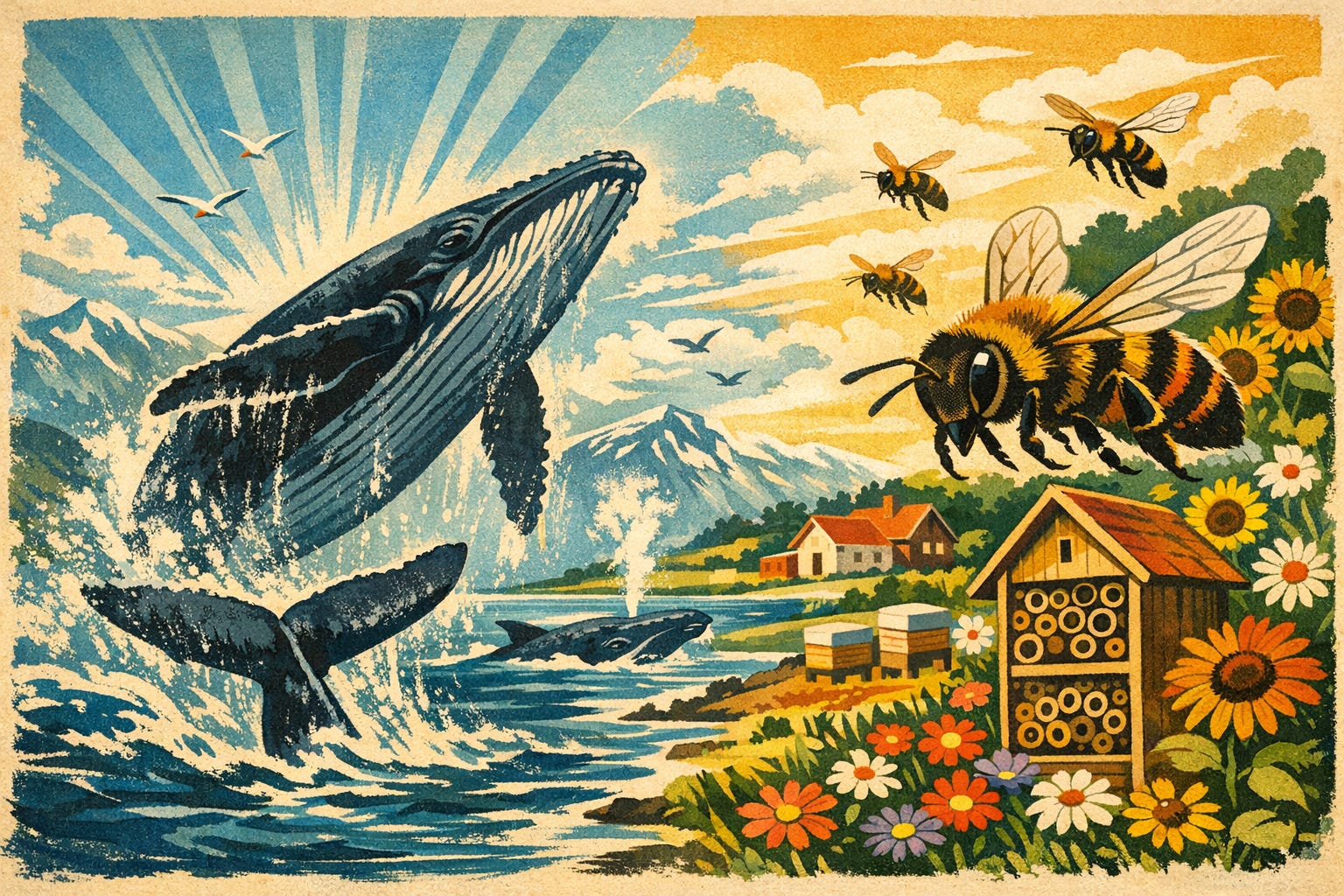
The question slipped out of my mouth in a meeting. ‘Who did the PR for bees?!’ I had no prepared answer for it.
Why did I blurt that question out in a meeting? Well, at some point, someone told the story of bees so well that it changed behaviour without asking.
Bees became shorthand for ecological collapse. If the bees disappear, we disappear.
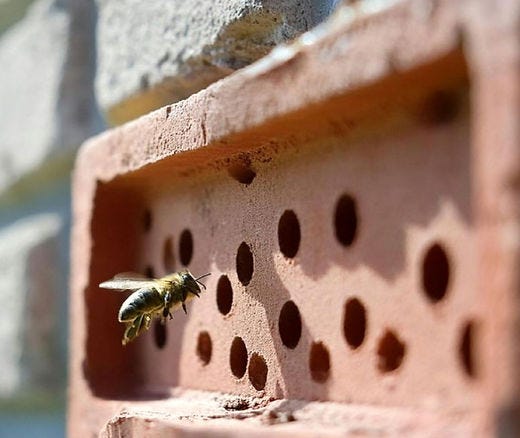
The message is now so embedded that people act on it without being told. They let gardens grow wild. Councils mow less. You can buy bee bricks with holes designed into them so solitary bees can nest in garden walls. Bee hotels sit on balconies in cities where most residents have never seen a hive.
The World Wildlife Fund has a dedicated explainer: ‘Why Bees Are Climate Heroes.’ The United Nations Environment Programme published ‘Why Bees Are Essential to People and Planet.’ Across the UK, the Bee Friendly Schools programme puts pollinator gardens and wildflower pots into classrooms, teaching children not just why bees matter but what they can do about it.
Morgan Freeman converted his 124-acre ranch into a honeybee sanctuary. He brought in over two dozen hives, planted fields with bee-friendly flowers like clover and lavender, and began feeding them sugar water by hand.
The bee movement won. Not through legislation or protest, but through story. Through saturation. Through giving people something they could do in their own gardens, on their own balconies, with their own hands.
Then the obvious question followed.
Why have we never managed to do that for whales?
The trillion-dollar story that never landed
Whales regulate climate. They dive deep to feed, then rise to the surface and release nutrient-rich waste that fertilises phytoplankton, the microscopic plants that form the base of the ocean food chain. Those phytoplankton contribute to the oxygen we breathe and absorb vast quantities of carbon dioxide. When whales die, their bodies sink to the ocean floor, locking that carbon away for centuries. One widely-cited estimate, published in an IMF magazine in 2019, valued the ecosystem services of great whales at over one trillion dollars. A single whale, by their estimate, could be worth more than two million.
On paper, that story is at least as strong as the bee story. Possibly stronger.
It hasn’t landed in the same way.
This all comes down to four things: proximity, agency, simplicity, and villain clarity. In the rest of this piece, I unpack why the bee movement succeeded where whale conservation has not. I look at why Save the Whales, once the biggest environmental brand on the planet, faded into nostalgia. I land on two women who decided to do something anyway, and who stand trial in Iceland today for the crime of caring too much.
