


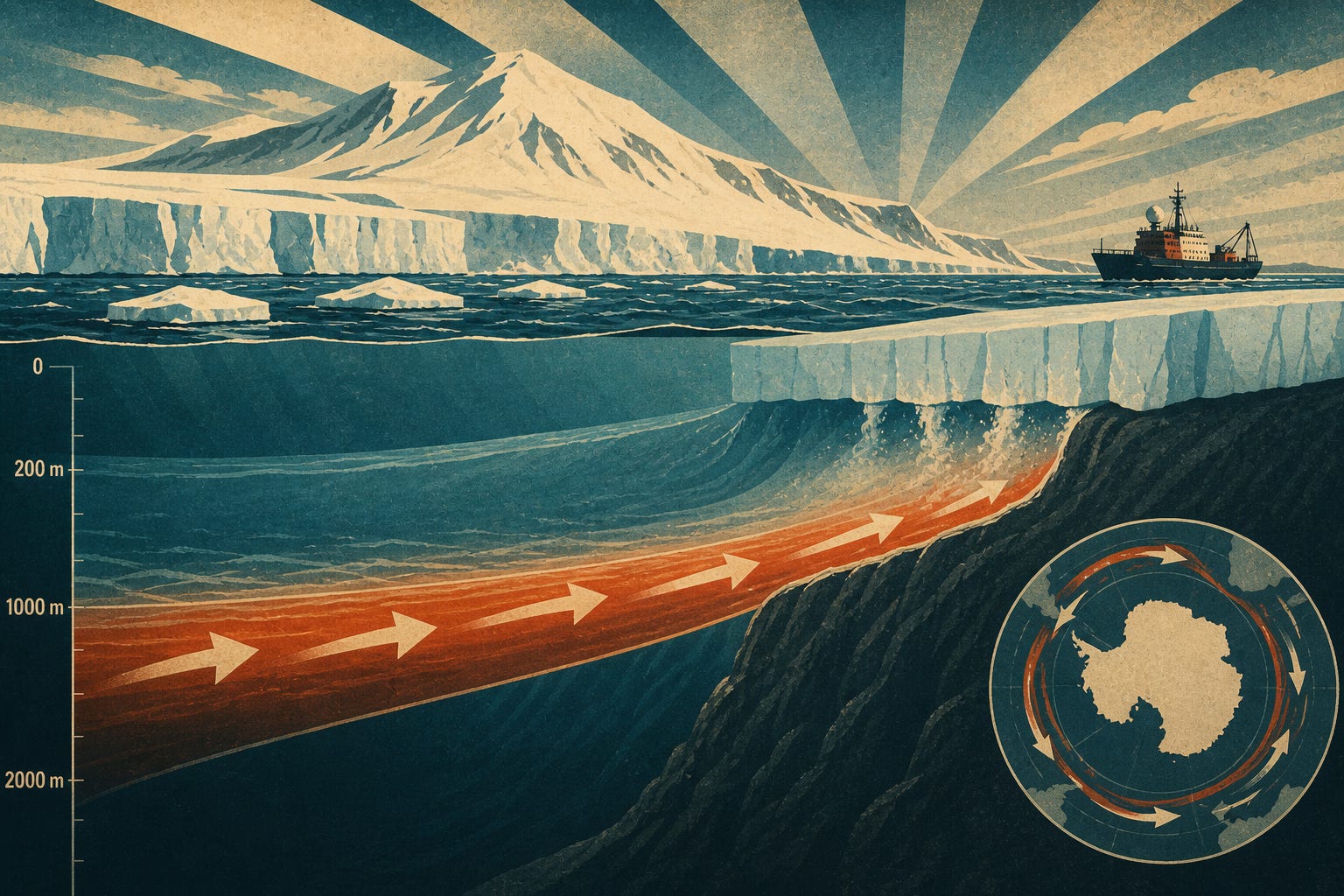
A study published last week in Communications Earth & Environment makes a measurement that hasn’t been made before. Over the past two decades, a layer of warm water deep beneath the Southern Ocean has been shifting south, towards the Antarctic continent, at an average rate of about 1.26 kilometres per year. Compounded over twenty years, that comes to roughly 25 kilometres of poleward redistribution, a meaningful fraction of the distance between the typical core of this warm layer and the Antarctic continental shelf.
The water is called Circumpolar Deep Water. It sits between roughly 200 and 2,000 metres down, wrapping around the continent, and it carries the heat that melts Antarctic ice shelves from below.
Those shelves matter because they hold back the much larger ice sheet behind them. The ice that sits on the Antarctic continent, if it eventually entered the ocean, would raise global sea level by about 58 metres.
The new study, led by Joshua Lanham at the University of Cambridge with colleagues at Scripps Institution of Oceanography and UCLA, uses two independent datasets to show that the warm layer is expanding nearer the continent and contracting further north. Both methods reach the same conclusion. Earlier observational work had already detected poleward shifts in specific regions of East Antarctica. What is new here is a circumpolar picture, built from a methodology that bridges two very different kinds of ocean data.
Why warm water at depth matters
Circumpolar Deep Water is warm because of where it came from. It originated in the North Atlantic and Pacific, sank with more heat than the abyssal water around it, and travelled south on timescales of decades to centuries, retaining much of that heat as it went. By the time it reaches the Southern Ocean it is no longer warm in any everyday sense, typically a degree or two above freezing, but compared with the near-freezing surface waters around Antarctica and the ice it might encounter, the temperature difference is substantial. When it reaches the underside of an ice shelf, that small difference is enough to drive significant melting.
The reason warm water can sit beneath cold water in this part of the ocean is salinity. Cold water near Antarctica is freshened by sea ice melt and precipitation, while the deeper layer carries higher salt content from its origins thousands of kilometres away. Salt makes water heavier. The deeper layer is denser despite being warmer, and stratification holds it in place.
Ice shelves are floating extensions of the ice sheet that sits on the Antarctic continent. They do not themselves contribute to sea level when they melt, because they are already in the water. What they do is buttress the glaciers and ice behind them. When ice shelves thin or collapse, the inland ice flows faster into the sea. Basal melt, driven by ocean heat reaching the underside of these shelves, is the dominant control on ice shelf mass loss. Surface melt matters far less than what is going on underneath.
What the study did
The first dataset is a network of repeat ship surveys called GO-SHIP, in which research vessels sail the same lines across the world’s oceans every decade or so, lowering instruments that measure temperature, salinity, oxygen, and a handful of other chemical tracers from surface to seabed. These measurements are precise but the lines are widely spaced and visited infrequently. Comparing surveys from 2005-2010 against surveys from 2015 onwards, the team found that warm Circumpolar Deep Water had increased in concentration nearer the Antarctic continent and decreased further north.
The second dataset is the Argo float programme: nearly four thousand robotic floats drifting through the world’s oceans, surfacing every ten days to transmit profiles of temperature and salinity in the upper 2,000 metres. The Argo data offers monthly resolution and global coverage, which the ship surveys cannot. The floats only measure two variables, however, which is not enough to identify water masses using the standard chemical-fingerprint method that ship surveys allow.
The team’s solution was to train a machine learning model on the rich GO-SHIP data, where water masses can be identified directly from the chemistry, and then apply that model to the sparser Argo measurements to fill in the spatial and temporal gaps. When tested against ship measurements it had not been trained on, the model performed well in nearly every region of the Southern Ocean. Applied to twenty years of Argo data, it produced the same poleward shift the ship surveys had shown, with finer detail. The pattern is the dominant feature of the twenty-year record once seasonal variation is removed, which is what makes the paper persuasive.
What the paper does and does not show
The study demonstrates that warm deep water has shifted closer to the Antarctic continent. It does not directly measure how much additional heat is reaching the ice shelves themselves. The Argo float data used in the analysis stops at 65°S, the latitude band immediately north of the Antarctic shelf, and it cannot sample the near-shelf waters where ice melt actually happens.
What the study does show is that within the band of ocean immediately north of the continent, ocean heat content in the warm-water layer has been accumulating at a rate equivalent to a continuous 2.81 terawatts of energy. That is a substantial amount of heat building up close to where the ice meets the sea. Whether and how much of it is currently crossing onto the shelves depends on local processes the study cannot resolve at continental scale. Winds, eddies, bathymetry, and the behaviour of dense shelf water that can act as a barrier all shape what happens at the final stretch.
The mechanism behind the migration is also unsettled. The paper presents two broad candidates. The first is that dense, cold water that normally sinks near the Antarctic coast (Antarctic Bottom Water) has been weakening, a trend already observed in independent studies, and as it contracts the warm layer migrates south to fill the space. The second is that wind-driven changes in the Southern Ocean, including strengthening westerly winds and a poleward shift in the wind belt itself, have moved the position of the Antarctic Circumpolar Current and the upwelling pathways of warm water along with it. The two mechanisms are not mutually exclusive, and the paper does not pick between them.
Why this is significant
Until now, scientists have relied largely on climate models to project what would happen as the Southern Ocean warmed. The models suggested that warm deep water would shift poleward and that ice shelf melt would accelerate as a result. Observational evidence for the shift has been piecemeal and regional.
This study is the first to show, from observations rather than projections, that the predicted shift is already underway across the entire Southern Ocean. As Lanham put it in the Cambridge press release, this is no longer a possible future scenario, it is something that is happening now.
The timescales over which the world is making decisions about climate, ice loss, and sea level rise rely on assumptions about what is happening to Antarctic ice. If the heat delivery system is shifting in the way this study describes, the question is not whether basal melting accelerates but how quickly. The paper does not answer that question, but it does establish that the question has stopped being hypothetical.
Ocean Rising depends on paid subscribers. Explainers like this one stay free. The investigations, which take longer and go deeper than a single newsletter can carry, are for paid readers. If you want the work that follows the questions this piece raises, that's where it lives.