


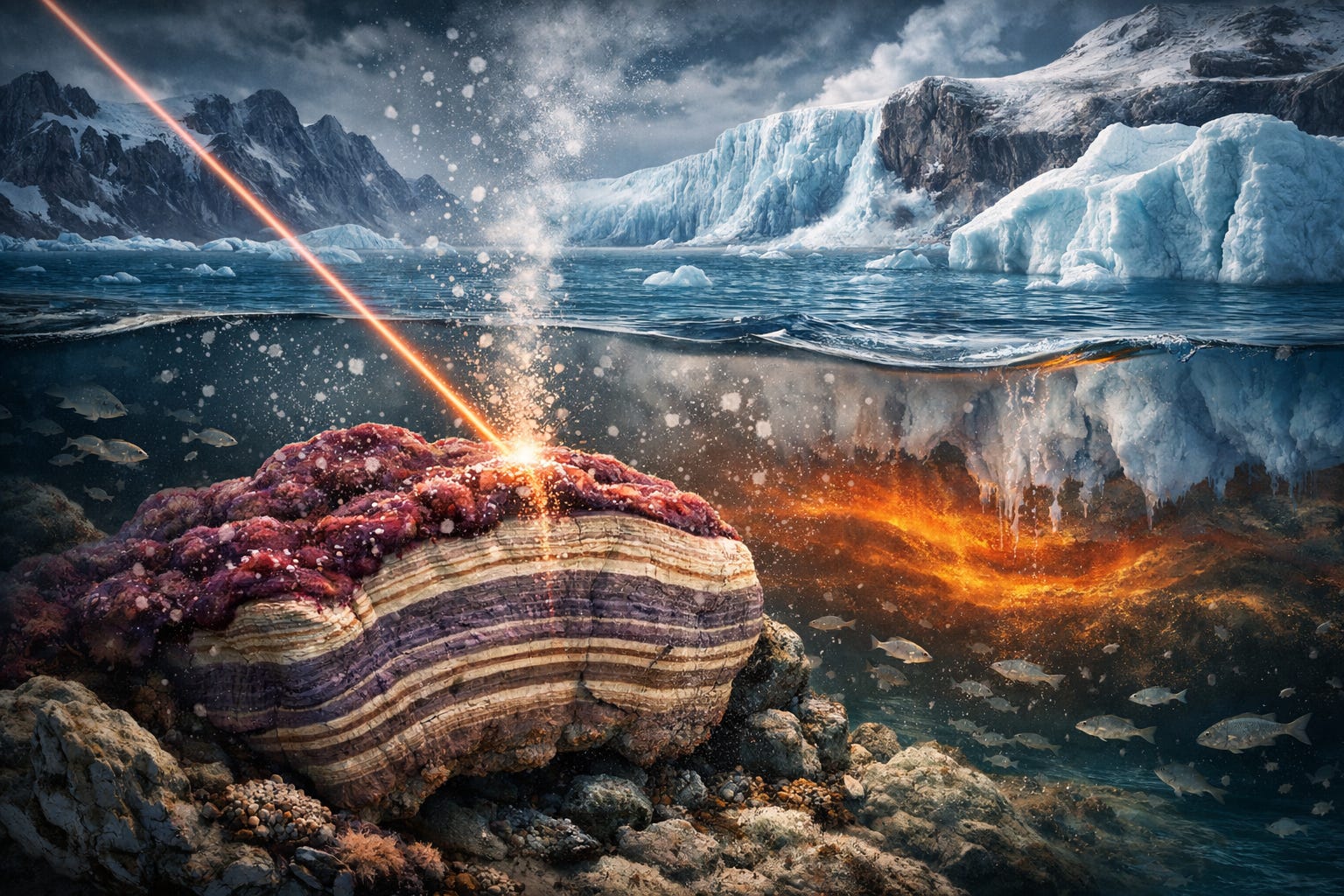
In the shallow waters off western Greenland, a species of slow-growing crusty seaweed has been quietly recording the chemical signature of everything that flows past it.
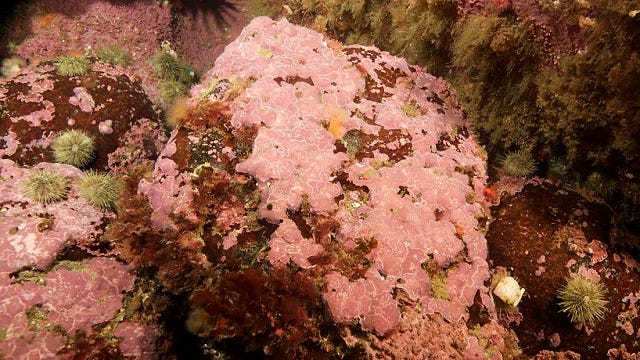
For more than a century, a coralline alga called Clathromorphum compactum (a hard, rock-like organism that builds up in layers on the seafloor) has been laying down annual growth bands, like tree rings, each one preserving a chemical fingerprint of the seawater it grew in.
A team of scientists from Kiel University in Germany, the University of Toronto Mississauga, and the University of Geneva has now read that record. What they found is alarming.
Their 115-year reconstruction of meltwater runoff into Disko Bay was posted online in February 2026 as a preprint, a research paper shared publicly before it has been through formal peer review (the process where other scientists scrutinise the methods and conclusions before a journal will publish it). It is currently under review for the journal Climate of the Past. The findings reveal that the Greenland Ice Sheet’s largest glacier crossed a critical threshold nearly two decades ago. Since 2007, runoff from the western ice sheet has permanently exceeded the entire range of natural variability observed throughout the 20th century.
The word ‘permanently’ matters here. This is not a spike, or a record year followed by recovery. The system shifted into a new state in the early 2000s and, as of 2018 when the algal record ends, has not returned.
How seaweed becomes a climate archive
The method is ingenious. Barium, a naturally occurring chemical element, is carried into the ocean by glacial meltwater, transported in fine sediment particles that wash off the ice sheet as it melts. When that barium-rich water reaches the shallow ocean, the algae absorb it into their hard chalky skeletons. More meltwater means more barium. The ratio of barium to calcium in each growth band becomes a stand-in measurement (what scientists call a proxy) for how much glacial runoff reached the bay that year.
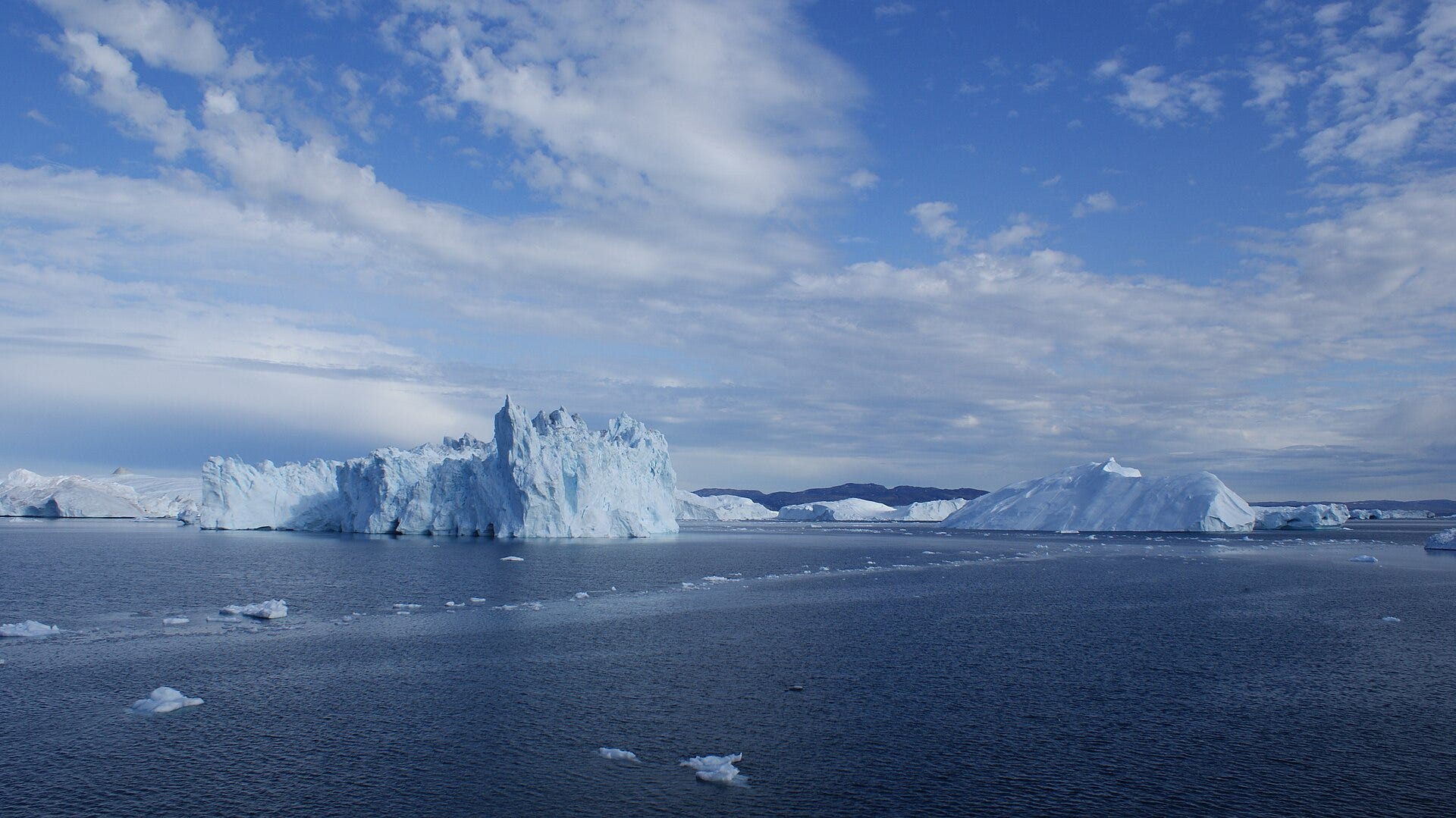
The researchers collected nine specimens from sites in southern Disko Bay, southwest of Jakobshavn Glacier (also known as Sermeq Kujalleq). Jakobshavn is the fastest-flowing glacier on the Greenland Ice Sheet that terminates directly in the sea. It drains roughly 6.5% of the ice sheet’s total area. Between 2000 and 2012, it was one of just four glaciers responsible for approximately half of the entire ice sheet’s mass loss.
To read the chemical record locked inside the algae, the team used a technique that fires a laser at the specimen’s surface and analyses the vaporised material to determine its chemical composition. They measured the barium-to-calcium ratio along each specimen’s growth layers at a resolution finer than one year. The longest single specimen record extends back to 1903. By combining all nine specimens into a single composite record (with at least five specimens overlapping from 1932 onwards), they built a continuous timeline that captures both the stable baseline of 20th-century variability and the dramatic departure that followed.
The signal that temperature data missed
The study’s most striking finding is a disconnect between what the algal record shows and what temperature records show.
The researchers applied a statistical test called ‘time of emergence’ analysis. The idea is simple: define a range of normal variability based on the historical record, then determine when the signal moves outside that range and stays there. In this case, ‘outside normal’ means the signal exceeded the upper boundary of the historical range (the 1932-2000 reference period) and never came back down. For the algal barium-to-calcium record, that emergence point arrived in 2007. For modelled ice sheet mass balance (the difference between snowfall adding mass and melting removing it) across the western ice sheet, it arrived in 2010.
For temperature? It hasn’t arrived yet. None of the long-term temperature datasets for the Disko Bay region, including sea surface temperature, surface air temperature, and local weather station records, have exceeded their historical range of variability by the same measure.
This means the ice sheet’s response to warming has outpaced what surface temperature records alone would predict. The runoff is accelerating faster than the thermometer suggests it should.
The researchers identify a moment in the algal record, in summer 2001, after which the upward trend steepens sharply. Before that date, there was no statistically significant trend in the chemical signal. After it, the rate of increase was tenfold. The algal record peaked in 2012, the same year the Greenland Ice Sheet experienced its most extensive surface melting in the satellite era. Every year from 2007 onwards ranks above the emergence threshold. Twelve of the highest runoff years in the entire 115-year record occurred in the most recent two decades.
What’s driving the acceleration?
The authors point to the role of warm Atlantic water intruding into Disko Bay at depth. Since the mid-1990s, warmer water from the Atlantic has been flowing into the bay beneath the surface, particularly at 200 to 250 metres down. This warming had a direct effect on Jakobshavn Glacier, eating away at the floating shelf of ice where the glacier meets the ocean (what glaciologists call the ice tongue). That shelf disintegrated in the late 1990s and early 2000s, and the glacier sped up dramatically, peaking in 2012.
This deep-water warming is harder to detect in standard sea surface temperature records, which measure conditions at the top of the ocean. Higher-resolution satellite data from the US National Oceanic and Atmospheric Administration (NOAA), available from 1982, does show exceptionally rapid warming in the inner Disko Bay region: more than 1°C per decade since 1982. The coarser, longer-running temperature datasets that allow historical comparison simply cannot pick up this localised warming.
That matters for policy. If the monitoring tools we rely on for long-term comparison are missing the signal, we may be underestimating the speed of change.
The tipping point question
The paper’s language on tipping points is careful, and deliberately so. The authors write that their findings provide ‘independent evidence for a non-linear accelerated response’ of Greenland’s largest glacier, and that this ‘underscores modelling results that a tipping point in glacial mass balance might soon be reached.’
Note the phrasing: underscores modelling results. Might soon be reached. This is not a declaration that the tipping point has been crossed. It is evidence that the system is behaving in ways consistent with approaching one.
The distinction matters because ‘tipping point’ has a specific meaning in climate science: a threshold beyond which changes become self-reinforcing and effectively irreversible on human timescales. Think of a ball balanced on the rim of a bowl. A tipping point is when it rolls over the edge and can’t be pushed back. A separate study published in The Cryosphere in January 2025 estimated that such a threshold for the full Greenland Ice Sheet would be reached when approximately 230 gigatons of ice are lost in a single year. (A gigaton is a billion tonnes, roughly the weight of 3,500 Empire State Buildings.) The ice sheet is not losing that much yet, though annual losses have been accelerating.
What the Hetzinger study adds is a longer baseline against which to measure that acceleration. When you can see 115 years of relatively stable runoff, followed by a sharp, sustained departure starting around 2001, the word ‘nonlinear’ stops being abstract. The change is not gradual and proportional. It is accelerating. The algae are showing us the shape of the curve, and it is bending upward.
Why this matters beyond Greenland
The Greenland Ice Sheet is not just a regional concern. Between 1992 and 2020, melting of the polar ice sheets caused 21 millimetres of global sea level rise, and Greenland accounted for nearly two-thirds of that (approximately 13.5 millimetres), according to a comprehensive assessment published in Earth System Science Data in 2023.
The freshwater pouring into the North Atlantic also has potential consequences for ocean circulation. The Atlantic Meridional Overturning Circulation, or AMOC, is a vast system of ocean currents that carries warm water northward from the tropics and cold water back south at depth. It functions like a conveyor belt for heat, and is a major reason why northern Europe has a relatively mild climate. Research published in Nature in 2018 found evidence that this circulation may have weakened by roughly 15% since the mid-20th century. More recent modelling, published in Nature Geoscience in 2024, suggests that if Greenland meltwater is factored into projections, further weakening may occur sooner than previously expected. The mechanism: fresh meltwater is lighter than salty seawater, so large volumes of it can sit on the surface and prevent the sinking that drives the conveyor belt.
The Hetzinger study adds a caveat here. While the nonlinear runoff increase from western Greenland is now documented, it remains an open question whether the same pattern exists for glaciers draining the eastern ice sheet. The AMOC impact depends partly on where the freshwater enters the North Atlantic, and recent observational work suggests that currents off western Greenland may play a lesser role in driving AMOC changes than those off eastern Greenland.
What to watch
This study is a preprint. It was submitted in December 2025, posted for discussion on 5 February 2026, and is currently under peer review. The methodology builds on the research team’s previous validated work using the same chemical approach to reconstruct glacier runoff in Svalbard (a Norwegian archipelago in the high Arctic), published in Climate Dynamics in 2021. The technique is well-established across multiple studies using different shell-building organisms in different environments.
There are important caveats. The statistical correlation between the algal record and Jakobshavn Glacier mass loss estimates is very strong (0.91 on a scale where 1.0 would be a perfect match), but that figure is based on only 18 years of annual data (1995-2012). The longer correlation with modelled ice sheet mass balance (0.54, covering 1903-2012 with smoothed data) is statistically significant but more moderate. The paper does not claim to measure runoff directly. It reconstructs a chemical signal that tracks barium delivery to the surface ocean, which correlates with meltwater input.
The raw data will be deposited at PANGAEA, a publicly accessible scientific data library, after the paper is accepted. That transparency matters. It means other researchers can check the findings, replicate the analysis, and build on the record.
In the meantime, the message is clear enough. The ocean has been keeping receipts, recorded in the growth bands of organisms most people have never heard of. Those receipts show that the Greenland Ice Sheet’s behaviour changed fundamentally around the turn of the millennium and has not changed back.
The question is no longer whether the ice sheet is losing mass at an accelerating rate. Satellites have confirmed that. The question is whether that acceleration is tracking toward a point of no return, and whether the models we use to project the future are accounting for it.
These algae suggest the answer to the second question may be no.
Hetzinger, S., Halfar, J., Watanabe, T.K., and Tsay, A. (2026). Nonlinear increase of Greenland Ice Sheet runoff into Disko Bay. EGUsphere [preprint]. DOI: 10.5194/egusphere-2025-6074
Ocean Rising covers ocean governance, marine conservation, and the science that informs both. Subscribe to receive investigations, analysis, and reporting that holds institutions accountable for what happens to the ocean.
This is so significant. I find the use of the coralline alga really fascinating. In reading through this article, I am struck that this needs to be told as a simpler story to catch people's attention. Writers and storytellers that are very good at condensing information are so critical right now to raising public awareness. I wonder if Catherine Heyhoe has written about this. I will have to have a look. Thanks for this important insight!
Thank you for breaking down the science and weaving together biology, chemistry, and climate science so thoughtfully.