


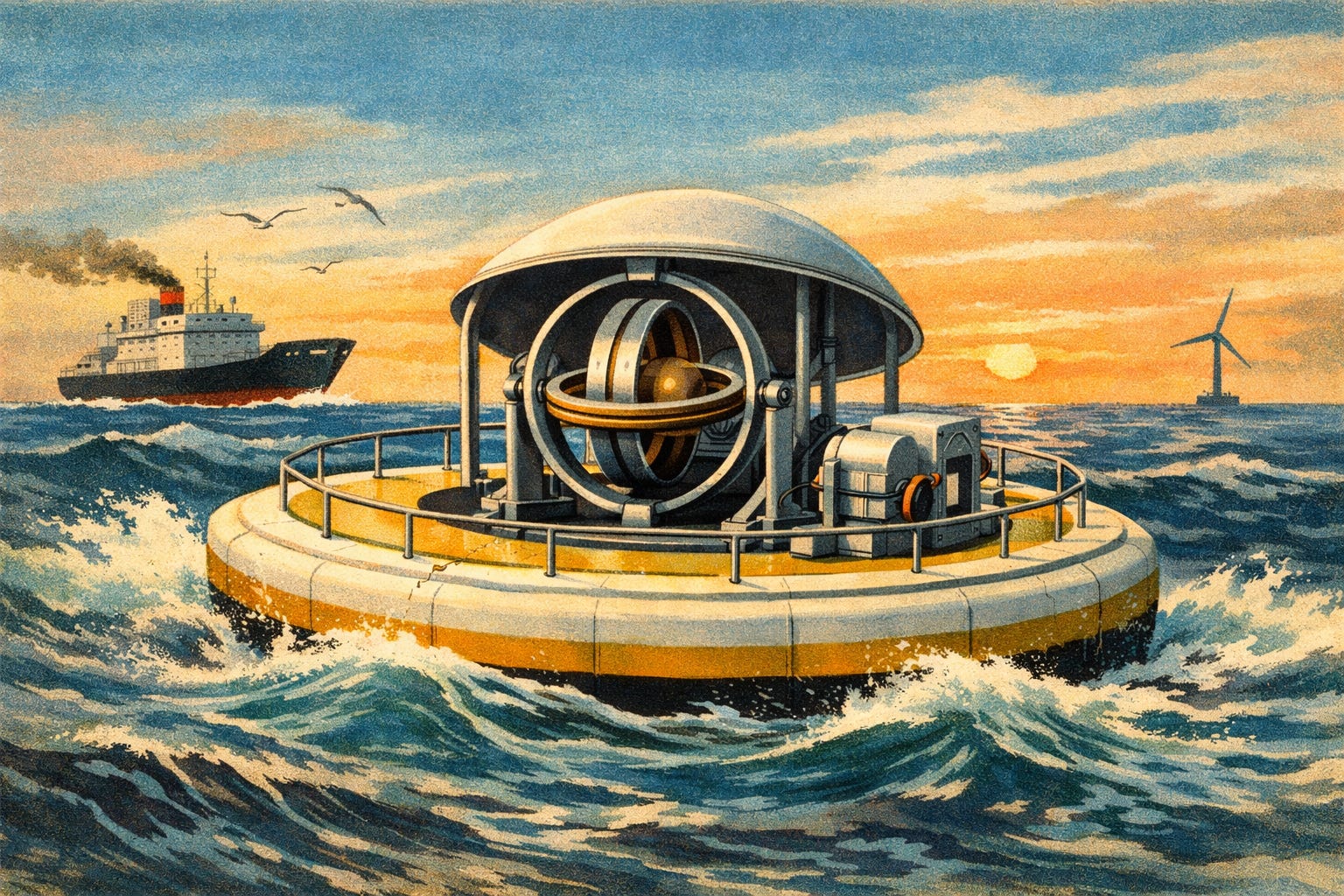
There is a toy that most people encounter in childhood. A gyroscope: a spinning disc mounted inside a frame, which resists any attempt to push it over. Press it sideways and it doesn’t fall. It pivots at a right angle to the force, tracing a slow, stubborn circle. The harder you push, the stranger the behaviour.
Takahito Iida, a naval engineer at the University of Osaka, has spent serious time thinking about what happens when you put one of those on the ocean.
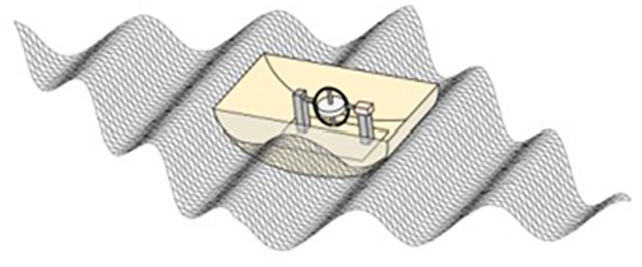
His answer, published in the Journal of Fluid Mechanics in February, is that you can extract electricity from waves by mounting a spinning flywheel inside a floating platform and tuning it to respond to the pitch and roll of passing water. As waves push the platform, the flywheel’s axis shifts. That shift is called gyroscopic precession: the same force that keeps a spinning top from falling over. It drives a generator. The electricity follows.

Gyroscopic wave energy converters have been proposed before. What Iida’s analysis adds is mathematical precision: a framework that identifies the exact conditions under which one of these devices reaches its theoretical maximum efficiency. That maximum is 50%. Half the energy in any given wave, converted to electricity.
The 50% figure needs unpacking, because it’s easy to misread. This is not a ceiling Iida discovered. It is a long-established constraint in wave energy physics, analogous to the Betz limit in wind turbines. The Betz limit establishes that no turbine can extract more than around 59% of the energy in moving air, regardless of its design. Every technology has a theoretical ceiling it can approach but never pass. What Iida demonstrated is that a properly tuned gyroscopic converter can reach its equivalent wave energy ceiling not just at one specific wave frequency, as previous work assumed, but across a wide range of conditions. The ocean rarely delivers the consistent, predictable wave patterns that most converter designs rely on. A device that performs well only in one set of conditions is commercially useless. Iida’s modelling suggests this one doesn’t have to be.
A wave tank prototype is now being built to test whether the physics holds in water.
Why wave energy keeps losing to solar
In 2024, global renewable energy capacity grew by a record 585 gigawatts, according to the International Renewable Energy Agency. A gigawatt is roughly the output of a large power station. Solar accounted for more than three-quarters of that growth. Wind took most of the rest.
Wave energy contributed, in practical terms, nothing. IRENA’s annual capacity statistics track ocean energy as a category but do not report wave energy as a separate figure, because the global total is too small to distinguish from rounding. The International Energy Agency, in its most recent renewables outlook, noted that the role of ocean energy “is expected to decline due to a lack of policy support.”
Not because the resource isn’t there. The US Department of Energy estimates that wave energy available along American coastlines alone equals roughly 34% of the country’s total power generation. Globally, the theoretical resource is vast, consistent, and, unlike solar, continues through the night.
The problem has never been the resource. It has been converting it at a cost that makes commercial sense.
Wave energy’s commercial history is a series of promising devices that collapsed on contact with the real ocean. Scotland’s Pelamis project, once the leading edge of the technology, went into administration in 2014. Carnegie Clean Energy in Australia underwent repeated restructurings after its wave energy programme failed to reach commercial viability. The pattern is consistent: machinery placed in one of the world’s most corrosive and mechanically demanding environments, expensive to install and maintain, producing power in ways that electricity grid operators struggle to plan around. The resource is enormous. The economics have not worked.
The gap between research money and real money
The US government has committed more than any other institution to closing that gap. In September 2024, the Department of Energy’s Water Power Technologies Office announced a funding opportunity of up to $112.5 million over five years for open-water testing of wave energy converters, covering small-scale distributed devices, community power systems, and large utility-scale projects.
That is significant money by the standards of this sector. It is also research and development funding, not project finance. The distinction matters. Research grants pay for prototypes and testing. Project finance pays for construction at scale, and it comes from investors who need a predictable return. Wave energy has attracted the first kind of money. It has not yet attracted the second in any meaningful volume.
Offshore wind, by contrast, now has mature supply chains, standard contracts, and a track record long enough for large institutional investors such as pension funds to price the risk confidently. Wave energy is several stages of commercial development behind that. Private capital tends to wait until it doesn’t have to be first.
The IEA’s forecast is blunt: without a significant shift in policy support, ocean energy’s share of global capacity is likely to shrink, not grow, over the coming decade.
Where ships change the calculation
Iida is not framing his device as a rival to offshore wind. His stated target application is auxiliary power for ships: specifically, a 300-kilowatt output based on the energy demands of a typical commercial vessel. Auxiliary power means the electricity a ship uses to run its lights, navigation systems, refrigeration, and crew facilities, separate from the engines that move it through the water. The device is designed to operate without being fixed to the seabed, floating freely, which makes it suited to ships rather than fixed coastal installations.
That framing matters because it puts the gyroscopic converter into a different commercial conversation, and a more pressured one.
In April 2025, the International Maritime Organization’s Marine Environment Protection Committee approved the IMO Net-Zero Framework, described by the IMO itself as “the first in the world to combine mandatory emissions limits and GHG pricing across an entire industry sector.” GHG stands for greenhouse gas. The framework sets targets for how much greenhouse gas large ocean-going ships over 5,000 gross tonnage are allowed to emit per unit of energy used. These ships account for around 85% of the sector’s total emissions. Ships exceeding the thresholds face financial penalties. The net-zero target for the sector is by or around 2050.
Formal adoption was expected in October 2025 but was adjourned by a year after the US opposed the measures and several major shipping nations changed their votes. The framework is now expected to be adopted in October 2026 at the earliest, with compliance beginning in 2028 if that timeline holds. The direction of travel is not seriously in doubt. The underlying 2023 greenhouse gas strategy remains in force regardless of the framework’s adoption status, and the IMO has confirmed that work on implementation continues in the interim. The question is not whether shipowners will face binding obligations to cut emissions, but when those obligations take full legal effect.
Every technology that reduces fuel consumption has a potential role in meeting that requirement. A device that generates 300 kilowatts from wave motion, without burning fuel and without connecting to any shore-based grid, sits directly in that commercial space.
Wave energy’s problem has never been the resource. It has been finding a customer with a deadline. Maritime decarbonisation, with binding regulatory obligations and financial penalties for non-compliance, is one of the more credible candidates. It does not solve wave energy’s cost and durability problems. It does make those problems worth solving for a defined market.
What still has to hold
Iida is careful about what his paper does and doesn’t claim. The modelling was conducted under linear wave theory, an approach that works well for small, regular waves but simplifies the behaviour of real seas, where waves arrive from multiple directions at irregular intervals and varying heights. His own analysis shows efficiency degrading in larger, irregular wave conditions: not failing, but not reaching the theoretical ceiling either.
The cost of keeping the flywheel spinning, what engineers call parasitic load, is not yet accounted for in the efficiency calculations. That matters enormously. A device that theoretically captures half of available wave energy but consumes a significant portion of that output just keeping its flywheel spinning is not commercially interesting. This is a known open question, not a resolved one.
The maintenance economics also have to work. This is where previous wave energy technologies have most consistently broken down: not in laboratory conditions, but eighteen months into deployment, when the ocean has found every seal and bearing, and the cost of keeping equipment running has overtaken the revenue from the power it produces.
A wave tank prototype will begin to answer some of these questions. It will not answer all of them. There is a long distance between a controlled wave tank and the North Atlantic in winter.
What the paper does provide, and what wave energy has lacked in too many previous iterations, is a rigorous mathematical basis for understanding where the efficiency ceiling sits and how to approach it across variable conditions. Engineers building the next generation of devices now have a clearer target. Whether the physics survives contact with actual water, and whether the economics survive contact with actual shipowners, remains to be established.
The ocean’s surface holds more untapped kinetic energy than any land-based renewable resource. The difficulty has never been finding it. It has been building something that can last long enough to use it.
Ocean Rising covers ocean governance, marine science, and the institutions shaping both, including who funds what, and why. The investigations are behind the paywall.
Absolutely fascinating. I had really never considered this. Thank you.