


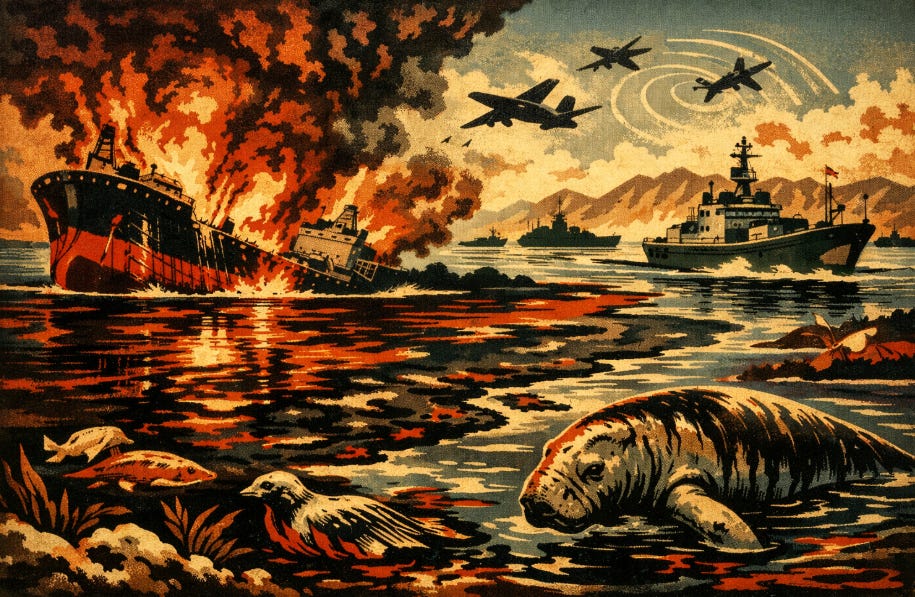
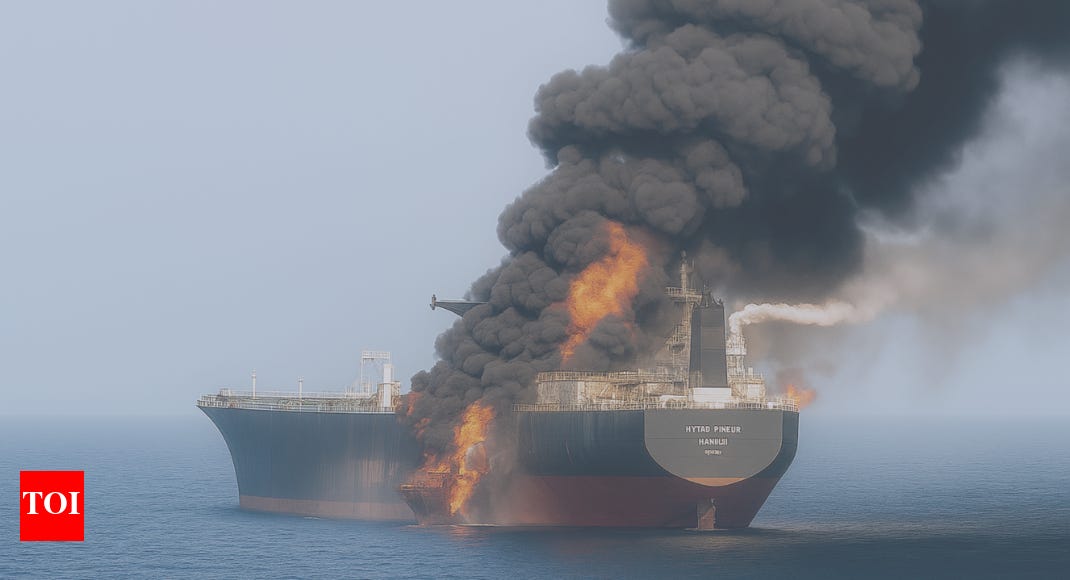
On 17 June last year, two oil tankers collided in the Persian Gulf. The vessel ADALYNN caught fire. An 8-kilometre oil slick spread across the water. Nobody ordered that spill. Nobody aimed at the sea. Investigators believe GPS spoofing, a form of electronic interference common in active conflict zones, may have contributed to the collision. Whether or not it did, the incident illustrated something the sea cannot explain away: when a body of water becomes a military corridor, accidents become more likely, and clean-up becomes less possible.
The ocean wasn’t a target… it was just in the way.
The sea generally isn’t damaged deliberately in a war. It happpens through consequence, through contamination, through the systems built for other purposes that treat the marine environment as an acceptable side effect. The Persian Gulf is burning again. The Strait of Hormuz, the narrow passage between Iran and Oman through which one fifth of the world’s oil consumption moves every day, has been largely closed to commercial traffic since 28 February 2026. Over 150 tankers sit at anchor. The water that connects the Gulf to the rest of the ocean has become a military corridor.
Nobody will be held accountable for what that does to what lives there.
Already Broken
The Persian Gulf is not a pristine ecosystem. Decades of oil industry activity have already stressed its coral systems, its dugong populations, and its fisheries. Dugongs are large marine mammals, relatives of the manatee, that graze on seagrass beds throughout the Gulf. Seawater temperatures in the Gulf are among the highest recorded for any sea on earth. The region’s marine protected areas, zones designated by governments where industrial activity is supposed to be restricted, exist in the shadow of the world’s largest fossil fuel infrastructure.
War arrives into this already-degraded environment and makes everything worse, and it does so with complete legal impunity. No one pays. No one is required to.
The legal principle that those who cause environmental damage should pay to clean it up has a name. In wartime, it has no application.
Consider what is happening right now. Iranian retaliatory strikes have targeted port infrastructure across the Gulf, in Abu Dhabi, Dubai, Jebel Ali, and Manama. The Conflict and Environment Observatory, an independent organisation that monitors environmental harm in active conflict zones, documents sunken vessels and damaged port infrastructure presenting significant pollution risks from fuels and oils. Emergency response capacity, already strained, is operating in conditions where the conflict actively prevents clean-up.
The ADALYNN spill last June was not from a direct strike. It came from GPS spoofing, the electronic interference that causes ships to lose their positional awareness and, in this case, each other. As long as electromagnetic warfare continues, as long as vessels navigate blind in contested waters, collisions will happen. Spills will happen. The sea absorbs the consequences.
The Last Time
This is one of the oldest patterns in modern warfare, and it has never produced accountability.
In 1991, Iraqi forces opened the valves at the Sea Island terminal off Kuwait and dumped between four and eight million barrels of crude oil into the Persian Gulf. The resulting slick was, at the time, the largest deliberate oil spill in history. It coated hundreds of kilometres of Saudi coastline. It killed seabirds, sea turtles, and fish in numbers that were never fully counted because no one was counting. The war ended. Reconstruction focused on infrastructure. The marine environment was not a line item.
No international legal mechanism existed to compel remediation. None exists today.
Iraq was eventually ordered to pay reparations through the UN Compensation Commission, a body created specifically to process Gulf War claims. Over three decades, it awarded $5.26 billion for environmental and public health damage, a genuine, if partial, precedent. Saudi Arabia alone had sought $4.7 billion for its fouled coastline. The final payment arrived in January 2022. The framework required a defeated aggressor, Security Council unanimity, and a mandatory ceasefire resolution. It was built for one war. It cannot be rebuilt for the next one.
For the marine environment of the Gulf in the conflict of 2026, there is no equivalent process underway. There is no institution monitoring marine damage as a primary concern. There is no legal obligation on any party to remediate what the sea absorbs.
A Different Sea, The Same Story
Ukraine offers the same lesson from a different body of water.
Since February 2022, the Black Sea has functioned as a battlefield. Within weeks of Russian warships entering the sea, dolphins and porpoises began washing up dead on Black Sea beaches in numbers researchers had never recorded. The largest counts came during May and June 2022, when fighting around Snake Island was most intense. Scientists attributed the deaths to acoustic trauma from naval activity. Research published through the European Commission’s Joint Research Centre, the EU’s in-house science body, documents further damage: contamination from sunken vessels, the disruption of spawning grounds, and oil slicks covering tens of thousands of square kilometres of Ukraine’s marine protected areas, recorded by satellite imagery. Snake Island itself, a designated marine reserve, was fought over from February to July 2022. Its waters absorbed the wreckage.
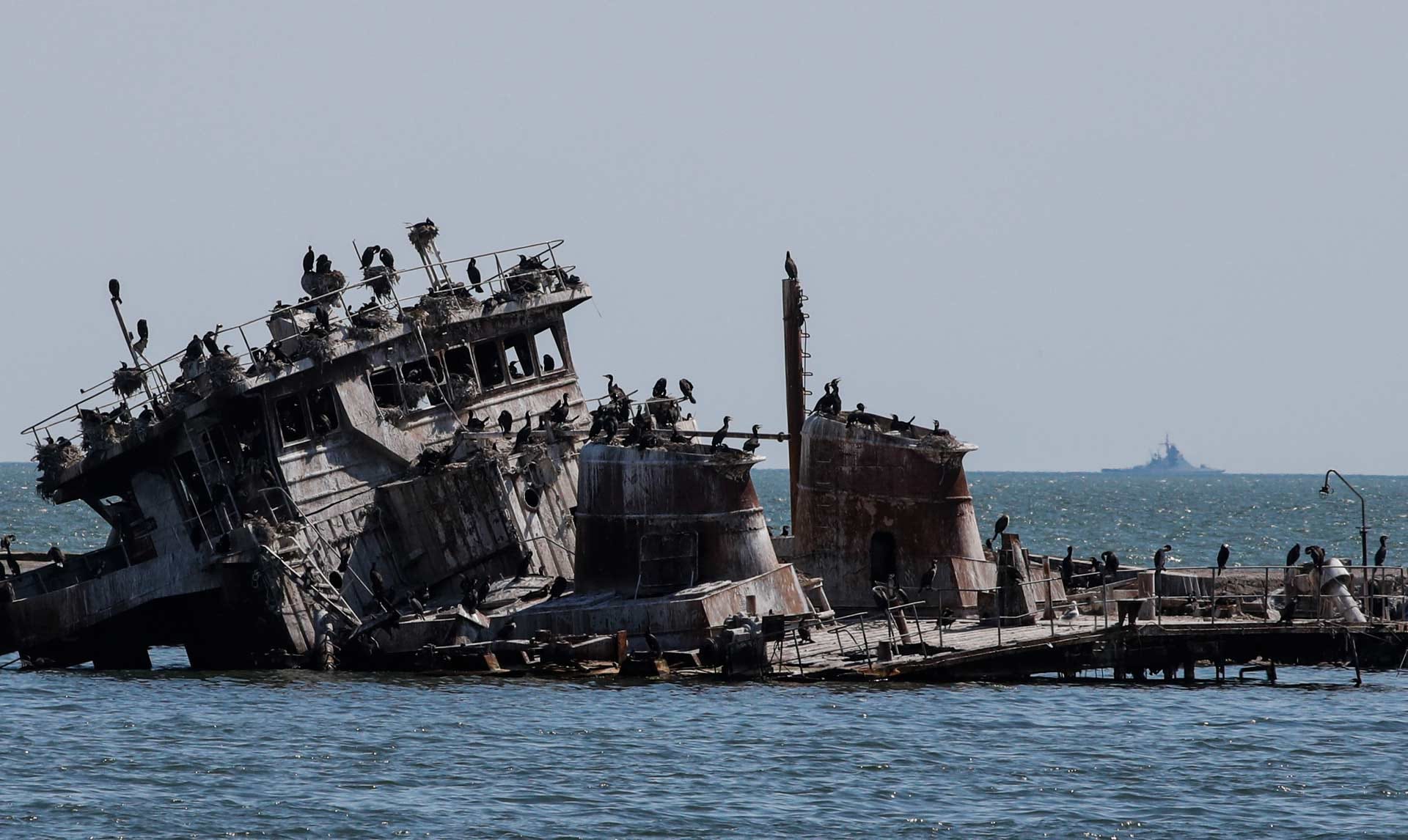
The war continues, and the damage compounds. The legal mechanisms for environmental remediation in armed conflict remain almost entirely theoretical.
The Rome Statute, the international treaty that established the International Criminal Court, includes environmental destruction as a potential war crime, but only when it causes ‘widespread, long-term and severe damage to the natural environment’, a threshold so high that, as of late 2025, no charges had ever been brought under it at all. The customary rules of international humanitarian law, the body of rules governing how wars are fought, on environmental protection are widely regarded by legal scholars as inadequate and unenforced. The countries most responsible for the most damage are also the countries with the most power to block reform of those frameworks.
The Same System
This war is being fought across the strait that carries one fifth of the world’s oil. Whatever its causes, its consequences run through these waters. The tankers at anchor, the contaminated ports, the GPS-spoofed shipping lanes: the marine environment is not collateral to this conflict. It is the terrain. When the ADALYNN spill happened, the news covered the shipping disruption. The market impact. The insurance premiums. The ecological harm received a paragraph in a specialist monitoring report, noted and filed.
That is the order of priority. That is what we have decided the sea is worth.
The Principle That Stops at the Waterline
The ‘polluter pays’ principle holds that those who cause environmental damage bear the cost of remediation. In peacetime, it is imperfectly applied. In wartime, it does not apply at all.
No mechanism exists to attribute marine environmental damage to a party in a war, calculate its cost, and compel payment. The International Maritime Organisation, the UN body that regulates global shipping, has no mandate in active conflict zones. The UN Environment Programme can monitor and report, as it does, with rigour and frustration. Reporting is not remediation.
The Persian Gulf’s dugongs do not know there is a war. The coral systems stressed by forty years of industry and a warming ocean do not know that the legal framework governing the water they live in contains no provision for what is happening above them. The fish spawning in waters designated as protected areas before the first missile was fired do not know that designation means nothing when the shooting starts.
They will absorb what they absorb. The law will not follow.
What No One Is Negotiating
After the next ceasefire, whenever it comes, there will be reconstruction efforts. Infrastructure will be assessed, economic losses will be calculated, and diplomatic frameworks will be negotiated.
The marine environment of the Persian Gulf will not be on that agenda, just as it wasn’t on the agenda after 1991. It was not on the agenda after the Iran-Iraq Tanker War of the 1980s either, which damaged or destroyed hundreds of vessels in this same body of water. The Black Sea’s damaged protected areas will not drive the terms of any eventual peace settlement in Ukraine.
What would accountability look like? It would look like a dedicated international mechanism for marine war damage restoration, with compulsory funding and defined standards for who pays. It would look like the Rome Statute’s environmental provisions being applied rather than cited.
None of that exists, and none of it is being seriously negotiated.
The tankers sit at anchor in the Gulf. The sea absorbs what it absorbs. Somewhere below the surface, in water already carrying more than it should, something is dying that no one is counting.
The sea has no seat at the table. Ocean Rising exists to put it there. Paid subscriptions make that possible.
Great story Luke. War uses fossil fuels intensively like nothing else. The US Military is Big Oil’s biggest client. No holding back. As oil and gas prices rise accordingly, Big Oil pockets $Billions in profits, then as the bombs are dropped, the missiles are fired, the ships sink, the fossil infrastructure ruptured and the oil spreads through the sea… the costs are socialized through the marine ecosystems and the local people, institutions and governments who pay the ultimate price.
War is the ultimate racket.
the ocean 🌊 will win, in the end. Thank you for helping us keep her and those as safe and healthy as possible, until then.