


It’s Sunday afternoon and I’m trying to make sense of my feed.
Climate change, again. Comments sections turning into trenches. People lobbing data at each other like it’s ammunition. Nobody listening. Everyone certain.
I’ve seen this film before, but something struck me differently this time.
It wasn’t the arguments. It was the certainty on both sides and what that certainty is actually costing us.
Here’s where I land on the science: climate change is real, it’s human-driven, and the evidence for that is substantial. I’m not hedging on that. But I want to talk to the other side for a moment, not to convert anyone, because that ship has clearly sailed, but to ask a simpler question.
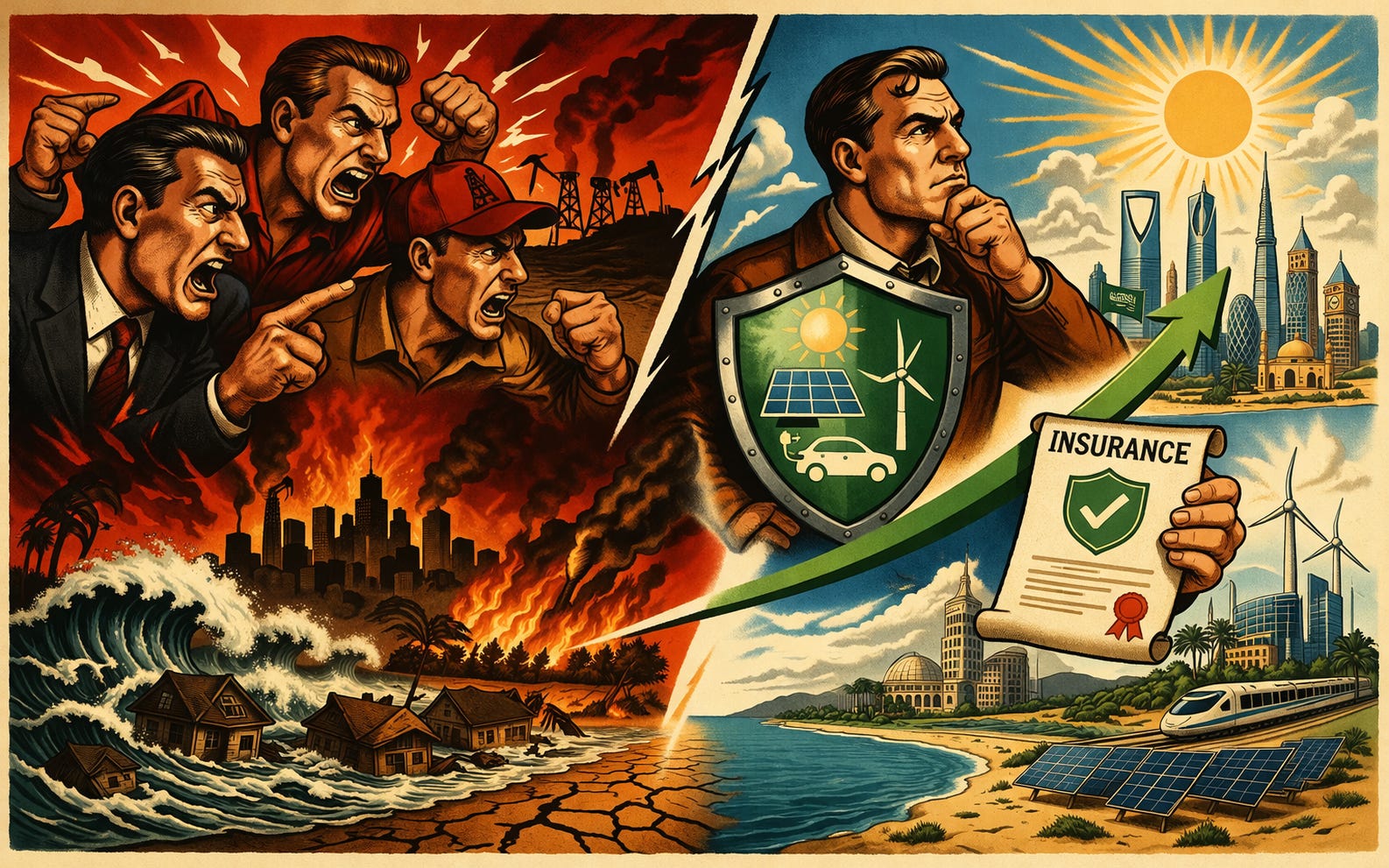
Where’s your insurance policy?
Not a metaphor. An actual logical question. Because here’s the thing about insurance: you don’t buy it because you’re certain your house will burn down. You buy it because you can’t afford to be wrong.
Run the numbers on climate change the same way.
If the sceptics are right, if this is all overblown, if the models are wrong, if the scientists are mistaken, and we transition away from fossil fuels anyway... what happens? Energy gets more expensive for a while. Some industries restructure. Some politicians lose votes. It’s painful and disruptive and expensive.
But if the sceptics are wrong, and we do nothing, the cost isn’t inconvenience. It’s civilisational.
That asymmetry matters. It’s the whole game.
I’m not asking climate sceptics to accept the science. I’m asking them to apply the same logic they’d use buying car insurance or hedging a business risk. You don’t need certainty to justify precaution. You just need to take the downside seriously.
Here’s what makes this stranger still. The countries most economically dependent on fossil fuels, the ones with the most to lose from a global energy transition, are already hedging. Saudi Arabia has spent the last decade building out tourism, finance, and technology investment through Vision 2030. The UAE is positioning itself as a hub for everything that isn’t oil. These are not the actions of governments confident that the current model lasts forever. They are reading the same future the climate scientists are reading, and quietly buying the insurance policy, while their exports fund the politicians loudest about drilling more of it.
The noise is coming from one place. The hedging is happening somewhere else entirely.
What’s strange, what I keep coming back to as I watch these arguments play out, is that the certainty is loudest on the side with the most to lose if they’re wrong.
I don’t know why that is. Maybe it’s tribal. Maybe it’s economic. Maybe admitting doubt feels like surrender in a culture where everything has become a team sport.
The fact is, however, the house doesn’t care which team you’re on.
What about home owners in flood risk areas being uninsurable ……
We buy insurance because we have to. We have a mortgage, the bank insists we have insurance. We have and drive a car and the states require we have a minimum liability policy. If we are important enough at our job or our job is risky enough our company insists on insurance. I believe in climate change. However, for the naysayers, it would have to be mandated by the state or govt. especially if it costs the individual money.