


This chapter didn’t make it into Finlay and the Whale, my forthcoming book about the ocean’s collapse and the systems keeping it that way. The first draft is nearly done. Then comes the search for a publisher. Some of the ideas I cut feel worth sharing on their own terms, and this one has been sitting in a folder long enough.
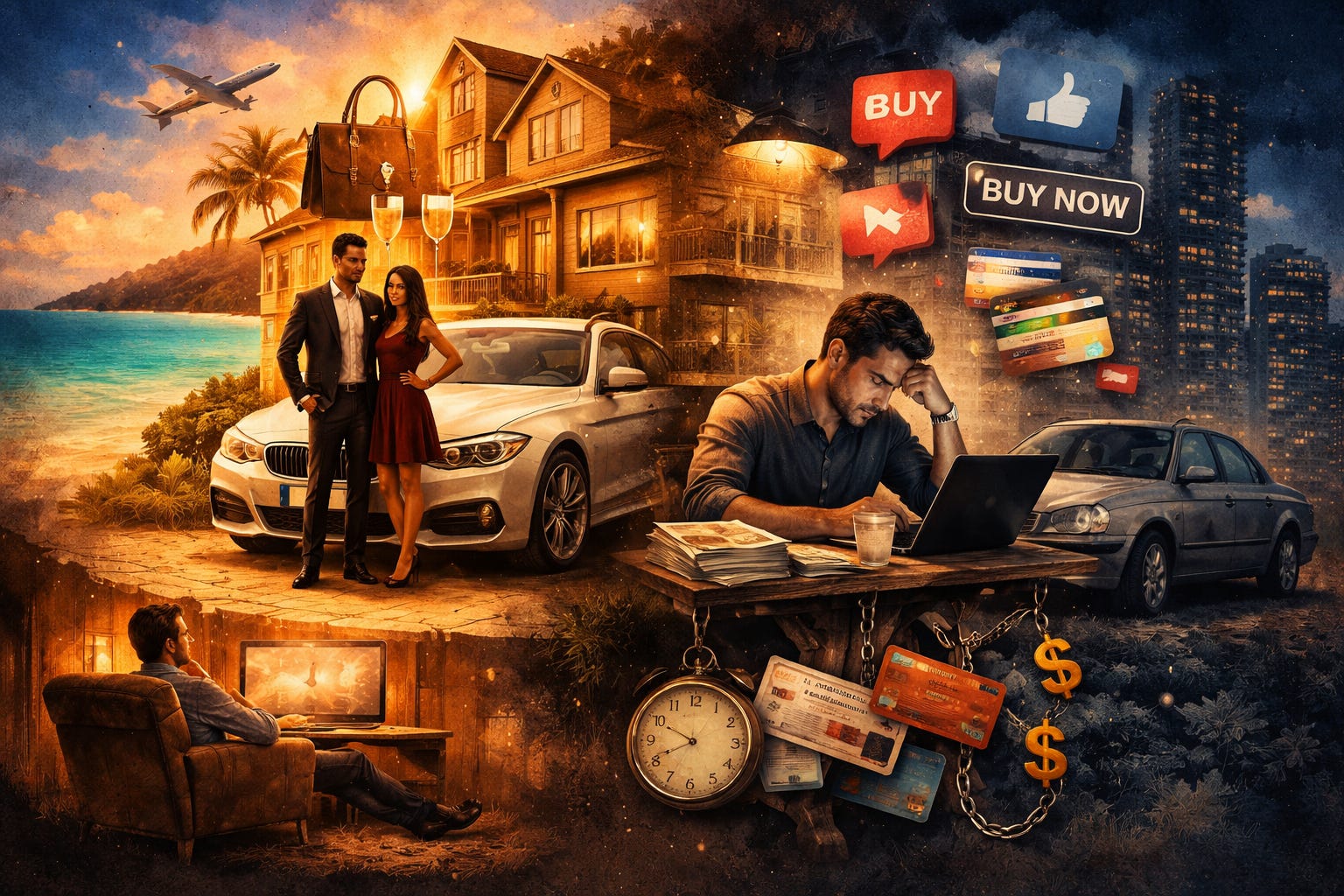
Imagine it is 1995. Your neighbour pulls into the driveway in a brand-new BMW. The street glances over… admiration, envy, maybe a flicker of pride that one of their own is doing well. The walls are thin, and an hour later you can hear the argument through the plaster. The car was never the whole story.
Fast forward. The walls are thicker, but the windows have been torn off. You see the driveway moment on repeat. The new car, the luxury holiday, the kitchen refit. The arguments and the sleepless nights are cut out. The curation is the point. The image is spotless because the mess has been edited away.
We compare our insides with other people’s outsides. Their gloss becomes our deficit. Every scroll is a prompt telling you that you are behind, you need more.
Your brain is not weak. It is being farmed.
***
In 2014, a film called The Gambler slipped under the radar. Critics were mixed, but buried inside its plot about a debt-ridden literature professor was, in my humble opinion, one of the sharpest monologues on freedom ever put to screen. A loan shark explains life’s real equation:
“You get a house with a 25-year roof, an indestructible economy shitbox car and you put the rest into the system at 3 to 5 percent... That’s your fortress of fucking solitude. That puts you, for the rest of your life, at a level of ‘Fuck You.’ Someone wants you to do something? Fuck You. Boss pisses you off? Fuck You.”
Crude, but also clarifying. The fortress has nothing to do with luxury. It is the ability to live without begging forgiveness from banks, bosses, or anyone else.
When I bought my 16-year-old Volvo, some people mocked it. No sat nav. No CarPlay. A CD player instead of Bluetooth. Dented doors, mismatched wheels, 130,000 miles already on the clock. My friends Dave and Alex, old-car people, gave me kudos. They saw what others missed: no payments, low insurance, cheap to run, a boot big enough for baby stuff, seats that fold flat if you need to sleep in the back on a camping trip.
It is creeping towards 200,000 miles now and still going. Every ignition is relief, not anxiety.
That is the fortress. That is what it feels like.
***
The logic of comparison is ancient and obvious. Humans are status animals. In every tribe and city, knowing where you ranked mattered for survival. Status brought resources, mates, security. That wiring has not gone anywhere.
What has changed is the scale. For most of human history, you measured yourself against a few dozen people you actually knew. Now you measure yourself against thousands of curated feeds, each one engineered to widen the gap.
Then the system offers to close it. Miss a payment? Spread it over four months. Want the new look? Pay later, no questions. They call it flexibility. It is absolution with interest.
The engineers of social platforms know this. They do not just sell ad space. They sell identity loops. Envy, desire, click, defer the cost. Buy now, pay later is a business model built on the distance between who you are and who the feed tells you to be.
The cost lands somewhere real. Outstanding credit card debt in the UK hit £76 billion in 2025. One in four British adults used a buy now, pay later service at least once last year, up from one in seven the year before. The financial regulator looked at what they were buying. The most common answer: lifestyle and beauty purchases. Globally, buy now, pay later spending has gone from $2 billion a decade ago to $342 billion today. Plastic surgeons worldwide performed more than 33 million procedures in 2022 alone, a 41 per cent increase over four years.
The system built a machine to monetise the gap. Then it built another one to finance closing it.
***
Escaping the loop is slow work. Praise the thing that lasted rather than the thing that is new. Post the ordinary dinner instead of the filtered highlight. Before you buy something, ask whether it makes your daily life better or just looks good for a moment. That pause, practised enough, becomes a muscle.
The loop survives because it is invisible, has momentum, and has been normalised. Name it, and it starts to wobble.
***
Ego rarely stays contained. What begins as envy becomes something harder when the scales tilt too far. The neighbour who flashes the BMW is one thing. The executive collecting bonuses after a bailout is another. We do not just measure ourselves against others. We measure whether others are playing fair. When the gap feels rigged, something ancient stirs.
That is where the next loop begins.
The book isn't out yet. It might not find a publisher on the first try. That's how this works. If you want occasional chapters when they're ready, before anyone else sees them, go annual. If you just want the journalism, a paid subscription gets you everything we publish. Either way: I'd like to know what you think about this chapter. Leave a comment below.
So on point! Especially the end -that extraordinary level of unfairness when multitudes lost their homes, and the few benefited. Marching for No Tyranny last Saturday in Vancouver, I told a woman I felt like I hit the sweet spot in my life.A big loving family with little means, just enough opportunity to get work few women had ventured into. Work outside the city, no glamour, shared accommodation, driving a beater car- making just enough to get by and save for rainy days. My partner and I have always been frugal and saved. We buy the used car and drive it to the ground. I allow a few impulse purchases at the thrift store and purchase most of my clothes there. We have splurged on travel, but longer self planned trips -mostly off the beaten path. With luck and inheritance we live mortgage free in our modest home. I think a lot of this luck was life circumstances and timing. But it is definitely also mindset for meaning over stuff. Three years ago we bought a brand new vehicle which we plan to be our last. It is both EV and Hybrid. I still take transit, ride my bike and walk when I can as transport. We share this car and want it to last.
This is a great article for awareness-in our circles what we have done is definitely counter-culture. I am floored by the level of debt people carry!