


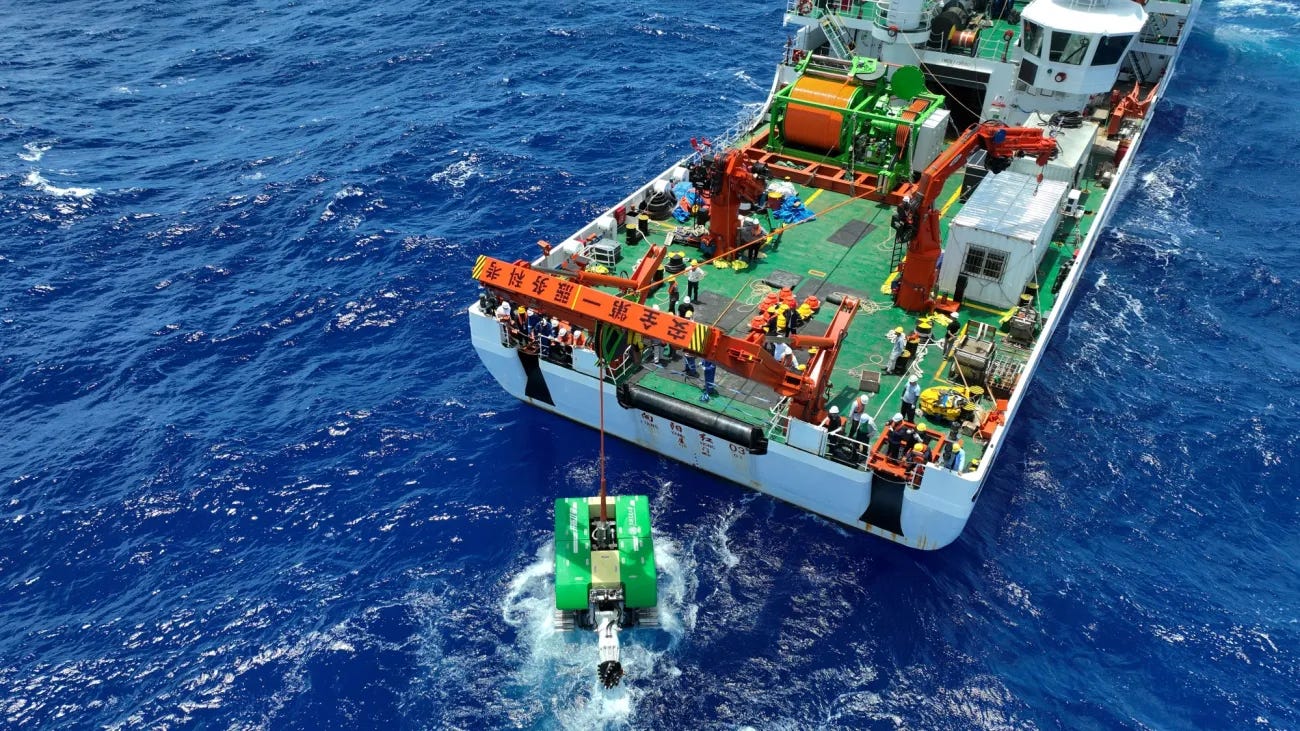
Earlier this year, I wrote that several big decisions on deep-sea mining would converge in 2026. Most of those deadlines have now arrived. The international rules for commercial mining are still unfinished, exploration contracts are being extended, and a separate US permitting system is attracting new applicants.
“Several things converge this year.”
That’s how I ended a long investigation for Oceanographic Magazine earlier this year.
One company’s exploration contract was about to expire. Governments were still trying to finish the rules that would govern commercial deep-sea mining. Companies were asking for a more formal role inside the organisation that oversees mining on the international seabed. At the same time, a separate permitting system was beginning to attract new applicants in the United States.
If this is the first time you’ve come across deep-sea mining, the basic idea is fairly simple. Companies want to recover minerals from the deep ocean floor. Much of the attention is focused on polymetallic nodules, dark rocky lumps that form extremely slowly on the seabed and can contain manganese, nickel, copper and cobalt.
Some of the areas companies are interested in lie beyond national waters, thousands of metres beneath the surface. The International Seabed Authority (ISA) was created under the United Nations Convention on the Law of the Sea to manage mineral activity in this international seabed area for countries that are part of the treaty.
Companies can already receive exploration contracts from the ISA. These allow them to survey particular areas of seabed, collect samples, and gather information about the minerals and environment there. An exploration contract doesn’t give a company permission to begin commercial mining.
That would require a separate set of rules, usually called the Mining Code. After years of negotiations, those rules are still unfinished.
The ISA Council, which does much of the detailed work on mining rules and contracts, and the ISA Assembly, which brings together all ISA member countries, have now finished their latest meetings in Kingston, Jamaica.
Here is what changed.
