


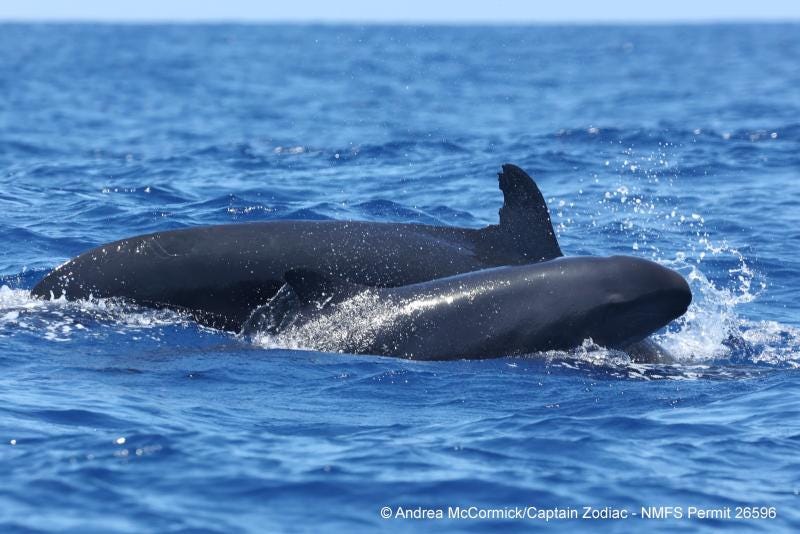
The National Oceanic and Atmospheric Administration (NOAA) estimates that the main Hawaiian Islands population of false killer whales has been declining by about 3.5 per cent a year since 2013. On 16 September, it reported that two calves first photographed in February had both been seen again in August.
I spend most weeks looking at what is going wrong in the ocean. This week, enough of the evidence pointed the other way that I decided to give the whole Brief to good news.
Deep Dives
Two rare false killer whale calves were seen again in August
There are only about 140 false killer whales in the endangered population that lives around the main Hawaiian Islands. NOAA says just ten newborn calves have been documented in that population since 1999.
Staff from the Hawaiian Islands Humpback Whale National Marine Sanctuary photographed two newborn calves off Maui in February. One was swimming beside a female known as HIPc0363, which researchers at Cascadia Research Collective have followed since she was first seen as a juvenile in 2009. This is the first year they have recorded her with a calf, and they believe it is her first.
In August, staff from Captain Zodiac saw both calves again and contacted Cascadia. By then they were around eight months old and swimming strongly. NOAA says the first six months are an especially vulnerable period for young false killer whales.
Females generally reach reproductive age between eight and eleven years old, pregnancies last about 14 months, calves can nurse for up to two years and the available data suggest females usually give birth only once every seven to nine years. That can mean only four to seven calves across a female’s lifetime.
Read the NOAA Fisheries update
An oyster reef off South Tyneside survived its first North Sea winter
In October 2025, conservationists created a one-hectare native oyster restoration site off Whitburn, South Tyneside. Twenty specially designed reef cubes were placed on the seabed with 60,000 juvenile oysters and 100 tonnes of scallop shell, while 4,000 adult oysters were attached to the cubes. The structures give oysters hard surfaces to attach to and create shelter for other animals.
Nine months is too early to know whether a reef has been successfully restored, but it was enough time to see whether the oysters and the structures had made it through their first winter.
On 10 September, the Zoological Society of London (ZSL) reported the results of surveys by seven volunteer divers carried out in July, and all 20 cubes were still in place. ZSL said 99 per cent of the adult oysters attached to them were alive and healthy, juvenile oysters had survived the winter, and divers recorded fish, crabs, sea urchins, shrimps and squat lobsters using the reef.
Native oyster reefs disappeared from this part of the North East more than a century ago, and across the UK, ZSL says native oyster numbers have fallen by more than 95 per cent since the 1800s following habitat loss, over-harvesting, pollution and disease.
A study published in Ecosphere on 15 September gives us a much longer view. Researchers studied restored oyster reefs at Harris Creek in Chesapeake Bay six to ten years after restoration. The project covers about 1.4 square kilometres, and the researchers combined underwater video with high-resolution sonar to study both the reefs and the animals using them. The authors note that sonar can miss animals hidden within the reef or remaining still during a recording.
The habitat surveys found that restored reefs still had high oyster cover and more complicated three-dimensional structure years after restoration. In the smaller sonar comparison between restored and harvested reefs, the restored sites supported larger animals overall. Reefs restored using stone had the highest numbers of animals longer than 30 centimetres, while harvested reefs had more animals overall and more small schooling fish.
Read the South Tyneside update from ZSL
Pacific bluefin’s 2022 spawning stock was estimated at nearly twelve times its 2010 low
The stock assessment used in the International Scientific Committee’s latest Pacific bluefin status summary covers the period from 1983 to 2022. These are modelled estimates rather than counts of individual tuna.
The model put spawning stock biomass, the estimated weight of adult tuna capable of reproducing, at about 12,300 tonnes in 2010. By 2022, it was about 144,000 tonnes. That is nearly twelve times higher. Fishing pressure also fell substantially over the same period, particularly on younger tuna.
The international rebuilding plan had two stages. The second target was to get the spawning stock above 20 per cent of the level scientists estimate would exist without fishing. Pacific bluefin passed that target in 2021, and the 2022 estimate put it at around 23 per cent.
There’s also been a new management decision this month. At its annual meeting from 31 August to 4 September, the Inter-American Tropical Tuna Commission adopted new eastern Pacific catch measures for 2027 and 2028, along with an interim management procedure for deciding how future catches should change as the stock changes.
Read the latest Pacific bluefin status assessment
Quick Hits
Ships followed mandatory whale slowdowns 96 per cent of the time
Canada uses a mixture of mandatory and voluntary vessel measures for North Atlantic right whales in the Gulf of St Lawrence. The study here looked at the mandatory dynamic shipping zones. When a right whale is detected and a navigational warning is issued, vessels longer than 13 metres must stay at or below 10 knots in the affected zone.
A Marine Policy paper published online on 3 July 2026 analysed 11,509 journeys made by cargo ships, tankers and cruise ships across 49 slowdown periods between 2020 and 2023. Of the 3,944 transits through zones while a mandatory 10-knot restriction was active, 96 per cent were at or below the limit.
When vessels did go faster, the average speed was 10.54 knots, and none of the cruise ships in the study exceeded the limit during an active slowdown. The researchers also looked at speeds in neighbouring areas and found only small changes. The study measured ship behaviour rather than whale deaths, so it cannot tell us how many collisions the restrictions prevented.
Maryland gave common terns a floating place to nest
By 2020, fewer than 30 common tern nests remained in Maryland’s Coastal Bays. Conservation groups responded by putting a floating wooden nesting platform into the water to replace some of the sandy island habitat the birds had lost.
In its first breeding season, the raft held 23 nests and produced 22 chicks. During the 2026 season, biologists counted 376 nests there and another 84 on nearby Reedy Island, where natural habitat has also been restored.
Some birds that hatched on the raft are now nesting on Reedy Island.
New Zealand has extended limits on new Hector’s dolphin tourism permits
New Zealand’s Department of Conservation (DOC) announced on 11 September that it would place another ten-year moratorium on new marine mammal tourism permits around Banks Peninsula. Existing permits held by six operators in Akaroa and Lyttelton are unaffected, while the area covered by the moratorium has been expanded beyond Akaroa Harbour to waters around much more of the peninsula.
Banks Peninsula is an important stronghold for Hector’s dolphins, one of the world’s smallest dolphin species. DOC says around 15,000 remain and that research has found changes in behaviour and habitat use following repeated vessel interactions. The department says the wider area is intended to leave dolphins places where they can feed and socialise with fewer tourism and recreation vessels around them.
Scientists have described nine new sponge species in Alaska
On 10 September, NOAA Fisheries announced that scientists had described nine deep-sea sponge species from the Gulf of Alaska and Aleutian Islands that were previously unknown to science. The specimens came from annual bottom-trawl surveys dating back to 2012. There is an awkward bit to that: NOAA’s own research in Alaska has found that bottom trawling can remove and damage large sponges, with lower sponge densities still detectable years later.
The samples themselves have produced a lot of new information. One species was different enough for scientists to create a new genus, the category above species, for it. Another belongs to a group previously known only from tropical waters. The discoveries take the number of known sponge species in Alaska to 232, while researchers think many more remain unidentified in rocky deep water that normal bottom-trawl surveys cannot reach.
The genetic information from the new species has also been added to public databases used for environmental DNA, or eDNA, work, giving researchers more reference material when they analyse traces of DNA collected from seawater.
Hard Truth From The Sea
The bad news in the ocean can pile up so quickly that it starts to feel like the only direction of travel, and I think that’s why weeks like this matter.
Two rare whale calves are still swimming beside their mothers. Tuna numbers have climbed, ships are slowing down, terns are returning and oysters have survived a North Sea winter.
Each one shows us something that worked, now the challenge is to build on it.
If you fancy trying a paid subscription, it opens up the full archive, every investigation and back issue. If not, that’s honestly fine. I’m glad you turn up each week for this.
See you next week.
Luke
Thank you, Mr. McMillan.