


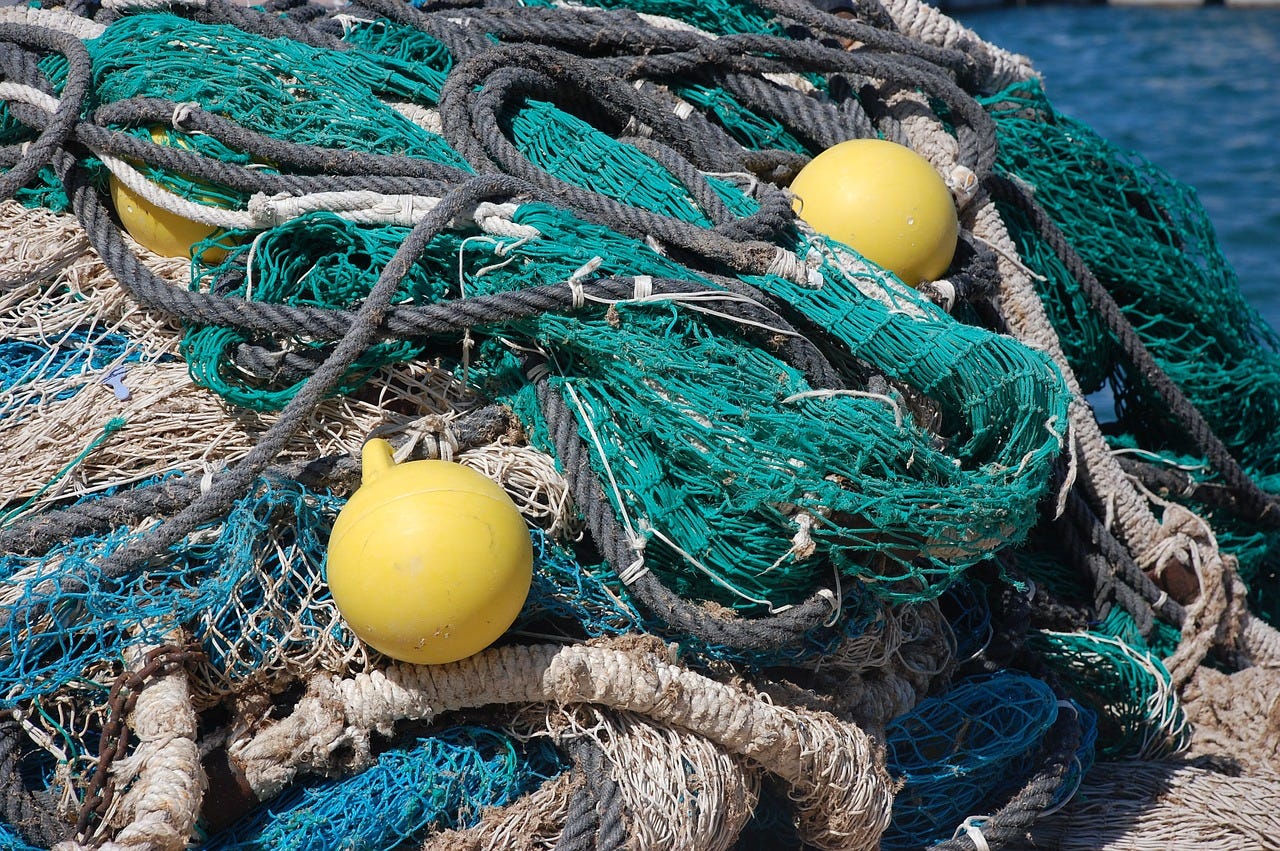
In November 2019, researchers hauled a fishing net off Cornwall and found a harbour porpoise dead in the mesh, about 20 metres from one of the underwater recorders they’d attached to the gear.
The recorders were there because scientists were trying to answer a surprisingly difficult question.
Harbour porpoises use echolocation. They send out clicks and listen to the echoes coming back, which helps them find fish and work out what’s around them. Yet they still get caught in fishing nets.
Usually, researchers only see the end result. An animal comes up dead in the net, with no way of knowing exactly what happened in the minutes before it became trapped, but this time, they had a recording.
The data showed two porpoises feeding around the net before one became entangled. The trapped animal repeatedly tried to swim towards the surface and pulled the net upwards by around seven metres. The second porpoise stayed close by.
A paper published this week reconstructs what happened.
Elsewhere, researchers have tried measuring foreign fishing fleets by the iron and vitamin B12 leaving with their catch, rather than simply tonnes of fish. There’s also a strange new attempt to restrict Russian mackerel fishing, record heat has bleached corals far beyond Japan’s tropical reefs, NOAA is exploring the deep sea around American Samoa, and an Antarctic crustacean has shown just how badly some polar animals may cope as seawater becomes fresher.
Deep Dives
Scientists recorded what a harbour porpoise did before it died in a fishing net
Fishing nets fixed in place on the seabed are used all over the world. They’re cheap, effective and generally cause much less damage to the seabed than fishing methods that drag heavy gear across it.
They also accidentally catch dolphins, porpoises and other animals. That accidental catch is known as bycatch.
Porpoises regularly swim around these nets without becoming trapped. The researchers behind this new study had already recorded animals feeding close to the gear and avoiding it successfully.
So, what happens in the rare encounters where something goes wrong? Researchers from the University of St Andrews have been working with fishers to find out. They attached several hydrophones, basically underwater microphones, to fishing nets.
A porpoise produces thousands of echolocation clicks as it swims. By comparing when those clicks arrive at different microphones, researchers can work out roughly where the animal is moving around the net in three dimensions.
The event recorded off Cornwall gave them something they’d rarely had before: data showing what a porpoise was doing immediately before and during an actual entanglement.
Two harbour porpoises were feeding around the net, and one became caught. It repeatedly tried to swim towards the surface, pulling part of the net upwards by about seven metres, before eventually dying.
The sounds made by both animals also changed. They began producing unusual sequences of clicks that the researchers think were being used to communicate.
The second porpoise remained nearby for at least an hour and may have returned twice during the following five hours.
The researchers think the pair may have been a mother and a calf around a year old, with the younger animal becoming trapped. The recordings can’t prove that relationship, so it has to remain a possibility rather than a fact.
The same applies to the sounds they made. The clicks changed during an obviously unusual event, but that doesn’t mean scientists can confidently describe them as a specific porpoise “distress call”.
There’s another limit worth keeping in mind. This happened once, involving two animals, so it can’t tell us that every porpoise behaves this way when it becomes trapped. What it does give scientists is a detailed sequence of events they can start trying to understand.
The porpoises were feeding near the net. One became entangled. It tried to escape. The way both animals were communicating changed. The other animal stayed nearby. That gives researchers more to work with when they try to stop the next one happening.
The scientists themselves aren’t arguing that these nets should simply disappear, indeed for many small fishing communities, they’re an important way of making a living. Instead, researchers are working with fishers in the UK, Iceland and Sweden to test ways of making the nets safer.
One idea involves adding pearl-like beads to the nets, which may make them easier for a porpoise’s echolocation to pick up. Another involves acoustic devices that react when a porpoise approaches rather than making noise all the time.
The recording has also created new questions. The animals were feeding before the entanglement, so researchers want to know whether chasing prey changes the chance of a porpoise becoming caught.
They’re also studying whether the unusual sounds recorded during the incident could eventually help us understand when an animal is in trouble.
Those are research questions for now, nobody has proved they’ll provide the solution, and the porpoise whose death produced the recording won’t benefit from whatever researchers find next.
A study counted what leaves with foreign trawlers in iron and zinc, not just tonnes of fish
Fishing agreements tend to be described using a few familiar numbers.
How many tonnes can be caught? How much does a fishing licence cost? How much money does the catch bring in?
A paper published in npj Ocean Sustainability this week asks what happens if nutrition gets added to that calculation. The researchers looked at fish caught by foreign industrial trawlers and estimated how much calcium, iron, zinc, vitamin B12 and omega 3 was contained in those catches.
Then they ran a big “what-if” experiment. What would happen to the supply of those nutrients if the fish caught by foreign vessels had instead stayed available in the country where they were caught?
Before getting to the answer, there are some important things to know about the study.
Three of its authors work with Oceana, including David Costalago, the paper’s lead author. Oceana campaigns on fisheries policy and also provided staff time for some of the analysis and interpretation.
One of the Oceana authors was a guest editor of the journal collection where the study appears, although the journal says he had no role in reviewing this paper or deciding whether it should be published.
The authors reported no competing financial interests.
That doesn’t tell us the research is wrong. It tells us to look closely at how the result was produced, particularly when the conclusions overlap with the campaigning position of one of the organisations involved.
The model uses fishing data from 2017, and it also makes a big assumption.
It starts by treating fish caught by foreign fleets as though those fish aren’t available to people in the country where they were caught. It then creates a best-case scenario where all of that fish stays available locally instead.
That gives the researchers an idea of how much nutrition could theoretically remain in those countries, but it doesn’t tell us what people would actually eat.
Under that scenario, the researchers estimate that up to 10.6 million people, mostly in countries where nutrient deficiencies are a bigger problem, could move from having too little of a nutrient to having enough.
They also estimate that around 4.2 million people, mainly elsewhere, could lose access to enough of those nutrients because the fish would no longer be moving through the same international markets.
The researchers produced separate estimates for five different nutrients, then averaged them. So 10.6 million is not a count of 10.6 million individual people who’d become adequately nourished if foreign trawling stopped.
It’s a model showing how the availability of individual nutrients could change. There’s also a big gap between fish existing in a country and those fish reaching somebody who needs them.
They still have to be landed, sold, transported and made affordable. People need to want to eat them. Governments and fishing companies also decide where catches eventually go.
The paper recognises that. This is a what-if model showing the maximum potential supply of nutrients. It isn’t a prediction of what millions of individual people would actually eat.
Imagine two countries each lose 10,000 tonnes of fish to foreign fleets.
On paper, the number is the same, yet one catch might contain large amounts of iron, zinc and omega 3 taken from a country where people already struggle to get enough of those nutrients. The other might come from somewhere where those nutrients are already widely available.
Looking only at the weight of the catch misses that difference, but that doesn’t mean every foreign fishing agreement is harmful, or that keeping every fish at home would automatically improve people’s diets. It means governments could ask another question when deciding what access to their waters is worth.
A tonne of fish has a weight, a price and nutrients inside it. Fisheries policy has traditionally been much better at counting the first two.
A new mackerel measure targets Russia through ports, fuel and where the fish can be landed
A strange new fishing rule came into force in the North East Atlantic on Friday, involving 1,495 tonnes of Russian mackerel. The organisation behind the rule, the North East Atlantic Fisheries Commission, or NEAFC, calls that number a “stock protection reserve”.
It also makes a point of saying that it isn’t a quota.
NEAFC brings together countries and governments that manage fishing in the North East Atlantic. Its members can object to some decisions, which Russia has done in this case.
That makes it difficult to simply announce that Russia has been given a normal 1,495 tonne catch limit. Instead, the rule puts pressure on what happens after Russian vessels catch more than that amount.
Other participating countries can refuse to let those fish be landed in their ports. They can stop them being moved from one vessel to another, which is known as transhipment. They can refuse fuel and other support, and they can restrict access to their own waters.
The European Union says it has already been using similar restrictions since 3 July and has refused port entry to vessels carrying Russian mackerel caught above the threshold. The UK and Iceland have also decided to apply restrictions.
So a Russian vessel may still catch fish in international waters.
A fishing vessel needs somewhere to land its catch. It may need fuel. It may need another ship to take the fish. It may need access to somebody else’s waters, and the new rule tries to use those points as leverage.
The argument behind it is about the condition of Northeast Atlantic mackerel, as scientists at the International Council for the Exploration of the Sea, usually called ICES, advised that the total mackerel catch in 2026 should be no more than 174,357 tonnes.
The politics get messier when you look at what everyone else is doing. The UK, Norway, Iceland and the Faroe Islands agreed a reference catch of 299,010 tonnes for 2026. That’s around 72 per cent higher than the scientific advice.
Russia then announced its own allocation of 67,548 tonnes, which works out at 22.6 per cent of that 299,010 tonne figure. Those 67,548 tonnes is 22.6 per cent of the four-party reference catch, not 22.6 per cent of the much lower 174,357 tonnes recommended by scientists.
Russia isn’t the only party planning to catch mackerel at a level that sits above the scientific recommendation. The combined reference catch agreed by the four other coastal states already does that.
The European Commission argues that Russia’s extra allocation puts even more pressure on a depleted stock and says the new restrictions are a response to unsustainable fishing.
The interesting part is how the restriction works. NEAFC can call 1,495 tonnes a stock protection reserve rather than a normal quota. The number gains power because other countries control ports, fuel, waters and services that fishing vessels need.
Catching the fish is one part of fishing, but getting it back to land is another.
Quick Hits
Record heat bleached corals across subtropical and temperate Japan
Japan experienced an extraordinary marine heatwave in 2024, and a study published in Scientific Reports this week shows that serious coral bleaching spread well beyond the country’s tropical reefs.
Researchers surveyed corals at eight sites stretching from tropical waters in the south to much cooler areas farther north, and at most of the temperate sites, between 55 and 95 per cent of the corals they surveyed showed bleaching.
At Tsushima, researchers recorded what they describe as the first known coral bleaching there caused by extreme heat.
One site, Tateyama, produced a particularly strange result, experiencing more than 12 degree heating weeks, which is a measure scientists use to add up how hot the water has been and how long the heat has lasted. NOAA says bleaching risk becomes serious at four degree heating weeks, while eight or more is linked with widespread bleaching and deaths among heat-sensitive corals.
Tateyama reached more than 12, and researchers found no bleaching there.
That doesn’t mean heat wasn’t important, indeed it shows that temperature alone doesn’t tell the whole story. The coral species living at a site, local conditions and what those corals have experienced in the past can all affect what happens during a marine heatwave.
NOAA is mapping the deep sea around American Samoa, including metal-rich rocks on the seabed
NOAA’s research vessel Okeanos Explorer is spending almost a month exploring deep waters around American Samoa. Scientists are using remotely operated vehicles, basically deep-sea robots controlled from the ship, alongside detailed seabed mapping.
They’re looking at seamounts, deep-sea corals, sponges, fish habitats and the water itself, and they’re also collecting basic information about polymetallic nodules.
These are metal-rich rocks that form extremely slowly on parts of the deep seabed and contain metals such as nickel, cobalt, copper and manganese. They’re one of the resources at the centre of the global argument over deep-sea mining.
NOAA is collecting baseline information about what’s actually down there, including the animals, habitats, geology and mineral deposits.
That distinction matters because large parts of the deep ocean still haven’t been mapped or studied in much detail.
The first planned dive on 24 August was cancelled because of high winds. Exploration is due to continue into September, if the weather allows.
An Antarctic animal adapted to stable seawater may struggle as the ocean gets fresher
The giant Antarctic amphipod Paraceradocus miersi is a crustacean that lives in coastal Antarctic waters, waters which have historically stayed remarkably consistent in how salty they are.
Researchers wanted to know what would happen as melting ice and increased freshwater begin to change that, so they lowered the salinity, basically the saltiness of the water, from around 34.6 to 28 for periods of 12 to 48 hours.
The animals started struggling to keep the right balance of salts inside their bodies, and when researchers dropped the salinity to 22.1, they found severe and irreversible damage to the animals’ gills.
There’s a real-world comparison that makes the experiment more interesting. During a freshening event at Ryder Bay in Antarctica in 2017, salinity fell to 28.4, very close to the level used in part of the experiment.
The researchers say an event like that may harm these amphipods and could potentially kill some of them, but they didn’t actually record amphipods dying during the 2017 event, so we can’t say that happened.
This is also one species tested during short experiments in a laboratory. It doesn’t show that Antarctic seabed animals are already dying as the ocean gets fresher. It does, however, show that at least one Antarctic species has a limited ability to cope when the seawater around it suddenly changes.
Hard Truth From The Sea
Several of this week’s biggest numbers become more complicated once you look at what sits underneath them.
The 10.6 million nutrition figure comes from a best-case what-if model. NEAFC’s 1,495 tonne mackerel figure only really works because other countries control ports and fuel. In Japan, one coral site experienced extreme heat stress without bleaching even though other sites were badly affected.
The numbers are useful, but understanding what produced them is more useful.
Paid subscriptions fund Ocean Rising’s reporting and help me keep The Deep Brief free for everyone.
If you found this useful, please send it to someone who’d enjoy it too.
If you’d like to support the reporting, you can become a paid subscriber below.
See you next week.
Luke