


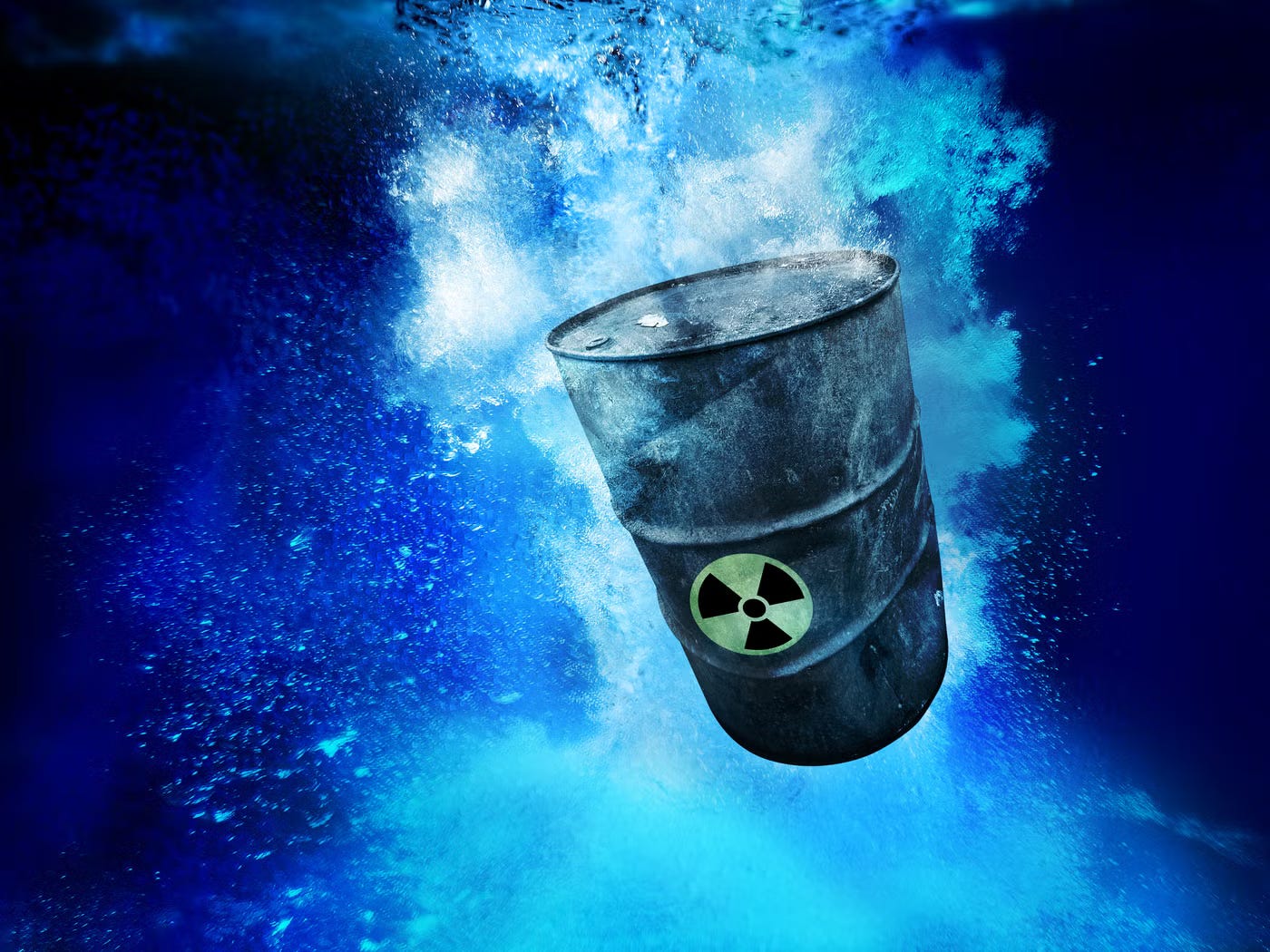
4,700 metres down in the North-East Atlantic, crabs, sponges and anemones are living on the outside of rusting barrels of radioactive waste. A French submersible went down this summer to look at them, decades after the barrels were dropped there.
That’s one of this week’s three. There’s also the arrival of AI data centres in the sea, and a Maine city that has just voted to stop one. And the fight to get the ocean into the text governments actually negotiate at this year’s climate summit. Two quick hits and a hard truth after that.
Deep Dives
Data centres are moving into the sea. One Maine city has already hit pause.
They’re putting data centres in the sea now. Not the cables, the actual server farms.
The reason is heat. Data centres run hot, cooling them can eat a quarter or more of the electricity they use, and on land it drinks fresh water too, often somewhere that hasn’t got much. The sea is cold, it’s enormous, and it doesn’t send you a bill.
China is furthest along. There’s one sitting about 35 metres down off Shanghai, roughly 2,000 servers sealed in pods, running commercially since May on power from a nearby wind farm. Japan has a floating demonstration at Yokohama. Singapore is building a 4 storey version due to open in 2028. South Korea is working on an underwater model at Ulsan. And a startup called Panthalassa, backed by Peter Thiel, has raised $140 million for nodes that would float far out at sea, run on wave power, and beam the answers back by satellite.
It isn’t lawless out there, whatever you might read. Under the law of the sea, countries have authority over structures in their own waters, and these things go through normal planning and permits like anything else. The question is whether rules written for other kinds of infrastructure tell you much about this one.
The pitch is decent as far as it goes. Less land, less fresh water, power made where it gets used. What it doesn’t do is get rid of the heat. Shanghai’s pods pass theirs straight into the sea and Singapore’s floating design will use seawater cooling, so either way it ends up in the water, and warmer water holds less oxygen.
How much that matters, we mostly have the companies’ word for. Hailanyun, which runs the Shanghai site, points at its own monitoring and an assessment it commissioned, which found the water 3 metres downstream from a sea trial went up by less than 0.2°C. That’s one installation on its own. It tells you very little about twenty of them in the same bay.
Eastport, Maine, decided not to wait and find out. A company called DeepGreen wants to put a tidal powered data centre in the water off the town. Residents and Passamaquoddy tribal representatives objected, worried the waste heat would make the bay too warm for lobsters and take the fishing and the tourists with them. On 12 August the city council voted unanimously to block any data centre, on land or underwater, for 180 days while they work through 2 citizen initiated ordinances. The federal permit hasn’t come through either. Regulators sent the application back over missing tribal information and incomplete specifications.
There’s an odd footnote to all this. A 2024 study found you can disrupt an undersea data centre by pointing sound at it. Maintenance is harder down there, cables are harder, corrosion is harder. Meanwhile the industry is scaling, and the measurements anyone has published don’t reach that far.
The ocean has a place at the climate talks. The fight is over whether it reaches the negotiated text.
The ocean covers most of the planet and barely gets negotiated at climate summits.
COP31 is this year’s UN climate summit, in Antalya, Turkey. The ocean isn’t ignored exactly. There’s been a dialogue on it every year since Glasgow in 2021, and the summit has an oceans section in its action agenda. What the dialogue doesn’t do is produce anything a government has to sign.
African countries, the EU, Latin American nations and small island states have been pushing to change that. More than 150 experts and leaders have written to Turkey and Australia, who are running the summit between them, asking for the ocean to turn up in the texts governments actually negotiate: cutting emissions, coping with the damage, and paying for both. Turkey has told Climate Home News it’s planning a Blue COP31 roadmap, an action plan ministers will discuss next month. That isn’t the same thing.
Countries have been putting the ocean into their climate plans. A UN analysis of 119 countries that filed plans between January 2024 and April this year found 91 of them, just over three quarters, had something in there for the sea.
Then you look at the money. Of the countries that said they’d need funding for those ocean promises, close to half made the promise conditional on getting it. Ocean work has historically taken somewhere between 0.8 and 1.4 per cent of the world’s aid budget, and that budget is falling off a cliff. The OECD says aid dropped about 23 per cent in real terms last year, the steepest fall it has ever recorded, with roughly another 7 per cent expected this year.
The politics are no easier. This year’s dialogue suggested countries talk about moving away from fossil fuels, which went down badly. The Arab group’s submission opposes any report that targets particular energy sources, explicitly or otherwise. India and the Arab group both warned against putting extra burdens on developing countries.
A roadmap would give the ocean more weight in Antalya. It still isn’t a decision anyone has to keep.
A French expedition has been down to the barrels of radioactive waste on the Atlantic floor.
Between 1950 and 1990, more than 200,000 barrels of radioactive waste were dropped into the North-East Atlantic.
A French project called NODSSUM has been down to see what became of them. They mapped the site last year, then went back this May and June with around 30 scientists aboard a ship called the Pourquoi Pas? A crewed submersible made 20 dives to more than 4,700 metres. CNRS put the results out on 2 July, so this has been sitting around for a few weeks.
Several of the barrels are falling apart. Some have leaked. The team could work out what the waste had been sealed in, which was resin, bitumen and cement, and their instruments picked up radioactive elements from the waste at higher levels than you’d expect that far down.
CNRS is careful about what that means, and the careful bit keeps getting dropped from the coverage. The levels are still low. Low enough that samples came back and were handled without special radiation gear. Higher than expected isn’t the same as dangerous, and the lab work that will tell you how much is still going on.
Crabs, sponges and anemones have moved onto the barrels and are living on them. Whether the radioactivity has got into those animals is exactly what the team is now trying to establish, which is why they brought back water, sediment and creatures to test.
CNRS ran the project with Ifremer, France’s nuclear safety authority and around 15 other institutions across France, Norway, Germany and Spain. They also picked up clues that might eventually say who dropped which barrels.
Quick Hits
Someone poured 62,500 litres of lye into the Gulf of Maine. This was the first US-permitted attempt to make a patch of sea more alkaline, on the principle that more alkaline water pulls down more carbon dioxide. The Woods Hole-led LOC-NESS project ran it in August 2025, and preliminary estimates presented in Glasgow in February put the extra uptake at 2 to 10 tonnes over 4 days. The interesting part happened first. After meeting fishermen at ports and fisheries council meetings, the team moved where they were going to do it, and on the day one fisherman asked to come along as an observer, with a stipend to cover the income he lost. Rachel Davitt of Rutgers measured the lobster and herring larvae and reported no significant effect on what they looked at. What the material is matters, though: a 2026 study found dissolving olivine, a different alkaline mineral, damaged oyster embryos, while sodium carbonate didn’t.
The world’s oceans had their warmest July on record. Copernicus put the average sea surface temperature outside the polar regions at 20.96°C last month, past the previous July record of 20.89°C from 2023. That’s a July record rather than an all-time one, though the daily figure on 31 July came within 0.04°C of the hottest ever measured, in March 2024. The number that stopped me was this: intense marine heatwaves covered 27 per cent of the ocean surface at some point during the month, the widest spread in 34 years of records, well past the 22 per cent of 2024. A fast strengthening El Niño is part of it. Sea temperatures hit July records along Europe’s Atlantic coast and in the western Mediterranean, and heatwaves on that scale kill things, corals and sponges and the big seaweeds that hold underwater forests together.
Hard Truth From The Sea
There is a strange time lag in the way we treat the ocean. The decision comes first. Understanding what the decision did can take decades. More than 200,000 barrels went into the North-East Atlantic between 1950 and 1990, and scientists are still testing the animals now living on them. The servers are going in now.
If you fancy trying a paid subscription, it opens up the full archive, every investigation and back issue. If not, that’s honestly fine. I’m glad you turn up each week for this.
See you next week.
Luke