


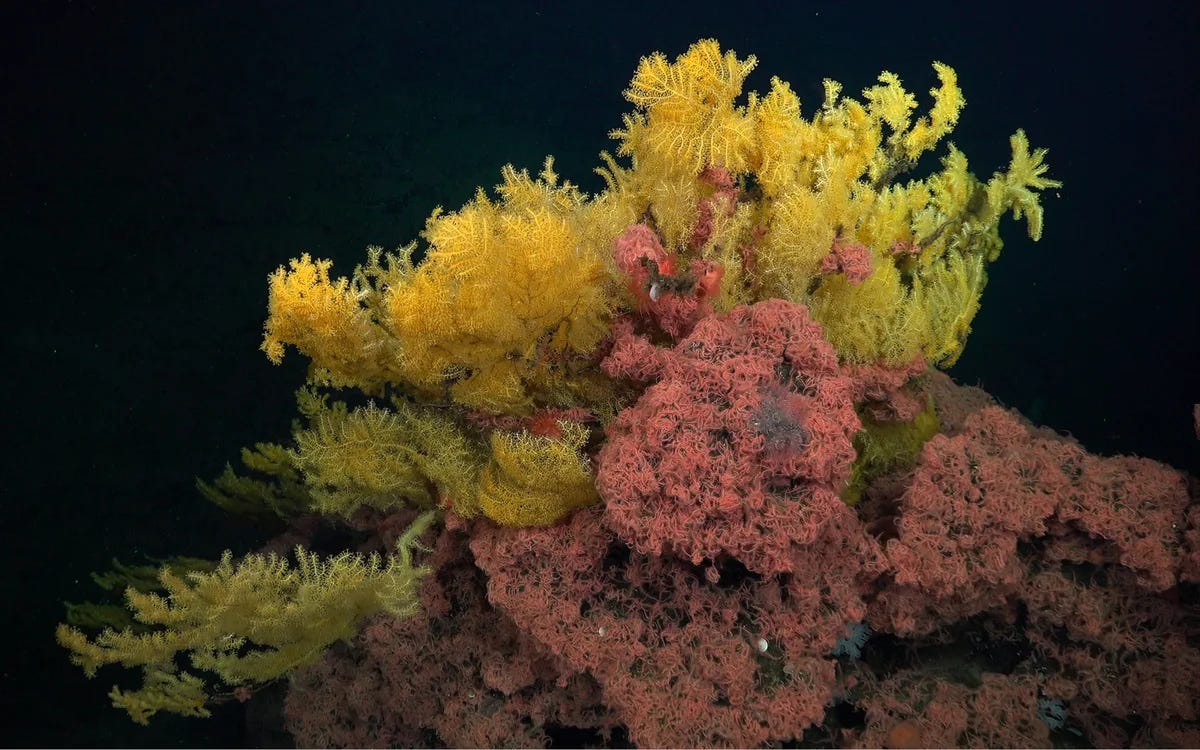
About 400 metres down off the coast of Costa Rica there’s a rocky outcrop almost completely carpeted in brittle stars. Rising out of them are bright yellow corals, over a metre tall, branched like small trees. The coral had never been formally described by science. It now has a species, a genus and a whole new family of its own.
That’s one of this week’s three. The lead is a paper from Utrecht that changes how we should be thinking about the Atlantic circulation, and there’s the plastics treaty, which a year after talks broke down in Geneva has produced a new document that campaigners say is weaker than the draft that already failed. Two quick hits and a hard truth after that.
Deep Dives
There may be no single temperature at which the Atlantic circulation collapses. A new paper says how fast we get there matters too.
The Atlantic Meridional Overturning Circulation, usually shortened to AMOC, is a system of currents that carries warm water north through the Atlantic and cold water back south. It moves an enormous amount of heat and helps shape the climate on both sides of the ocean, including ours. The number often quoted for when it could collapse is +4°C of global warming. What rarely travels with that number is the uncertainty around it, which runs from +1.4°C to +8°C.
A paper published in Nature Climate Change on 13 August, by René van Westen, Reyk Börner and Henk Dijkstra at Utrecht’s Institute for Marine and Atmospheric Research, argues that a single temperature may be the wrong way to think about the risk.
They ran the same climate model three times, each with carbon dioxide climbing at a different speed: 0.5 parts per million a year, then 2.5, then 5. For comparison, carbon dioxide measured at Mauna Loa in Hawaii rose by an average of 2.6 parts per million a year between 2015 and 2025. In the slowest run the circulation held together all the way to +5.5°C. In the two faster ones, it began collapsing at around +2°C.
The difference is about time. Warm the ocean slowly, and the surface and the deep water have time to change together. In this simulation, more evaporation and less sea ice also leave the North Atlantic saltier, which helps hold the circulation steady. Warm it fast and the surface water becomes lighter and settles into layers that do not mix, quicker than the water below can catch up. The places where surface water sinks, which is what drives the whole circulation, close off, and the AMOC collapses.
The experiments come from one setup of one climate model. The authors found a similar stabilising response in most of the CMIP6 models they checked, the shared set of climate models used for international assessments, though those were not repeats of the same experiment. Their main model also starts with extra freshwater added to the North Atlantic to correct a known flaw. That leaves its starting AMOC at about 13 Sverdrups, meaning roughly 13 million cubic metres of water moving every second, against about 17 Sverdrups in the real ocean. The +2°C figures are measured from that model’s own starting point, so they are not the same thing as the roughly +1.5°C of warming the world has already seen.
The figure that has been travelling this week, 0.3°C a decade as a critical rate, needs handling with care. The paper does not establish 0.29°C per decade as a universal threshold. The authors take an earlier estimate in which the AMOC begins collapsing near +2.5°C around 2060 and work out that, if that happened, it would imply a warming rate of +0.29°C per decade. That sits inside a projected range of +0.27 to +0.36°C per decade.
They also say clearly that any critical rate depends on the state the climate is starting from, the stabilising mechanisms at work and the path the warming took to get there. For these experiments they avoid calling the change a “tipping point”, because they cannot show the model crossed the kind of fixed threshold that term usually implies.
Deep Brief #36 covered a different AMOC paper, and the caution there still applies. What this paper adds is one reason a single warming number can mislead: the speed of the change, and the route taken, can alter the outcome. The authors’ conclusion is much simpler. Greenhouse gas emissions need to fall as quickly as possible to reduce the risk of an AMOC collapse.
A year after plastics treaty talks broke down, the chair has published a document meant to get them moving again. Campaigners say it is weaker than the draft that already failed.
Governments have been trying since 2022 to agree on a global treaty on plastic pollution. Formal talks broke up without agreement in Geneva last August. Limits on how much plastic gets made were among the issues dividing countries, part of a wider argument over whether the treaty should reach back into production at all, or deal mainly with products, waste and recycling.
On 8 August, the new chair of the negotiating committee, Julio Cordano of Chile, published something called an Aid to Negotiations. The UN Environment Programme, which runs the process, describes it as an informal reference document. Governments have neither negotiated nor agreed it. Its purpose is to give countries something to work from as they try to narrow the gaps before formal talks resume.
It follows three video meetings of heads of delegation since March, meaning the senior negotiator each country sends, and an in-person meeting in Nairobi from 30 June to 3 July. In the note accompanying the document, Cordano confirms that countries put forward possible compromise ideas in Nairobi and that he deliberately did not put them into this first version. He wants governments to work through those ideas in the meetings ahead.
Those meetings have not included campaign groups in the same format. The UN’s published arrangements limit the heads of delegation sessions to national delegations, while the chair has run a separate series of webinars for observer organisations since 24 March so they can put their views to him.
The Environmental Investigation Agency published its assessment on 10 August and it is not gentle. Ocean Campaign Leader Christina Dixon says Cordano had described the document as one with “no surprises” and argues that it retreats from the ambition needed to end plastic pollution. Legal and Policy Specialist Amy Youngman says you cannot “gut a treaty of its obligations” and still claim success. EIA campaigns for a strong treaty, so its assessment should be read as the position of an interested party rather than a neutral description.
Cordano’s own account is different. He calls the Aid his attempt to balance the positions governments have taken so far, describes it as a living document with another version due after Bangkok, and says the next round should be used to find areas of agreement and work through what is left. The document shows where some of that disagreement sits. It contains wording, still inside square brackets to mark that nobody has agreed it, that could require countries to cut back or phase out the production and use of certain plastic products. That is a different thing from a binding limit on how much new plastic gets made in total, which is what EIA argues the treaty needs.
Delegations meet again by video on 8 and 9 September, in Bangkok from 27 to 30 September, and once more at a date still to be fixed between 25 January and 2 February. Formal negotiations are due to resume within the period from 13 to 24 March 2027, at the session known as INC 5.4.
A bright yellow coral over a metre tall has been formally described from seamounts off Costa Rica.
The seafloor there is almost carpeted in brittle stars, and out of that dense mat rise bright yellow colonies shaped like small trees. Some grow more than a metre tall. They live on seamounts, which are underwater mountains rising from the deep seabed.
The genus is Laurinque, from Laurinquë, meaning “golden tree” in Quenya, the Elvish language Tolkien devised. The species is elenya, meaning “of the stars”, for the brittle stars it grows among. Laurinque elenya.
The description was led by Odalisca Breedy at the Universidad de Costa Rica, a specialist in octocorals, the group that includes soft corals and sea fans. It was published in the open access journal ZooKeys on 30 June. The publisher highlighted it this week, so this is a discovery surfacing rather than breaking.
Working out where the coral belonged was unusually difficult. The researchers first sequenced three genes commonly used to sort corals into groups, and each one pointed towards a different family. They then turned to phylogenomics, analysing hundreds of genes at once. That showed the coral sat on its own branch of the evolutionary tree, different enough in its genes and its body to need a new genus and an entirely new family, Laurinqueidae. Families sit several rungs above species in how life is classified, so adding one is rare.
The specimens came from between 360 and 529 metres down, off Isla del Coco and along Costa Rica’s Pacific coast. They were collected by the remotely operated vehicle SuBastian during Schmidt Ocean Institute expeditions in 2019 and 2023, aboard the ships Falkor and Falkor (too). A National Geographic Society research grant also supported the work.
The paper notes that coral gardens like these are considered vulnerable marine ecosystems, a label that matters because it flags them as habitat worth protecting, since they create shelter and structure for other deep sea life.
Breedy first saw the octocoral garden in 2019. Seven years later, the animal has a scientific name: Laurinque elenya.
Quick Hits
Late Pliocene evidence challenges a textbook idea about what helps sustain the Atlantic circulation. Warm, salty water from the Indian Ocean leaks around the tip of South Africa into the Atlantic, and one longstanding explanation is that this salt supply helps support the AMOC. A paper published in Nature Geoscience on 3 August, led by Suning Hou at Utrecht University, reconstructed how much leaked during the late Pliocene, using the fossilised cysts of dinoflagellates, a kind of single-celled plankton, along with chemical traces left behind by ancient sea life in seafloor mud. Between roughly 3.6 and 3.3 million years ago, the leakage and its salt supply declined, while the AMOC grew stronger. That challenges the assumed cause and effect under those ancient conditions. The authors note that scientists still disagree about the leakage’s role in today’s climate, and that Pliocene geography and ocean conditions were not ours.
Two schools of young squid left the Pacific almost together and travelled about 30 metres through the air. This is older science resurfacing. On 25 July 2011, researchers from Hokkaido University in the Northwest Pacific photographed two schools leaving the water at once, at least 121 animals in one and 92 in the other. They stayed airborne for about three seconds and covered an estimated 26 to 34 metres, moving through four stages: launching, jetting, gliding and a controlled dive back in. Squid flight had been reported for decades. What the 2013 Marine Biology paper added was a sequence clear enough to show the animals were actively steering rather than just leaping and falling. No specimens were collected, so the researchers identified them only as ommastrephid squid, a family of fast open ocean species, very likely young neon flying squid, Ommastrephes bartramii, though they could not rule out the purpleback flying squid, Sthenoteuthis oualaniensis.
Hard Truth From The Sea
Most of what’s here is science correcting itself. A collapse threshold that turns out to depend on the route taken rather than the destination. A textbook mechanism that did not hold in the Pliocene. A coral so unlike anything known that three separate genes each pointed to a different family, and the answer was that it belonged to none of them. Odalisca Breedy first saw that coral in 2019, and it took until this year to work out what it was.
If you fancy trying a paid subscription, it opens up the full archive, every investigation and back issue. If not, that’s honestly fine. I’m glad you turn up each week for this.
See you next week.
- Luke
More fascinating information that continues to help build the larger picture of the state of our oceans and the growing threat to the survival of this water planet. To state the obvious, ignorance, greed and those that make trouble that slows down progress.
The threat of non-survival is not of itself adequate to mobilise the population, but needs to be supported by a positive view of a post-industrial world that will allow our oceans time to recover. The establishment of large areas of protected ocean/shorelines, is a step in the right direction, but needs to be supported by very strong police-ing. Reconnecting with our natural world is our mission and it seems to me that our best bet now is the younger generation but how well are they equipoped and supported. They need to be able to see a better more fulfilling life that embraces nature and humanity.
Thank you, Mr. McMillan.