


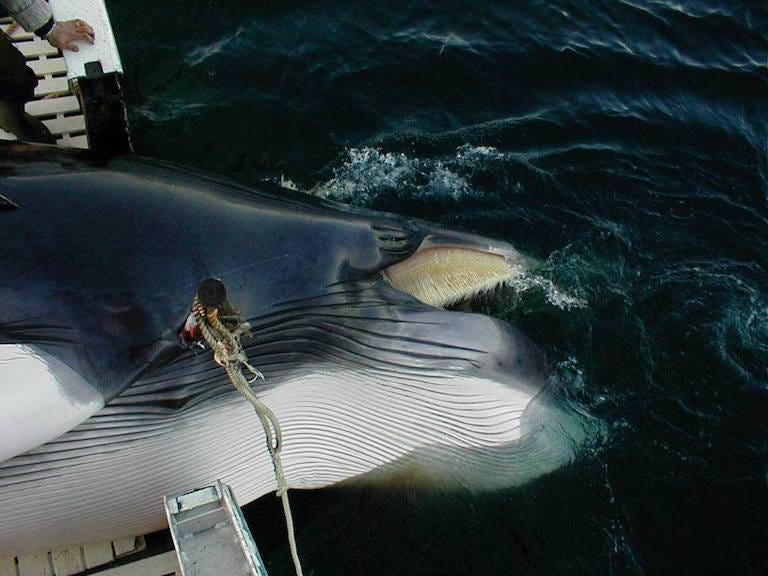
In May 2022 campaigners flew a drone over the water off Storstappen Island, in the far north of Norway. Below it a minke whale, struck by a harpoon from the vessel KATO, thrashed at the surface. A former UK deputy chief veterinary officer who reviewed the footage put the time it took to die at twenty minutes and twenty-eight seconds.
Norway has raised the number of minke whales its hunters can kill this year to 1,641. That’s where we start. I’ve also got a study on whether we should be feeding iron to the Southern Ocean to pull carbon out of the sky, and what happened to a coral reef when rats got onto the islands beside it. Two quick hits and a hard truth after that.
Deep Dives
Norway raised its minke whale quota to 1,641 this year. It scrapped the monitoring in 2023.
On 30 January the Norwegian fisheries ministry set this year’s quota at 1,641 minke whales, up 235 on last year. Whale and Dolphin Conservation, which published a report on the hunt this week, calls it the largest commercial whaling quota in the world.
Norway kills whales legally because it objected to the international ban when it came in. A country that objects isn’t bound by it. Norway sets its own limits and reports its own results, and the International Whaling Commission has no power to stop it.
Ten boats went out last year and killed 429 whales, about a third of what the government permitted.
Nobody independent watched them do it. Government inspectors came off the boats in 2006, replaced by an electronic recorder that logged the vessel’s position, engine speed and shots fired. On 23 March 2023 the ministry scrapped the requirement for that too. An inspector can still be sent, at the Directorate of Fisheries’ discretion. Otherwise the hunt goes unobserved and the boats report their own catch.
Everything we now learn about how these whales die comes from the whalers.
The last proper welfare study covered the 2011 and 2012 seasons. It found 82 per cent of whales died instantly. Forty-nine did not. For those, the average time to death was six minutes, and some took more than twenty. Norway has published nothing comparable in the fifteen years since.
Of the 429 killed last year, 287 were female. The charity’s analysis of Norway’s catch reports puts the pregnancy rate among females killed at around 60 per cent for 2025. That is roughly 170 whales carrying a calf that died with her.
Norway would say, fairly, that this is what the biology produces. Minke whales breed year-round and a female can carry a calf almost every year, so a high pregnancy rate among the mature females killed is close to what you would expect in any large sample. Nobody picks them out. The government’s broader position is that the North Atlantic minke population is large and the hunt takes a small share of it. Fisheries Minister Marianne Sivertsen Næss said in January that the population is “in very good condition”.
One per cent of Norwegians now eat whale meat regularly, down from four per cent in 2019, according to polling by Respons Analyse for the animal welfare group NOAH. The quota went up by 235 whales for a market that has almost entirely left.
Disclosure: I’m Head of Hunting and Captivity at Whale and Dolphin Conservation, which published this week’s report. Quota, catch and regulation figures come from the Norwegian government’s own records. Where a number is the charity’s analysis, I’ve said so.
Scientists have worked out where you could dump iron in the ocean to pull carbon from the air. Most of it comes straight back out.
The idea is decades old. Across big stretches of ocean, the microscopic plants drifting near the surface have everything they need to grow except iron. Add iron and they bloom. Blooming plants pull carbon dioxide out of the water, the water pulls more from the air to replace it, and when the plants die and sink some of that carbon goes down with them.
A study published in Nature on 29 July, led by Jun Yu at the University of California, Irvine, ran a global ocean model across ten regions, simulated sixty years of fertilising, then watched what happened after it stopped.
Sixty years of it removed the equivalent of between 1.1 and 5.3 parts per million of atmospheric carbon dioxide. More than half came back out within decades. For scale, carbon dioxide has gone up by more than 140 parts per million since the industrial revolution.
Where you do it changes what you break. Fertilising the equatorial Pacific expanded the ocean’s oxygen-poor zones and cut the biomass of the larger drifting animals that fish and whales feed on. The same thing in the Southern Ocean took up comparable carbon with less damage.
The authors are careful about the model. It’s one model rather than an ensemble, and the way it handles plankton carries real uncertainty. They’re blunter about the money. Fertilise one patch of sea and the effects travel, so the carbon removed and the harm caused surface somewhere other than where you did the work. That disconnect, they write, “complicates robust carbon crediting”.
A carbon credit needs someone to certify that a specific amount of carbon came out, that it stayed out, and that one particular act did it. On these findings, iron fertilisation fails all three. The work was funded by the US Department of Energy, NASA and the National Science Foundation.
Rats that got ashore on Indian Ocean islands have quietly rewired the reefs offshore. The fix is one conservationists already know how to do.
The arc-eye hawkfish is about the length of your finger, orange and pink, and it likes to perch on a coral head and wait. Around some islands of the Chagos Archipelago it’s thriving and around others it isn’t, and the reason has nothing to do with the water.
It has to do with rats. Where rats got ashore off ships, they ate the eggs and chicks of nesting seabirds and the colonies collapsed. Where rats never landed, the birds are still there in extraordinary numbers. Work published in Nature in 2018 measured the difference at roughly 760 times the seabird density on rat-free islands.
Seabirds feed out at sea and come back to the island to roost, and their droppings wash off the land onto the reef around it. The birds fertilise the reef. Take the birds away and the reef loses its supply.
A study in Ecology this week, led by Laura-Li Jeannot at Lancaster University, followed that loss down into the smallest layer of reef life. Cryptofauna are the tiny animals living in the cracks and rubble, the little fish and shrimps and worms that almost nobody counts and nearly everything eats. Near rat-free islands, Jeannot’s team found the small fish outweighed the small invertebrates by more than five to one. Near islands with rats, the two were about level.
That matters because of what eats them. Small fish grow fast, die young and get replaced quickly, which makes them a steady supply of food for predators like the hawkfish. Invertebrates turn over more slowly. A reef that swaps one for the other is still busy, and it’s passing less energy upward.
Jeannot won’t call it collapse. Some species gain from the seabirds being gone. Nutrient-loss impacts “are not uniform”, she says. “There are winners and losers.”
What makes this different from most reef research is that the problem has a known solution. Getting rats off an island is a defined job with a method, a cost and an end point, and it’s been done on islands all over the world. This study says the payoff doesn’t stop at the waterline.
Quick Hits
Whale watchers off Western Australia counted about 60 per cent fewer humpbacks than usual in June, and a week later birdwatchers on the east coast were finding albatrosses and petrels a long way from where they should have been, a lot of them in poor condition. Writing in The Conversation this week, Mary-Anne Lea of the University of Tasmania and oceanographer Christopher Chapman set those sightings against marine heatwaves running in the Tasman Sea since April, and against Australia’s first confirmed case of H5N1 bird flu in a migratory seabird. They stop well short of a conclusion. These are reports from people who watch wildlife for a living or for love, not survey data, and the authors say plainly that “monitoring in the Southern Ocean is limited”. The Antarctic fur seal joined the endangered list in April, after its population at South Georgia fell by around 1.5 million animals.
A modelling study has asked whether a climate system can cross a tipping point and come back. Sacha Sinet and colleagues at Utrecht University, writing in the journal Chaos this week, paired the Greenland ice sheet with the Atlantic circulation that carries warm water north through the ocean. Modelling consistently finds that a collapse of that circulation would cool northwest Europe and shift rainfall belts a long way beyond it. Sinet’s result is that whether it recovers depends on how tightly the two systems are linked and how fast each one responds, and that for some rates of Greenland melt it can cross its threshold and still come back. The work is deliberately simplified and the finding holds best for small overshoots. It’s maths about the shape of the problem rather than a forecast.
Hard Truth From The Sea
The thing about the ocean is how slowly it answers. Rats came off a ship onto a Chagos island and the reef a mile offshore was quietly rearranging itself for years before anyone noticed. The iron paper says the same, that carbon put in one ocean surfaces in another decades later. Norway will take whales this season and we won’t know what that did to the North Atlantic for a long time yet, if we ever do. Whatever’s behind the humpbacks not turning up in June has probably been building for years.
If you’ve been enjoying these, you could try a paid subscription. It gets you the whole archive, every investigation and back issue there is. And if you’d rather just keep reading the free round-up each week, I’m genuinely glad you’re here for it.
See you next week.
Luke
This is such important work you are doing… I want to support you and share the opinion that sharks are sharks, not villains and we have got to love our oceans - they have loved us dearly. Merci, Kathryn
I like reading what you have to say, but the statement “carbon put in one ocean surfaces in another decades later” is inaccurate - there is only ONE global ocean, so little wonder that carbon put into one part of it surfaces in another part decades later…keep up the great work!