


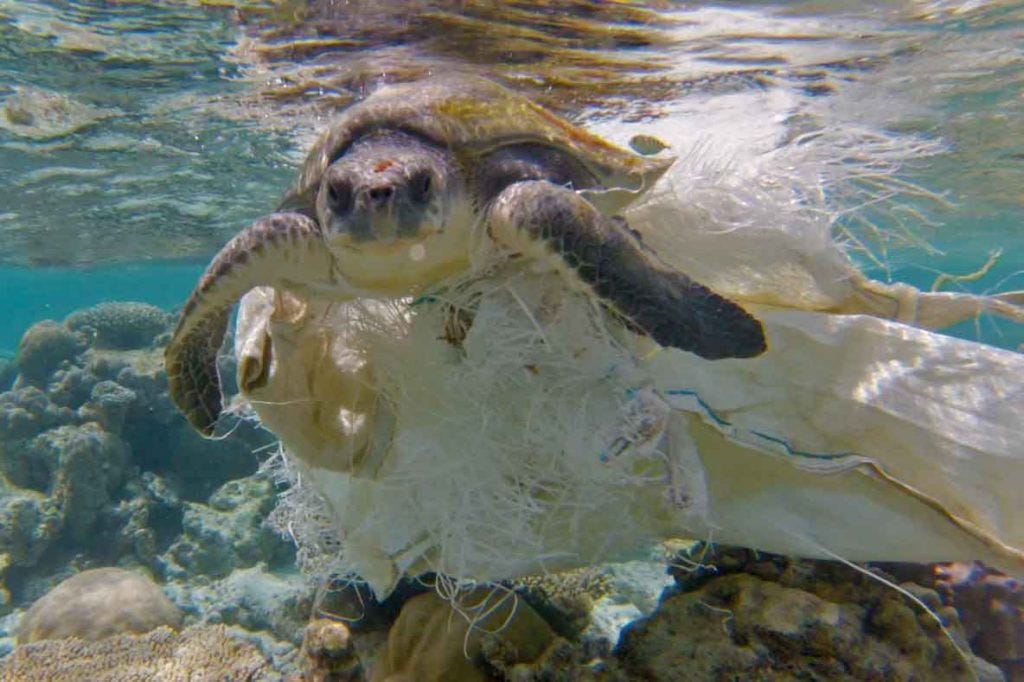
An olive ridley turtle somewhere off the Tamil Nadu coast is swimming through a current that carries, alongside the fish and the plankton, a tangle of abandoned nets, nylon ropes, styrofoam buoys and plastic rope. She doesn’t know what any of it is. She just knows the flipper is caught.
It’s Plastic Free July, a month that usually fills up with reusable coffee cups and Instagram posts about individual choices. This week I want to stay closer to the water. Three deep dives: what actually happens to a sea turtle caught in a ghost net, what the Ocean Cleanup saga tells us about how we solve hard ocean problems, and what the smallest nations on the planet are asking the world’s biggest packaging companies to do. Two quick hits and a hard truth to close.
Deep Dives
On India’s east coast, a woman has spent 24 years pulling ghost nets out of the ocean with the help of the fishermen who set them.
Supraja Dharini, the founder of Tree Foundation, has a rehabilitation centre for injured sea turtles and the permission of two state governments to run it. What fills it is ghost nets.
A ghost net is not a net someone is using. It’s gear that was lost in a storm or abandoned deliberately, still drifting, still catching everything it was designed to catch. Nylon rope. Polypropylene mesh. Styrofoam buoys. Plastic rope. Rubber. All of it moves with the currents, tangling around flippers and necks. Turtles trying to get free only pull the net tighter. Dharini’s team has found olive ridleys, green turtles, hawksbills and leatherbacks with flippers half-amputated, or with nylon embedded in their necks. Some survive. Many don’t.
India’s east coast is one of the most important sea turtle habitats on the planet. Olive ridleys nest here. Green turtles and hawksbills forage here. Leatherbacks show up as bycatch during fishing season. Ghost nets pile up near the harbours and ports, where shipping vessels have been discarding their own waste at sea rather than pay to offload it onshore.
In 2021 Dharini started paying fisherfolk to collect what they find. When a boat comes across a floating ghost net, the crew pulls it in, documents any entangled species, releases anything still living, and brings the net back to shore. The incentive goes straight into their bank accounts, split: 50 per cent to the fisherman, 50 per cent to his wife, or his mother if he’s unmarried. So far they’ve pulled more than 200 tonnes of ghost nets from just the Chennai and Chengalpattu coast.
The retrieved nets don’t sit in a pile. Some have been shredded and pressed into footpaths. In June this year, a road was laid using ghost-net aggregate. Fisherfolk who weave for a living have been working with artists to build life-size models of marine animals from the segregated material, displayed in coastal resorts.
It’s taken 24 years. Dharini is characteristically straight about that. Building trust with fishing communities is slow work, and the sea is not waiting. Every piece of net that makes it back to shore is one less death trap. She knows exactly how many pieces are still out there.
The Ocean Cleanup raised hundreds of millions of dollars and spent more than a decade trying to scoop plastic out of the Pacific. Scientists warned from the beginning it wouldn’t work. They were right, but the story is more complicated than that.
In 2012, an 18-year-old Dutch student named Boyan Slat gave a TED talk about a device that would clean the Great Pacific Garbage Patch. It went viral. The idea attracted millions in donations and years of breathless media coverage. It also attracted, from very early on, a group of scientists who thought the whole premise was wrong.
To understand why, you have to know what the Great Pacific Garbage Patch actually is. It isn’t a floating island of waste you could walk on. It’s more like a soup, most of it crumb-sized pieces of plastic, often too small to see clearly. The soup is threaded through with wildlife, because this region isn’t a biological desert, it’s full of neuston, the community of animals and larvae that live right at the sea surface and depend on the same floating material for shelter and food. Any device big enough to catch crumb-sized plastic would inevitably catch the animals living among it.
Dr Miriam Goldstein, now executive director of the National Ocean Protection Coalition, and Dr Kim Martini, a physical oceanographer, published a detailed technical review of the proposed Ocean Cleanup device in 2014. They identified specific reasons why it couldn’t function as described. They were subsequently proved right, in order: a 2016 small-scale test broke for exactly the structural reasons Martini said it would, and failed to collect significant plastic for exactly the physical reasons Goldstein and others described. In breaking, it briefly became ocean pollution itself.
The Ocean Cleanup has adapted over time, and in fairness it should be said they have. Their river interceptor programme, which catches plastic before it reaches the ocean, is the kind of upstream approach their critics had been suggesting since 2015. As of early 2026, they report having removed more than 50 million kilograms of waste from rivers and oceans combined, and they spent more than $72 million across their 2022-2024 fiscal years.
The trouble is the gap between claim and scrutiny. The organisation says its latest open-ocean designs have low adverse impact on marine wildlife, a position their own paper in Scientific Reports, published in 2025, was written to support. Independent scientists have challenged that conclusion. The supplementary materials of the same paper catalogue thousands of marine animals killed during Ocean Cleanup operations, including loggerhead, green and olive ridley sea turtles, classed as vulnerable or endangered, and fish from three species of sharks. The organisation characterises much of the bycatch as invasive species. The marine scientists interviewed by Dr David Shiffman for The Revelator this week do not agree with that characterisation, and dispute whether the paper’s methodology captures the full scale of harm.
Dr Clark Richards, a physical oceanographer at Fisheries and Oceans Canada, summed up the river interceptor pivot this way: the design was clearly based on existing solutions like Mr Trash Wheel in Baltimore, rather than working with the organisations that had been doing it for years, and came at considerably higher cost.
The Ocean Cleanup told Shiffman by email that their river interceptors are custom-designed for each river and that they are working to improve cost efficiency.
The lesson here isn’t simply that the Ocean Cleanup failed, because that framing is too easy. Scientists were ignored when they raised concerns, then criticised as haters when they persisted. The real lesson, which Dr Rebecca Helm and Dr Goldstein both point toward, is about what happens when a compelling vision gets more traction than the unglamorous evidence. The solution to ocean plastics is upstream: reduce production, change packaging, improve waste infrastructure. That’s harder to film for a TED talk, and it’s also the only thing that scales.
The smallest nations on the planet are asking the packaging industry a simple question: why are you sending this stuff to us when you know we can’t deal with it?
The Cook Islands is a scattered chain of fifteen small islands across 1.8 million square kilometres of the South Pacific. It has no large-scale recycling infrastructure, limited landfill space, and almost total dependence on imported goods, which means almost total dependence on imported packaging. It is surrounded by ocean.
Halatoa Fua, director for the Cook Islands’ National Environment Service, made an argument this week that is worth sitting with. For island economies, he says, the challenge runs from product design through import dependency, shipping costs and limited land to the absence of anything big enough to process a large volume of packaging waste. The plastic that gets dumped or blown into the sea from an island like this didn’t start there. It arrived in containers from somewhere else.
The position of Pacific and Caribbean island nations in the global plastic conversation is uncomfortable. They produce a tiny fraction of the world’s plastic waste, bear a disproportionate share of what ends up in the ocean, and the treaty that was meant to address the upstream problem, the UN Global Plastics Treaty, has failed to pass two deadlines and remains unfinished.
James Atherton, a conservation expert and former president of the Samoa Conservation Society, points to a sharp example. In 2021, he says, Coca-Cola switched from reusable glass bottles to single-use plastic in Samoa. A recent study found that food and beverage plastic packaging is one of the most common sources of litter on coastlines worldwide. From 2000 to 2023, Coca-Cola, PepsiCo and Nestlé produced around 138 million metric tonnes of plastic, of which between 8 and 11 per cent was recycled.
The industry has responses to this, and they are not entirely dishonest. Plastic packaging protects food. Switching to alternatives can increase food waste, which is its own environmental problem. Lightweighting and recyclability are real areas of investment.
Fua’s point cuts through the qualifications. The most effective solution, he says, is to stop problematic plastic packaging before it becomes waste, before it reaches the islands, and before it enters the ocean. That is a product-design argument, and it is aimed squarely at the companies that make the decisions upstream.
Quick Hits
The shipping industry has published new guidelines for reducing plastic in its own procurement. The Safety4Sea report, released this week, sets out a framework for shipping companies to assess the plastic content of what they buy, from packaging to equipment, and to favour suppliers with lower plastic footprints. The shipping sector is one of the least-discussed sources of ocean plastic. Industry self-regulation through procurement guidelines is a low-enforcement mechanism, and the guidelines don’t have teeth in themselves. What they establish is a standard that can be cited, audited against, and eventually demanded by port authorities, insurers and charterers.
The case for catching plastic in rivers rather than oceans keeps getting stronger, but the numbers people reach for need care. A widely circulated figure holds that around 1,000 rivers, roughly 1 per cent of the world’s rivers, carry the majority of the plastic that reaches the ocean. The figure comes from a 2017 study and has since been challenged by later analysis questioning both the methodology and the proportion. What is not in dispute is the principle: plastic travels to the ocean through rivers and coastal runoff over days and weeks, and catching it at river mouths is considerably easier than chasing crumb-sized fragments across open water. The Ocean Conservancy’s International Coastal Cleanup has removed more than 400 million pounds of waste from beaches and coastal areas since 1986, with more than 19 million volunteers, at a total annual plastics budget of around $6 million. The numbers are genuinely striking compared to $72 million for Ocean Cleanup’s 2022-2024 operations.
Hard Truth From The Sea
The turtle off the Tamil Nadu coast doesn’t know it’s Plastic Free July. She doesn’t know about the TED talk or the treaty or the procurement guidelines. She just knows the net is tightening. Supraja Dharini has been pulling those nets out for 24 years. The question this month isn’t really about individual choices. It’s about who decides what goes into the ocean in the first place, and whether they’re being asked to account for it.
Paid subscribers fund the accountability journalism that keeps asking that question, week after week. If you want to support my ongoing investigations that hold governments and companies to account, please consider upgrading to a paid subscription.
See you next week!
- Luke
This a bit like the ongoing but now somewhat discredited "bin-it" campaign which should, as you say be tackled at source. It is no point ex[ecting commercial organisations to put environmental responsibility before profit. Indeed our community group is fighting our local council and vested real estate interests, who see a large project to address serious environmental issues in a housing development, as a threat to sales. Council collusion with real estate agents is against its own Community Strategy plan.
Solutions that look at only one part of the system are often hollow. Thank you for sharing the story of Dr Supraja Dharini and the work they are doing. Was encouraging to see how they’re recycling ghost nets.