


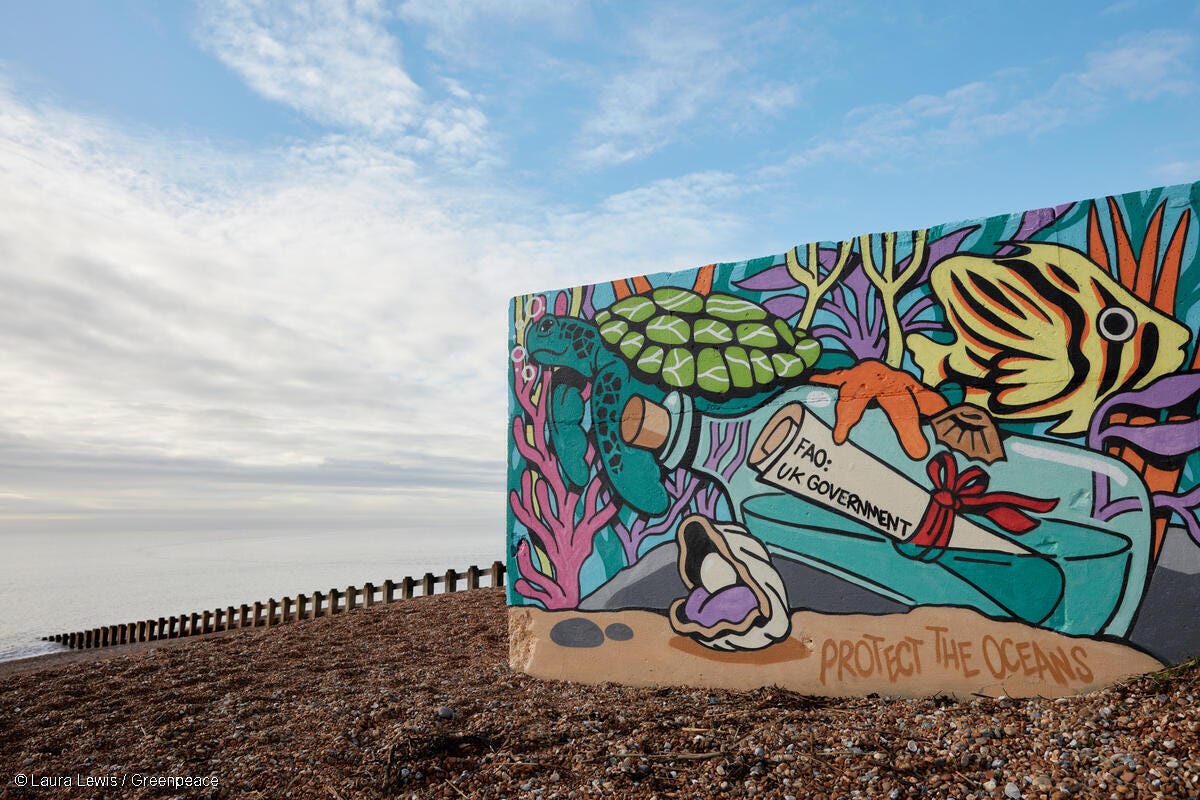
At 2.15pm on Friday, the UK formally ratified the High Seas Treaty, a global agreement designed to protect marine life across the huge stretches of ocean that lie beyond any country’s borders. Those waters cover nearly two thirds of the ocean. Until now, governments have had no single global process for creating marine protected areas across them.
That story opens a Deep Brief that moves from the United Nations to lobster pots in south west England, where fishers are finding octopuses alongside broken shells as the water warms. The third deep dive goes much deeper, into internal waves up to 300 metres high and the tiny movements climate models still have to simplify. There are three deep dives, three quick hits and one hard truth from the sea.
Deep Dives
The UK has ratified the High Seas Treaty. Here is what it is, what it can do, and what still has to happen.
The High Seas Treaty primarily concerns marine life in areas of the ocean that are not under the control of any country.
Coastal countries have rights over the waters and natural resources close to their shores. Beyond those national zones lies a vast shared ocean used by migrating whales, sharks, turtles and seabirds, as well as fishing fleets, cargo ships and scientific expeditions. These waters are known as the high seas. Together with the international seabed that also lies beyond national control, they make up what the treaty calls areas beyond national jurisdiction.
There were already rules out there. International organisations regulate shipping, fishing and seabed mining, while other agreements cover issues such as pollution and endangered species. The problem was the gaps between them. There was no single global system through which countries could propose a marine protected area and coordinate the different activities taking place inside it.
The new treaty creates that route. A country, or a group of countries, can propose an area for protection. The proposal must explain what lives there, what threatens it, how it would be managed and how success would be measured. Other governments, scientists, communities and organisations can comment before the countries that have joined the treaty make a decision.
The agreement does three other important things. It sets a process for checking the environmental damage that a planned activity might cause. It creates rules for sharing benefits from marine genetic resources, meaning biological material from ocean plants, animals and microbes that could be useful in medicine, agriculture or technology. It also promises training, equipment and scientific support for countries that would otherwise struggle to take part.
Ratification is the formal step through which a country agrees to be bound by a treaty. The UK signed the agreement in September 2023, passed the legislation needed to put it into British law, then deposited its ratification document with the United Nations on Friday. The treaty itself entered into force internationally in January and the United Nations listed 91 parties on 10 July.
Nothing became protected at 2.15pm on Friday. The agreement creates the legal machinery, while governments still have to build and operate it. They need to agree budgets and procedures, appoint scientific bodies, decide how proposals will be assessed and work out how new protections will sit beside the organisations that already regulate fishing, shipping and seabed activity.
The first Conference of the Parties will take place in January 2027. That phrase simply means the first formal meeting of the countries bound by the agreement. It may sound like another international conference, although its early decisions will shape who gets heard, what evidence is required and how quickly the first protected areas can move from proposals to decisions.
There is a fair reason for doing this carefully. A protected area with weak science, no money and no credible management plan can look impressive on a map while changing very little in the water. Countries with smaller governments and research teams also need enough support to participate on equal terms.
The same caution could slow the system for years, as fishing, shipping, pollution and climate change continue across the waters under discussion. Governments spent more than a decade negotiating the treaty. Its value will eventually be judged through the places and species it protects.
Friday secured the UK’s place at the table, and its record will be built from the protected areas it supports, the money and expertise it contributes, and the positions it takes when agreement becomes difficult.
Lobster pots in south west England are coming back with octopuses and broken shells as the sea heats up.
A photograph published by Plymouth Marine Laboratory this week shows two common octopuses inside a lobster pot in south Devon. Between them lies what is left of a lobster.
The common octopus is native to British waters, although it has usually been rare here and is more common in the warmer seas of southern Europe and the Mediterranean. Numbers began rising sharply across the south west early in 2025. The bloom, the term scientists use for a sudden rise in abundance, has continued for well over a year.
Plymouth Marine Laboratory keeps a record of marine life in the western English Channel stretching back to 1903. Professor Matt Frost described the current abundance as unprecedented within that record. PML also reported that more than 100 tonnes of common octopus passed through Brixham fish market in a single day.
Some fishers have been able to turn that arrival into an income. Jack West, a scallop fisher from Mevagissey, switched to catching octopus and built a market with local pubs and restaurants. He told PML last week that his boat was landing between 800 kilograms and 1.5 tonnes a day.
The experience has been very different for crab and lobster boats. Common octopuses are highly effective shellfish predators. Fishers have reported pots containing empty shells, damaged catch or octopuses where they expected to find lobsters and crabs. Beshlie Pool of South Devon and Channel Shellfishers described it as “a very difficult time for our community”.
Warm water appears to be a major part of the explanation, although it is not the whole story. A report involving the Marine Biological Association, Plymouth Marine Laboratory and the University of Plymouth found that every major octopus bloom recorded in the region had coincided with unusually warm conditions. Sustained easterly winds may also have carried young octopuses from the Channel Islands and northern France, while breeding that was once rare in UK waters became widespread during 2025.
The sea around Britain is unusually warm again now. A marine heatwave is a period when the water stays much warmer than the normal range for that location and season. It does not mean the sea has reached one fixed temperature. A summer temperature that is normal off Spain could still be extreme off England.
At the start of July, much of the English and Welsh coast, the English Channel and the central and southern North Sea was experiencing a Category 2 marine heatwave, classified as strong. Sea surface temperatures in those areas were roughly 1.5°C to 4°C above normal, and parts of the North Sea were forecast to reach 4°C to 5°C above average. The Met Office said some southern waters could move into Category 4, classed as extreme and rarely recorded around the UK.
The warmth is also reaching below the surface in tidally mixed places such as the Irish Sea, English Channel and southern North Sea. Temperatures around 2°C above normal have been measured at depth there, which means animals and habitats cannot necessarily escape the heat by moving a little lower in the water.
This is happening against an exceptionally warm global background. Copernicus calculated that the average sea surface temperature across the ocean between 60 degrees south and 60 degrees north reached 20.86°C in June, the highest June value in its dataset. The previous record, set in 2024, was only 0.01°C lower.
A photograph of one lobster pot cannot tell us what is happening to every lobster population around Britain. Fisher’s reports are not a national stock assessment, and researchers are still working out how temperature, winds, breeding and food availability combined to produce the bloom.
Waves up to 300 metres high are breaking inside the ocean. Scientists are still working out how to represent what follows.
A wave does not have to reach the surface to be enormous.
Deep in the South Pacific, cold water formed around Antarctica flows north through the Samoan Passage, a narrow route between underwater ridges. Instruments lowered into the passage have recorded internal waves between 200 and 300 metres high. They move inside the ocean, along the boundaries between layers of water with different densities, so a ship directly above may see almost nothing.
When one of these waves breaks, it creates turbulence. Large swirls of water break into smaller swirls, which break down again until the movement is small enough for heat, salt, oxygen, carbon and nutrients to mix between layers.
A Perspective published in Nature Communications this week looks at how these tiny movements influence the much larger ocean and, through it, the climate. A Perspective is a paper in which researchers bring together and interpret existing evidence. It is not a new experiment, and the waves in the Samoan Passage were measured during earlier expeditions.
The central problem is scale. The turbulence discussed in the paper can occur across distances ranging from a millimetre to around 100 metres. A global climate model divides the ocean into boxes that are far larger. Even the most powerful computer cannot calculate every breaking wave and swirl across the planet.
Scientists deal with this by using a simplified mathematical rule for the combined effect of all the movement taking place inside each box. This is called parameterisation. It is similar to representing the effect of millions of leaves in a weather model without calculating the movement of every leaf.
Turbulence is patchy and can become especially intense near rough seabeds, narrow passages and the edges of ocean basins. Those are expensive and technically difficult places to measure. A short burst of strong mixing can also matter more than a long period of quiet water, which makes occasional observations easy to misread.
Researchers can sometimes estimate turbulence indirectly from changes in temperature, salt and the speed of the water. The new paper says these estimates have been useful for finding areas of strong mixing, although they can be wrong by as much as an order of magnitude. In plain English, one estimate may be around ten times higher or lower than another.
This matters because mixing helps decide where heat, carbon, oxygen and nutrients end up. It contributes to the slow circulation of deep water around the planet, while also changing the supply of nutrients and the storage of carbon over periods shorter than a year.
The paper does not produce a corrected climate forecast or show that current climate models are useless. Its authors identify a part of the ocean that scientists know matters, can observe in detail at selected sites, and still struggle to represent consistently across the whole planet.
Their answer is more direct measurement, especially close to rough seabeds and ocean boundaries, combined with better rules inside the models.
Quick Hits
A four person underwater habitat has reached the seabed in Florida, although its first crew has not moved in. DEEP installed Vanguard at Tennessee Reef in the Florida Keys National Marine Sanctuary on 30 June. The complete system sits in water 17 metres deep, and its living section is designed to support four people for five days or longer. The company says future missions could include coral restoration, reef monitoring and climate research.
Every night, a vast layer of ocean life rises towards the surface and sinks again before dawn. Many fish, squid, crustaceans and tiny drifting animals spend daylight hours hundreds of metres down, where the darkness offers some protection from predators. After sunset, many travel upwards to feed before returning to deeper water. Sonar once made this mass of animals look like a false seabed that moved each night. Scientists call the journey diel vertical migration, meaning a movement that follows the daily cycle of light and darkness.
More than half of the molluscs found only around deep sea hydrothermal vents are now considered at risk of extinction. An IUCN Red List assessment published on Thursday classified 125 of 201 known vent mollusc species as threatened. These snails, limpets, mussels, clams and chitons live around cracks in the seabed where hot, mineral rich water escapes from below the Earth’s crust. IUCN identifies mineral exploration and the possibility of future commercial mining as major threats. No commercial deep sea mining is currently taking place in international waters, and the International Seabed Authority has approved exploration contracts only. More than 30 vent mollusc species living in areas closed to mining were assessed as Least Concern.
Hard Truth From The Sea
We have finally agreed on a way to protect the high seas, and scientists are still trying to understand everything happening inside them. The ocean is not going to wait for the rules or the models to catch up. A fisher in Devon can already see the change when his pot comes back with two octopuses and the remains of a lobster.
Paid subscribers fund the reporting that follows what governments do after the announcement, when the difficult work begins. If you want to support my work, please do consider upgrading to a paid subscription.
See you next week.
- Luke
Thanks for calling attention to the High Seas Treaty! The result of decades of diplomacy, scientific research, and jawboning. Big agreements like this don't come easy. The lesson is never give up!
Can you share the internal ocean wave paper reference please?
Thanks.