


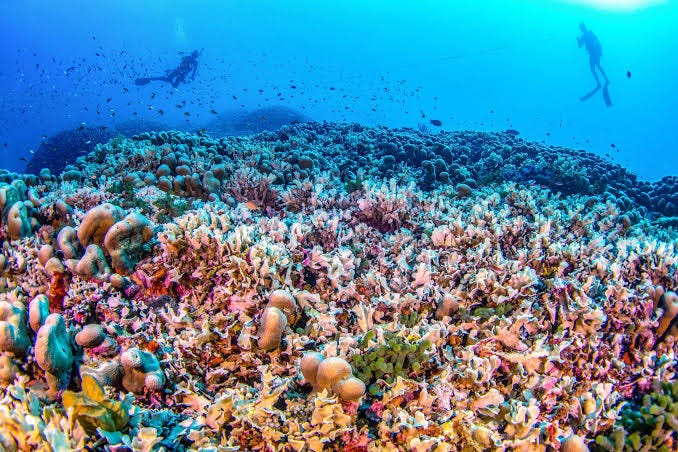
Somewhere off the Bahamas, or in a cool current near Vanuatu, there is a patch of reef that holds its colour while the coral around it bleaches white. For years, finding those pockets was mostly luck. A team of scientists has now gone looking for them on purpose and found more than they expected.
This is the good news edition, the one we run when the weeks have been heavy and the ocean has still managed to hand us something hopeful. Three deep dives. The reefs that are hanging on and the people mapping them, a first global reckoning of how much power the sea could give us, and a corner of Scotland working out how to plan for a warmer ocean without leaving its fishermen behind. Two quick hits and a hard truth to close.
Deep Dives
Scientists have mapped the coral reefs most likely to survive global warming. There are more of them than expected, and they are not where you might think.
The reef that keeps its colour is called a refugium, a place where conditions stay just kind enough for coral to survive a warming that kills its neighbours. Cool currents, some shade from the strongest sunlight, a position off the usual cyclone track. Find enough of these and you have a map of where reefs might still be alive in fifty years.
That map is roughly what a team led by the Wildlife Conservation Society has now produced. They fed 42 environmental factors and nearly 38,000 human observations of coral, gathered over 65 years, into a machine-learning model, and asked it to find the pockets where reefs are most likely to hold on. It builds on a 2018 assessment called 50 Reefs, at far higher resolution. The work identifies refugia across 72 countries and sorts them into three kinds: places that avoid the worst heat, places whose corals can withstand it, and places that bounce back fastest after bleaching.
The findings were presented in mid-June at the Our Ocean Conference in Mombasa, and are still going through peer review at the journal Environmental Research Letters, so treat the fine detail as provisional. The direction is what matters. Conservation money is finite, and a map like this tells governments and funders where protection has the best chance of lasting.
There is a person behind the caution as much as the hope. David Obura, one of the world’s most respected coral scientists, has spent his career in Mombasa watching reefs bleach. Every tenth of a degree of warming, he says, drives reefs “to the limit”. The refugia are not safe havens, only less exposed ones, and that buys time rather than guaranteeing survival. Warm the ocean far enough and even the shelters give way.
The pockets are not spread evenly. More than half sit in five countries: the Bahamas, Cuba, Australia, Indonesia and the Philippines. Others gather around small islands, in Vanuatu, American Samoa, Christmas Island and the Chagos Archipelago. That unevenness makes protecting the world’s most resilient reefs a diplomatic problem as much as an ecological one, spread across dozens of countries with very different means.
The hope here is narrow and real. For the first time at this resolution, the people who might save these reefs know where to begin.
A first global assessment says wave and tidal energy could supply a tenth of the world’s electricity. The catch is how little of it exists yet.
In the Pentland Firth, the strait between the Scottish mainland and Orkney, the tide runs hard enough to turn turbines the size of buildings. MeyGen, the tidal array anchored there, is the largest of its kind in the world, and over its life it has produced more than 80 gigawatt hours of electricity. That is a real, working number, and a tiny one against what a new report says the ocean could give us.
Launched on 29 June, Ocean Energy: The Largest Untapped Renewable Resource is described by its authors as the first global assessment of wave and tidal energy. It pulls together more than 70 government and academic studies, with contributions from the International Renewable Energy Agency and the European Commission, and concludes that ocean energy could in principle supply 13 percent of global electricity demand. That is more than all the world’s nuclear plants produce today. In Europe the figure is 21 percent, and the UK, which holds the best wave and tidal resources on the continent, is named the sector’s European ‘El Dorado’. Rémi Gruet, who runs the trade body behind the report, calls it proof that ocean energy “is not a niche technology”.
Two things temper the number. The report was published by Ocean Energy Europe, the industry’s own trade body, so its enthusiasm is not neutral. The 13 percent is also technical potential, the energy physically there to be captured, rather than a forecast of what will be built. IRENA’s own contributor put the caveat plainly, calling for better data and shared methods before too much weight is placed on any single figure.
The distance between potential and reality is the whole story here. Ocean energy supplies a rounding error of the world’s power today. The tidal electricity that does reach the UK grid is still expensive, secured at strike prices well above offshore wind. Turning a good resource map into cheap, reliable power is a long, unglamorous job of engineering and cost reduction.
The hopeful part is that the map now exists. For the first time, a government weighing whether to back wave or tidal power can see what its own waters hold, country by country. The report credits the UK’s ringfenced tidal funding, in place since 2022, with getting turbines into the water that would not otherwise be there. The resource was always out there. Knowing its size, and where it sits, is what turns it from a slogan into a plan.
In Orkney, scientists and fishermen spent two years planning for a warmer ocean together. The result is a template other coasts can use.
In the waters east of Orkney there are grounds that matter for sharks, skates and rays, species that are both a conservation priority and, for some, a commercial catch. Deciding how to protect them without shutting down the boats that work the same water is exactly the kind of problem that usually ends in a standoff.
A project called MSPACE spent two years trying to solve it in one place. Researchers from Plymouth Marine Laboratory and the universities of Essex, York and Heriot-Watt worked alongside the marine planners at Orkney Islands Council. First they built the most detailed picture yet of how climate change will reshape Orkney’s waters, its habitats, its fishing grounds and the communities that live off them. Then they sat down with the people who actually make the decisions and worked out what to do about it.
Professor Ana Queirós, who led the project, does not oversell it. The picture, she says, is sobering, with climate hotspots putting species and habitats at risk in the near term even if the world meets its current Paris commitments. Her point is that this is happening to a country usually thought of as sheltered, and that sitting still is not an option.
What came out of it is practical. The team mapped refugia worth protecting for sharks, skates and rays, identified seabed habitats worth safeguarding for both nature and fishing, and recommended shielding the North-West Orkney marine protected area from activities that disturb the seabed and release the carbon stored in it, trawling among them. Readers who followed the argument in last week’s Deep Brief will recognise that seabed carbon point. Several of the sites worth protecting turn out to sit outside the current protected network, which the researchers flag as a limit of the system rather than a gap in the science.
The reason this counts as good news is the method as much as the map. The recommendations arrived just as Orkney adopted its new statutory marine plan, so they can feed directly into how the islands manage their waters. A way of planning that begins with the people who fish and live there, rather than arriving with the answer already written, is something other coasts can copy. That is the quiet value of a place small enough to get everyone in the room.
Quick Hits
Europe has decided that keeping watch on the ocean is infrastructure worth paying for. The European Commission’s new OceanEye initiative, welcomed this week by the World Meteorological Organization and the Global Ocean Observing System, treats ocean monitoring as critical infrastructure and puts an initial €50 million behind it through the Horizon Europe programme. The money is meant to shore up the global network of floats, buoys and instruments that feed weather forecasts, early warnings and climate models. The timing is pointed. Readers of last week’s Deep Brief will remember that public funding for ocean science is being trimmed in the US and UK, and the bodies behind this announcement note plainly that the continuity of the global observing system can no longer be taken for granted. One region deciding the ocean’s vital signs are worth funding, at exactly the moment others look away, is a small piece of good news worth marking.
A Swedish machine that harvests waves, wind and sunlight at the same time is being tested in open water off Stockholm. NoviOcean’s floating platform spent the past month at sea, validating an 850 kilowatt design that puts three renewable sources on one structure, so it can keep generating when the wind drops or the sun sets. The company, which has now logged more than 500 days of testing across Sweden, the UK and France, has signed a letter of intent to explore a project in the Azores and raised fresh private money to push toward market. Keep the excitement measured. This is a prototype, full commercial deployment is still years off, and the electricity is dearer than wind or solar for now. What it represents is the slow, patient half of the energy story from the second deep dive, the actual machines being coaxed toward working at scale.
Hard Truth From The Sea
None of this week’s good news arrived by luck. The reef map exists because scientists logged nearly 38,000 coral observations over 65 years. Orkney’s plan exists because researchers sat with its fishermen for two years, and the machine off Stockholm runs because someone spent more than 500 days testing it in cold northern water. That is what hope in the ocean actually looks like, and it is being built by people who simply kept turning up.
Paid subscribers are what keep this newsletter going, through the grim weeks and the good ones like this. If you want to support the work, please consider upgrading to a paid subsciption.
See you next week.
- Luke
Fascinating insights about the reserve! I love Dr. Querios’ work…. Didn’t realize she was working on this project. Thanks!