


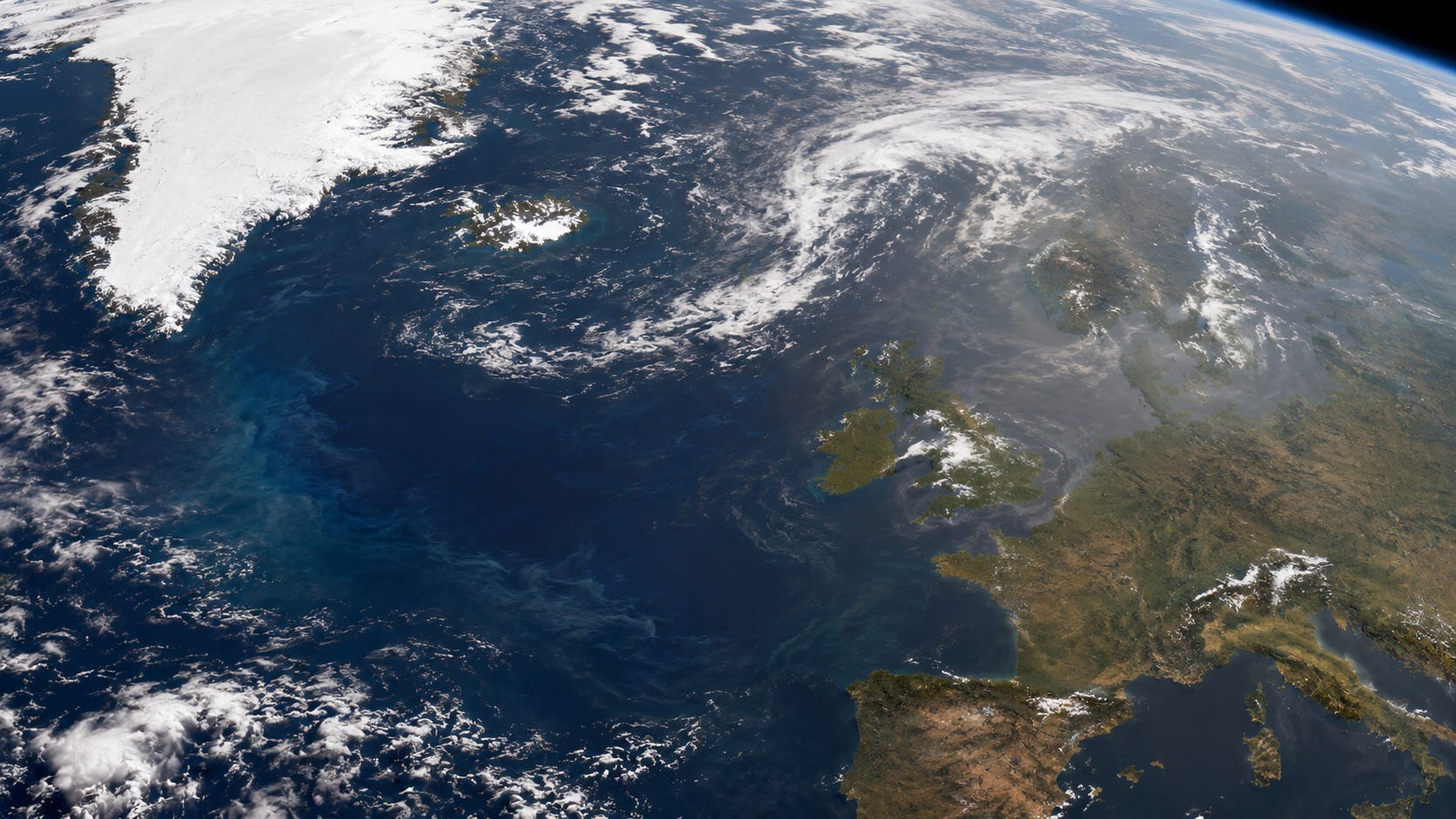
There’s a patch of the North Atlantic, south of Greenland, that’s been getting colder for decades while almost everywhere else in the ocean warms up. This week, with more than 100 million Europeans sweating through temperatures above 35°C, scientists were pointing at that cold patch of sea as one of the reasons the heat sat on the continent so hard.
That cold blob is where we’ll start. This week I’ve got three for you. The cold blob and the heatwave it might be feeding, a billionaire putting $260 million into ocean protection just as governments pull back, and a trip off Brazil that turned up 31 new species in a fortnight. Two quick hits and a hard truth after that.
Deep Dives
A cold patch of the North Atlantic keeps bucking global warming, and scientists think it’s making Europe’s heatwaves worse.
The patch sits south of Greenland and Iceland, and it’s been a puzzle for years. While the rest of the ocean has warmed, this bit of the North Atlantic has actually cooled, by up to around 0.9°C since 1900. Scientists call it the cold blob, or the warming hole. This week, with a heat dome parked over Europe, a few of them were out explaining how a cold patch of sea can help cook a continent.
It works through the jet stream, the fast river of air that runs west to east across the Atlantic and sets a lot of Europe’s weather. Where the cold blob meets warmer water, that sharp difference in temperature changes the air above it, and it can leave the jet stream slower and wavier. A wavier jet stream is more likely to park a big high-pressure system over the continent and hold it there. Marilena Oltmanns, a physicist at the University of Bremen, describes the cold front as a kind of guide, bending the jet stream north so it loops around Europe instead of crossing it, with a heat dome settling in behind.
The evidence for all this is suggestive rather than settled, and worth being honest about. A 2016 study found that cold patches in the Atlantic were a common forerunner to Europe’s big heatwaves going back to the 1980s. A 2023 study at Germany’s GEOMAR institute ran the climate models with and without the cold blob, and got longer, fiercer heatwaves when it was in the picture. Gerard McCarthy, an oceanographer at Maynooth University in Ireland, was careful about it this week. A cold Atlantic is no “get-out-of-jail-free card” on global warming, he said, and some of the hot extremes can be made worse by the blob.
What actually causes the cold blob has been argued over for a while, and a study last month had a go at settling it. A team led by Stefan Rahmstorf at the Potsdam Institute for Climate Impact Research, writing in Geophysical Research Letters, reckons the cooling comes mainly from ocean currents bringing less heat into the region, rather than heat escaping off the sea surface. That same team reads the slowdown as an early warning that the Atlantic Meridional Overturning Circulation, the conveyor of currents that carries warm water north and cold water south, is weakening. I’d flag the same caution we did back in Deep Brief #36. Plenty of scientists are worried about which way this is heading. The precise timing of any tipping point, though, still has no confident date, and Rahmstorf is one of the more alarmed voices on it.
If you’re in Britain or Europe living through this week, the unsettling bit is the loop. Greenland’s ice melts and pours freshwater into the North Atlantic, that helps cool the blob, the cooler blob shifts the currents and the air above them, and that seems to push European summers hotter still. Europe is warming faster than any continent on Earth, and a patch of cooling sea might be part of the reason.
Michael Bloomberg has put $260 million into ocean protection, aimed straight at the gap between what governments promise and what’s actually in the water.
Picture a stretch of ocean marked as protected on an official map. Now picture a trawler dragging its net along the seabed inside that same line, perfectly legally. That distance, between protection on paper and protection in the water, is what Bloomberg’s money is going after.
On 23 June, at the Earthshot Prize Impact Assembly during London Climate Action Week, Bloomberg Philanthropies announced the $260 million to expand its ocean work. The idea is to help close that gap between what’s been committed and what’s been done, with some of it going towards enforcing the High Seas Treaty, the UN deal that came into force in January 2026 and, for the first time, lets countries create protected areas out in international waters.
The numbers underneath are what make it urgent. Governments have a shared target, called 30x30, to protect 30 percent of the ocean by 2030. The World Database on Protected Areas, which tallies up what governments report, now has coverage at around 10 percent. The Marine Protection Atlas, run by the Marine Conservation Institute, looks at how much of that is actually managed well enough to keep the destructive stuff out, and it comes to 3.3 percent. Out on the high seas, which are more than 60 percent of the ocean, barely 1 percent is protected at all.
To be fair, designating a marine protected area is a real legal step, and the reported coverage genuinely has climbed over the last decade. The trouble is that a line on a chart and a proper no-take reserve in the water get counted exactly the same in the headline figure, even though only one of them actually keeps a bottom trawl out.
The timing of his pledge is pointed. It lands just as the US and UK are trimming money for climate, nature and science, the UK while scrambling to find more for defence. The UK hasn’t walked away from the ocean, to be clear. A week earlier, at the Our Ocean Conference in Mombasa, it put up £13.9 million in new Blue Planet Fund money, and it can point to more than £86 million for those programmes since 2021. Even so, Bloomberg’s one pledge is worth more than ten times that latest UK chunk. Over in the US, Lance Morgan, who runs the Marine Conservation Institute, reckons recent moves to allow commercial fishing in four big Pacific marine national monuments, which the administration says is about restoring access for American fishermen, could knock up to 0.7 percent off the share of fully protected ocean, if they survive the legal challenges coming at them.
A private fortune plugging a hole that public money is backing out of is a mixed thing to celebrate. The $260 million is real cash for monitoring, enforcement, and the slow, dull work of turning lines on a map into protection that holds, and it’s there partly because governments have left the room for it. The hard part is the thing the money is aimed at, which is keeping a trawler on the right side of a line once someone’s drawn it.
A two-week trip off Brazil turned up 31 new species, and let scientists watch deep-sea cells build their skeletons live on the ship.
A few hundred metres down off the coast of Brazil, a siphonophore drifts in the dark, a string of glassy clones that each do one job for what is really a single hunting animal. A laser scans it without ever touching it, building a 3D picture while it carries on swimming. The same fortnight turned up a fast-swimming gossamer worm, nine kinds of jellyfish, and a single-celled creature big enough to see with the naked eye.
In two weeks at sea, a team aboard the Schmidt Ocean Institute’s research vessel Falkor confirmed 31 species new to science. They were working in the ocean’s midwater, the huge stretch of water between the sunlit surface and the seafloor, which is the biggest living space on the planet and one of the least explored. Most of the animals down there are soft and jelly-like, and they fall apart the moment you haul them up in a net, which is a big part of why we still know so little about them.
The speed came down to the kit. Instead of collecting animals and describing them in a lab years later, the team imaged them where they live, using laser scanners and a shadowgraph camera bolted onto a remotely operated submersible. On board, a microscope they’ve nicknamed the Squid let them watch the living cells of a single-celled organism in 3D as it built its glass skeleton, something the institute says had never been done at sea before. Sequencing the genomes on the ship itself turned identifications that usually take years into confirmations made in days.
Karen Osborn, the chief scientist, has spent her whole career on these animals and still, by her own account, feels like she’s only getting started with them. The team reckons the pace of discovery might be a record.
There’s a governance edge to this as well as the wonder. The midwater is exactly the zone that proposed deep-sea mining and midwater fishing would disturb, and it’s hard to weigh up the cost of wrecking a habitat when you haven’t even named most of what lives in it. Every fortnight like this one widens the gap between what’s actually down there and what any rulebook has got around to accounting for.
Two honest caveats. The 31 are confirmed new by the researchers, but the formal write-ups, the bit that makes a species official, still have to be published. The findings were actually announced earlier in June, reaching a bigger audience this week through the Guardian, so this is a story coming back round rather than breaking. The animals, and the sheer amount still unnamed below the surface, are real either way.
Quick Hits
Ocean people gathered in London this week to make the case that the sea belongs in the middle of climate talks, not off to one side. The session, run by the Commonwealth Secretariat and the UK government during London Climate Action Week, was really a warm-up for COP31 in Antalya, Türkiye, and the Commonwealth summit in Antigua and Barbuda, both coming in November. The Commonwealth’s Secretary-General, Shirley Botchwey, pointed out that 49 of the bloc’s 56 members have coastlines and 25 are large ocean states, and warned that the sea is soaking up the costs of a warming planet at a rate that can’t be sustained. One of her three priorities was turning commitments into projects you can actually invest in. The honest measure of a session like this comes later, in whether the money everyone urged in June has actually moved by the time those November summits roll around.
A study mapping where ocean plastic actually harms wildlife suggests we may be cleaning up in the wrong places. The work, published last year in Nature Sustainability by Zhang and colleagues and flagged this week by the European Commission’s science service, compared where plastic collects with where animals actually live. The big garbage patches often sit where few animals are, so they may matter less than their reputation suggests. The north-eastern Atlantic, by contrast, is a real hotspot, with animals far likelier to get tangled near coasts, more than a hundred times likelier than out in the open sea. The authors flag a catch with ‘biodegradable’ gear, which breaks into bits that are easier to swallow, and note the model measures relative risk rather than absolute. It lands while the UN’s plastics treaty stays stuck, with informal talks in Nairobi from 30 June and no agreed text after two failed deadlines.
Hard Truth From The Sea
What stays with me from this week is the heat. The ocean has quietly soaked up something like nine-tenths of the extra heat we’ve trapped, which is a big part of why a brutal week in Europe wasn’t far worse. It’s been carrying that for decades, steering our weather, holding more life than we’ve ever counted, and getting pledges and maps back in return. The sea we call ten percent protected, and actually protect about three, is the same sea keeping the rest of this summer survivable.
One more thing from me this week. My latest article for Oceanographic Magazine is up: The Flamingo Revolution, on the loggerhead turtles nesting along Albania’s protected Vjosa-Narta coast and the luxury resort development rising near them. It is the public half of a longer Ocean Rising investigation landing soon for paid subscribers.
Paid subscribers fund the reporting that tracks what is changing in the ocean and who is responsible for protecting it. Please consider upgrading to a paid subscription.
See you next week.
- Luke
Thank you for your always-informative and crucial messages here. I do appreciate them each week.
Thank you for such a clear explanation of the cold blob too