


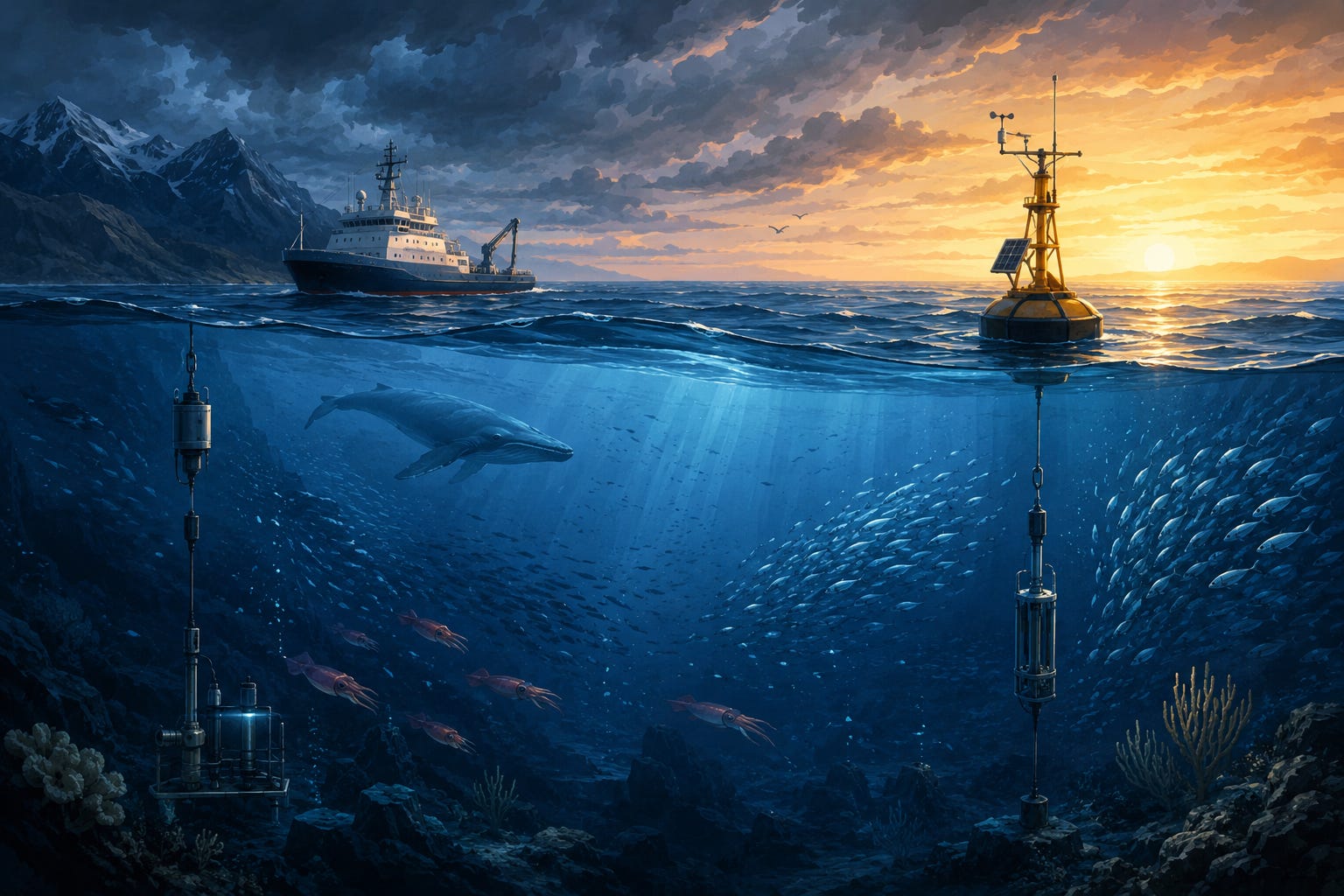
On Thursday, the Trump administration reversed its decision to dismantle the Ocean Observatories Initiative, a $368 million deep-sea monitoring network that provides real-time data on currents, storms, oxygen levels, and ocean chemistry from instruments anchored across the Atlantic, Pacific, and Southern Oceans. The reversal came after a bipartisan group of ten senators demanded the National Science Foundation back down.
Two weeks ago, this newsletter covered the global network of Argo floats that tracks the state of the ocean and warned it was being allowed to decay. This week, the US nearly lost an even larger piece of that infrastructure before Congress intervened. That story opens a Deep Brief built around the Our Ocean Conference in Mombasa, where Fiji and Panama launched the first international initiative to protect the ocean’s twilight zone, and where the EU and UK pledged a combined half a billion euros in new funding. Meanwhile, Norway approved funding for the world’s first ship tunnel through some of the roughest coastal waters on the planet. Three deep dives. Three quick hits. One hard truth from the sea.
Deep Dives
The Trump administration tried to dismantle a $368 million ocean monitoring system. It took ten senators to stop them.
The Ocean Observatories Initiative is a network of anchored and mobile instruments that has been measuring the deep ocean continuously since 2014. Its arrays sit in the Atlantic, Pacific, and Southern Oceans, collecting real-time data on temperature, salinity, oxygen, carbon dioxide, currents, and biological activity at depths that no other US system monitors. The programme cost $368 million to build, is coordinated by the Woods Hole Oceanographic Institution in collaboration with Oregon State University and the University of Washington, and costs roughly $48 million a year to operate.
In early June, the National Science Foundation announced it would dismantle the entire network, beginning with the removal of instruments from the Endurance Array off the Oregon and Washington coasts. The agency described the decision as part of a strategy to take a “nimbler approach to prioritizing support for evolving scientific priorities and emerging technologies.” Scientists disagreed. The Endurance Array provides data that feeds directly into National Weather Service forecasts, Coast Guard search-and-rescue operations, and monitoring of harmful algal blooms and El Niño events that affect fisheries, agriculture, and coastal safety.
The timing was particularly alarming. An intense El Niño event, accompanied by an associated marine heatwave, is expected off the US West Coast this summer. Removing the instruments that track those conditions in the weeks before they arrive would have left forecasters working blind. Hilary Palevsky, an oceanographer at Oregon State who uses OOI data in her research, told Eos there was “a lot of real concern” among the scientific community that the Endurance Array was being dismantled just as the event it was built to monitor was arriving.
On 15 June, a bipartisan group of ten US senators, led by Democrat Jeff Merkley of Oregon, sent a letter to Brian Stone, the acting director of the NSF, demanding a reversal. “The OOI system delivers crucial information about our ocean patterns and weather, reaching and touching all Americans,” the letter read. “The effort to dismantle this vital network, jeopardizing decades of prior research, must be reversed in order to prioritize public safety.”
On Thursday, the administration backed down. The instruments will remain in the water.
The reversal is welcome, but the pattern it reveals is not. This is the third time the Trump administration has attempted to cut funding for US ocean monitoring systems. Previous budget proposals sought to eliminate the Integrated Ocean Observing System, the separate $48 million coastal monitoring network, before Congress restored its funding. The Heritage Foundation’s Project 2025 policy blueprint, which has guided much of the administration’s approach to federal agencies, recommended that climate and weather research across the government “should be disbanded.”
For readers who followed Deep Brief #41’s coverage of the global ocean observation network and the pressure it faces, this story is the US chapter of the same problem. Continuous ocean monitoring is the infrastructure that weather forecasts, climate projections, and fisheries management depend on. It generates no profit. It has no constituency that lobbies for it. When budgets are cut, it is among the first things to go, and nobody notices until the next forecast goes wrong or the next marine heatwave arrives without warning.
Fiji and Panama have launched the first international push to protect the ocean’s twilight zone. It happened at the same conference where the EU pledged €338 million.
At the Our Ocean Conference in Mombasa this week, Fiji and Panama launched the Mesopelagic Zone Conservation Challenge, a call to governments worldwide to take concrete action to protect the layer of ocean between 200 and 1,000 metres deep, commonly known as the twilight zone.
This layer is too deep for sunlight to support photosynthesis and too shallow to qualify as the deep sea, which has left it in a governance blind spot. It sits below the jurisdiction of most fisheries management and above the attention of most deep-sea policy. It is also, as this newsletter has covered repeatedly, one of the most ecologically important parts of the ocean.
Every night, billions of tonnes of small animals rise from the twilight zone toward the surface to feed, then descend again before dawn, carrying carbon with them. This daily vertical migration is the largest synchronised movement of biomass on the planet and a significant driver of the ocean’s capacity to absorb atmospheric carbon dioxide. The creatures that live in this zone, lanternfish, squid, krill, and bristlemouths among them, are the primary food source for commercially valuable species above them. Off the Kenyan coast, where hundreds of local fishermen depend on tuna and swordfish for their livelihoods, Ocean Conservancy analysis released alongside the Mombasa announcement found that mesopelagic species make up as much as 81 per cent of swordfish diets and 46 per cent of yellowfin tuna diets. Kenya’s tuna and swordfish industry reported earnings of $3.3 million in 2023. The twilight zone is where those fishermen’s catch finds its food.
The initiative, led by Ocean Conservancy alongside the Marine Conservation Institute and Environmental Defense Fund, asks countries to take four steps: commit to protecting the mesopelagic zone in national waters, support inclusion of mesopelagic protections in the UN General Assembly Sustainable Fisheries Resolution, invest in research to fill the enormous knowledge gaps, and adopt precautionary management before industrial exploitation begins.
That last point is urgent. With improving technology and rising demand for fish protein, industries are already exploring ways to harvest twilight zone animals for fish oil, pet food, and aquaculture feed. Norway, the world’s largest krill fishing nation, has been at the forefront of mesopelagic fisheries research, and several companies are developing technologies to catch species that have never been commercially fished.
“The twilight zone serves as a gateway between the ocean’s surface and the deep sea,” said Chris Dorsett, Vice President of Conservation at Ocean Conservancy. “Under threat from climate change, growing commercial interests, and other activities, this ocean layer urgently deserves a spotlight.”
In addition to Fiji and Panama formally joining, Portugal and Vanuatu expressed support for the challenge’s goals. Whether other major fishing nations follow will determine whether this initiative becomes meaningful policy or remains a conference announcement.
Norway is about to build the world’s first ship tunnel. It will carry vessels through a kilometre and a half of solid rock to avoid one of the most dangerous stretches of water in Europe.
The Stadhavet Sea, off the western coast of Norway, is one of the roughest patches of water on the planet. Storms sweep across it roughly 100 days a year. Waves arriving from multiple directions simultaneously can reach up to 30 metres. The Stadlandet Peninsula forces every vessel travelling the Norwegian coastal route, fishing boats, cargo ships, salmon-farm transports, ferries, and cruise ships, out around an exposed headland where the conditions can change in minutes.
For decades, the solution has been to wait. Vessels anchor and sit out the weather, sometimes for days at a time, delaying perishable seafood shipments and putting pressure on Norway’s rail network as the only alternative. Tore O. Sandvik, county mayor in Trøndelag, put the cost simply: salmon exported from his region to the continent cannot be left stuck at Stad in bad weather if it is meant to arrive fresh. The delays cost money. The route costs lives. Since the end of the Second World War, 33 people have died in maritime accidents in the Stadhavet Sea. The problem is old enough that Vikings used to drag their longships over the Dragseidet isthmus, a narrow pass across the peninsula, rather than risk the open water.
Norway’s answer is to go through the rock instead of around it. The Stad Ship Tunnel will run for 1.7 kilometres through the narrowest part of the peninsula, connecting the Moldefjord on one side with the Vanylvsfjord on the other. It will be 50 metres tall and 36 metres wide, large enough to accommodate the Hurtigruten coastal ferries and cruise ships. The estimated cost is NOK 8.6 billion, roughly $900 million.
The project has been discussed for decades and has lurched between approval and cancellation multiple times. In October 2025, Prime Minister Jonas Gahr Støre told Norwegian broadcaster NRK that the tunnel was simply too expensive. Supporters refused to give up. By early 2026, the Norwegian Coastal Administration had worked with three contractor groups to reduce costs. On 7 June, initial funding of NOK 150 million, roughly $16 million, was included in the revised national budget after a deal between Norway’s centre-left parties. Final parliamentary approval was expected by 19 June. Construction is planned to begin in early 2027, with a build time of approximately five years.
The engineering is remarkable. Workers will blast and excavate roughly eight million tonnes of rock to create the passage. The tunnel will include lead-in structures built out into the water on both sides to guide ships safely through the portal. Traffic will be one-directional, managed by a control system similar to those used in road tunnels.
“We are ready to initiate the processes needed to facilitate a construction start in the beginning of 2027,” said Kystverket Director General Einar Vik Arset.
There is no precedent for this anywhere in the world. Canal tunnels exist. Road tunnels under water exist. A tunnel carved through coastal rock specifically to allow ships to avoid a dangerous stretch of open sea does not. If completed, the Stad Ship Tunnel will be a piece of maritime infrastructure unlike anything else on the planet, built for the simplest of reasons: the sea outside is too rough, and people keep dying.
Quick Hits
The European Union has pledged €338.35 million for ocean conservation, sustainable fisheries, and maritime security at the Our Ocean Conference in Mombasa. Commissioner for fisheries and oceans Costas Kadis made the announcement on 17 June at the 11th Our Ocean Conference, the first to be held on African soil. The funding covers marine protected areas, pollution reduction, climate adaptation, deep-sea biodiversity research, and fisheries enforcement. The EU’s cumulative Our Ocean pledges now run into the billions, though tracking how much of previous commitments has been disbursed and implemented remains a challenge for watchdog organisations.
The UK has committed £13.9 million to ocean communities through the Blue Planet Fund, bringing total UK investment to over £86 million since 2021. Marine Minister Emma Hardy announced the funding at the same Mombasa conference, directing it through three programmes: PROBLUE, the World Bank’s blue economy trust fund (£6.7 million), the Ocean Risk and Resilience Action Alliance (£2.2 million), and the Global Plastic Action Partnership (£5 million). The money is going to specific projects: in São Tomé and Príncipe, PROBLUE funding is reducing flood risk for more than 800 households. In Vanga Bay, Kenya, ORRAA is developing one of the world’s first marine biodiversity credit schemes in the global south.
A mysterious sound detected near the Mariana Trench in 2014 took eight years to identify. It was a whale. In October 2014, autonomous underwater gliders operated by researchers at Oregon State University recorded an unusual noise in the deep western Pacific: a low, sonorous grunt followed by a squeaky, metallic echo that sounded more like a machine than an animal. Dubbed the Western Pacific Biotwang, the sound puzzled scientists because it did not match any known whale call and was detected year-round rather than only during breeding season. In 2024, a team finally confirmed the source: Bryde’s whales, a species of baleen whale found across tropical and warm temperate oceans. The story, resurfacing this week through Popular Mechanics, is a reminder that the ocean still produces sounds that take the better part of a decade to explain.
Hard Truth From The Sea
This week, the world’s governments gathered in Mombasa and pledged hundreds of millions of euros for ocean conservation. In Washington, it took ten senators and a public outcry to stop the same government from destroying $368 million worth of ocean instruments that were already in the water and already working. Fiji and Panama asked countries to protect a layer of ocean that most people have never heard of and that industries are already preparing to exploit. Norway committed nearly a billion dollars to tunnel through a mountain because the sea on the other side keeps killing people. Somewhere off the Kenyan coast, a fisherman is pulling in swordfish whose diet is 81 per cent twilight zone. He was not in the room in Mombasa when the pledge was made. Whether his livelihood survives the decade depends on decisions made by people who were.
Paid subscribers fund the reporting that tracks what is changing in the ocean and why. If you want accountability journalism on the systems we depend on and the institutions responsible for protecting them, please condisr upgarding to a paid subscription.
See you next week.
- Luke
Fascinating as always Luke and it's the first time I have heard of the proposed tunnel.