


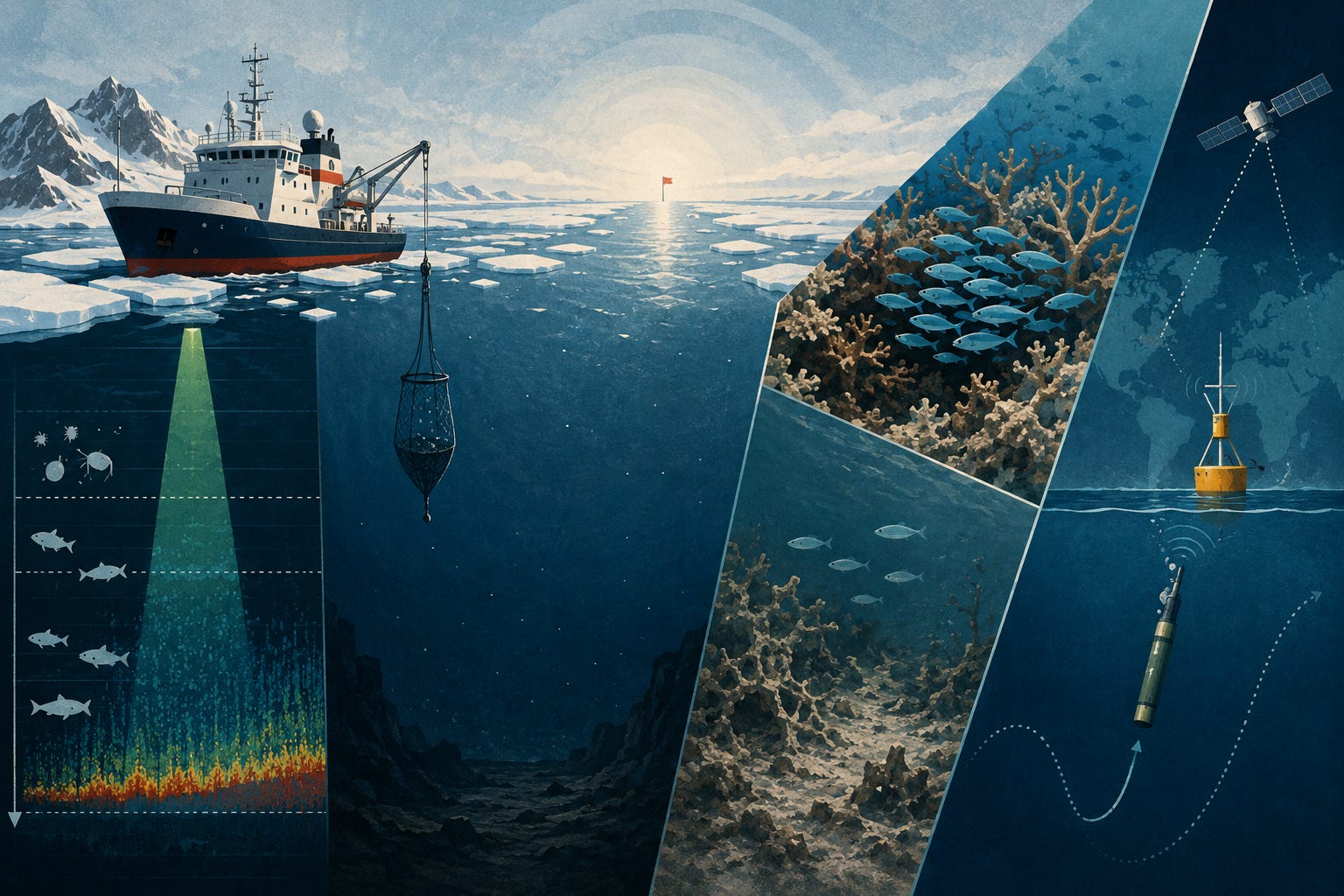
On the journey from Svalbard toward the North Pole, the research vessel Kronprins Haakon carried echo sounders and trawl nets designed to detect and collect fish. The instruments scanned the water column from the surface to 500 metres below. The trawls were lowered repeatedly through the Nansen Basin and the Amundsen Basin, the vast, ice-covered waters of the central Arctic Ocean. The scientists expected to find at least some fish. They found almost none.
That study, published this week in Communications Earth & Environment, opens a Deep Brief that also covers the quiet disintegration of social life on coral reefs under ocean acidification, and a warning that the global network of instruments tracking what is happening in the ocean is being allowed to decay at the moment its data is needed most. Three deep dives. Three quick hits. One hard truth from the sea.
Deep Dives
Researchers sailed from Svalbard toward the North Pole searching for fish. They found an ocean that was almost completely empty.
In the late summers of 2022 and 2023, scientists from the Norwegian Polar Institute and the Fram Centre in Tromsø took the research vessel Kronprins Haakon on two expeditions from the continental shelf north of Svalbard out into the deep basins of the central Arctic Ocean. Along the way, they used calibrated echo sounders, which send sound waves into the water and detect the echoes that bounce back from fish and zooplankton, and a specially adapted trawl designed to work through openings in the sea ice. The goal was to build the first systematic picture of what fish live in these waters, how deep they go, and how many are there.
Near the continental slope, conditions were relatively productive. The researchers found capelin, polar cod, and other species associated with the nutrient-rich Atlantic water that flows into the Arctic from the south. Zooplankton, the tiny animals that form the base of the food web for fish, seabirds, and marine mammals, were present in reasonable densities.
Then they crossed over the slope and into the deep basins, where the seabed drops to more than 3,000 metres and the water column is dominated by cold, low-salinity Arctic water. The transition was stark.
“When we reached the cold, deep waters, there was nothing there. It was completely empty of fish,” said Haakon Hop, a senior researcher at the Norwegian Polar Institute and one of the study’s authors.
The echo sounders, which are sensitive enough to detect individual fish, returned almost no signal. The trawl catches confirmed it: beyond the continental slope, the mesopelagic zone, the layer of water between 200 and 1,000 metres deep that in other oceans teems with lanternfish, bristlemouths, and other small deep-water species, was essentially vacant.
The findings matter for two reasons. The first is ecological. The mesopelagic zone in the North Atlantic and sub-Arctic is relatively well-populated. Its absence in the central Arctic suggests that the deep Arctic Ocean may be one of the least productive bodies of water on the planet for fish, a biological desert beneath the ice that has largely escaped scientific attention because it is so hard to reach. The study, published this week in Communications Earth & Environment, is one of the first to survey these waters systematically using both acoustic and trawl methods.
The second reason is political. The Central Arctic Ocean Fisheries Agreement, signed by ten parties in 2018, placed a moratorium on commercial fishing in the high seas of the central Arctic for at least 16 years, largely because so little was known about what lived there. This study provides the first substantial baseline, and that baseline suggests there is almost nothing to catch. The moratorium, in other words, is not protecting a fishery from exploitation. It is protecting an emptiness from becoming one.
As Arctic sea ice continues to shrink, the question of whether commercial fish species will eventually move into these waters has been debated for years. Some projections suggested that warming could open new fishing grounds. This study suggests otherwise: the deep Arctic basins lack the conditions that support fish populations, and the biological pathways that would need to develop for colonisation to occur are complex and uncertain.
Ocean acidification is breaking apart the social structures that keep reef fish alive, and the fish themselves do not seem to notice.
For small fish on a coral reef, survival depends on being part of a group. Fish in shoals spot predators faster. They forage more efficiently. The simple mathematics of dilution, more bodies meaning any one fish is less likely to be the one that gets eaten, keeps individuals alive in ways that no amount of individual vigilance could replicate.
A new study from Adelaide University, published this week in the Journal of Animal Ecology, has found that ocean acidification is quietly dismantling these social structures by degrading the reefs that make them possible.
The research team, led by Dr Angus Mitchell and supervised by Professor Ivan Nagelkerken, worked at an unusual set of coral reefs in Japan that sit near volcanic CO2 seeps on the seafloor. These seeps naturally raise the acidity of the surrounding water to levels that closely match what scientists project for the broader ocean later this century under continued carbon emissions. Some nearby reefs experience present-day chemistry. Others are warmer. Some experience both elevated temperature and acidity together. The site functions as a living laboratory for studying what climate change does to reef ecosystems, without needing to wait decades for the conditions to arrive.
What the researchers found was not what they expected. The direct effects of warming and acidification on individual fish behaviour were, in most cases, minimal. Individual fish seemed to cope. They were not disoriented, not visibly stressed, not behaving abnormally in any obvious way.
The damage was structural. On reefs where acidification had reduced the complexity of the coral, the branching structures, caves, overhangs, and crevices that provide shelter and gathering points for fish, the fish formed smaller shoals. Smaller shoals meant less social protection. Fish in those groups were more cautious, spent more time hiding, and ventured into the open less frequently.
“In the real world, fish do not experience climate change in isolation,” Nagelkerken said. “They experience it as members of communities, shaped by the habitat around them and the other individuals they live alongside. Our results suggest that even when individual fish seem to be coping fine behaviourally under climate stress, the social structures supporting their behavioural expression can quietly fall apart.”
The mechanism is indirect, which is what makes it easy to miss. Acidification dissolves the calcium carbonate that corals use to build their skeletons. As reefs lose structural complexity, the physical spaces that support large aggregations of fish disappear. The fish do not die from the acidity. They die from the loneliness that follows the loss of their habitat.
The global network of instruments watching the ocean is under pressure at the moment it is needed most.
The Global Ocean Observing System, known as GOOS, is the closest thing the world has to a continuous monitoring system for the state of the ocean. It is built from a patchwork of complementary platforms, each designed to measure different parts of the ocean in different ways, and together they underpin the weather forecasts, climate projections, fisheries management systems, and disaster warnings that modern societies rely on.
Its most visible component is Argo, a fleet of roughly 4,000 autonomous robotic floats distributed across the world’s oceans. Every ten days, each float sinks to a depth of 2,000 metres, then rises slowly back to the surface, recording temperature and salinity as it ascends. When it reaches the surface, it transmits its data via satellite to ground stations, where it is made freely available to anyone within 24 hours. The programme has been running since 2000 and has fundamentally changed how scientists understand ocean heat content, salinity trends, and sea level change.
The challenge, as a new piece in The Conversation this week describes, is maintenance. Argo floats last four to five years before their batteries fail. The fleet must be continually replenished to prevent gaps from opening up across the oceans. The expansion to OneArgo, which would add biogeochemical sensors, deep-diving floats capable of reaching 6,000 metres, and instruments designed for marginal seas and polar waters, requires sustained international funding that is not yet secured.
New Zealand provides a case study in what smaller countries can contribute: the research vessel Kaharoa has deployed more than 1,100 Argo floats for international partners across the Pacific and Southern Oceans since 2004. Elephant seals fitted with sensors collect data beneath polar sea ice in regions no other instrument can easily reach.
The piece, written by scientists involved in the programme, argues that national ocean observing strategies need to be developed, that ocean observations should be embedded in climate adaptation planning, and that governments should recognise ocean data as critical infrastructure.
The argument has particular force this week. Deep Brief #37’s good news edition covered the Rothera Time Series in Antarctica, 28 years of weekly water sampling sustained by scientists who kept going out in a boat regardless of whether anyone was paying attention. The GOOS story is the global version of the same principle: continuous measurement is the infrastructure that everything else depends on, and it is the first thing to be cut when budgets tighten. The instruments do not lobby for themselves. If governments do not fund them, the data stops, and nobody notices until the next forecast goes wrong.
Quick Hits
Ninety-eight per cent of Europeans say protecting marine life is important, but only 14 per cent identify underwater noise as a threat to the ocean. A survey conducted by Ipsos for the International Fund for Animal Welfare across France, Germany, the Netherlands, Spain, and Sweden in March 2026 found that once the impact of shipping noise on marine mammals was explained, 89 per cent of respondents said the issue should be addressed urgently, and more than 80 per cent supported practical measures including mandatory ship speed reductions. IFAW is calling on the EU to integrate ship speed limits into the revised Marine Strategy Framework Directive and the upcoming European Ocean Act. The gap between the 98 per cent who care and the 14 per cent who know about noise is itself the finding: the problem is not public indifference, it is public invisibility.
The European Commission has launched a public consultation on the European Ocean Act, with responses open until 16 July 2026. The Ocean Act, a key legislative proposal under the European Ocean Pact adopted in June 2025, aims to consolidate all EU economic, climate, environmental, and social targets for the ocean into a single legal framework. It would modernise maritime spatial planning, create a legal basis for the EU’s OceanEye observation initiative, and align with the ongoing revision of the Marine Strategy Framework Directive. The Commission plans to adopt the legislative proposal by the end of 2026. Whether it delivers meaningful enforcement mechanisms or becomes another layer of aspiration without teeth remains to be seen.
A great white shark has been caught in the western Mediterranean for the first time in years, and scientists are asking whether warming seas could push the species further north. A juvenile great white, just over two metres long and weighing between 80 and 90 kilograms, was captured in Spanish Mediterranean waters in April 2023. The finding, published this year in Acta Ichthyologica et Piscatoria, contributes to a slow accumulation of evidence that sub-tropical species are expanding their range as ocean temperatures rise. Great whites already frequent the Bay of Biscay. Whether they will eventually appear in Irish or British waters is speculative, but the direction of travel, for this species and many others, is northward.
Hard Truth From The Sea
Scientists sailed into the central Arctic and found an ocean almost completely empty of fish. On coral reefs in Japan, fish are forming smaller groups because the structures they gather around are dissolving. The global network of instruments that tracks what is happening in the ocean is running on batteries that last five years, and the funding to replace them is not guaranteed. Each of these stories describes a different kind of absence: the absence of life where life was expected, the absence of shelter where shelter once existed, the absence of commitment to the measurement systems that would tell us how much we are losing. The ocean is full of things that are quietly disappearing. The question is whether we are watching closely enough to notice before they are gone.
Paid subscribers fund the reporting that tracks what is changing in the ocean and why. If you want accountability journalism on the systems we depend on and the institutions responsible for protecting them, please consider upgrading your subscription.
See you next week.
- Luke
Iron fertiliser and surface cooling until fish comes back?