


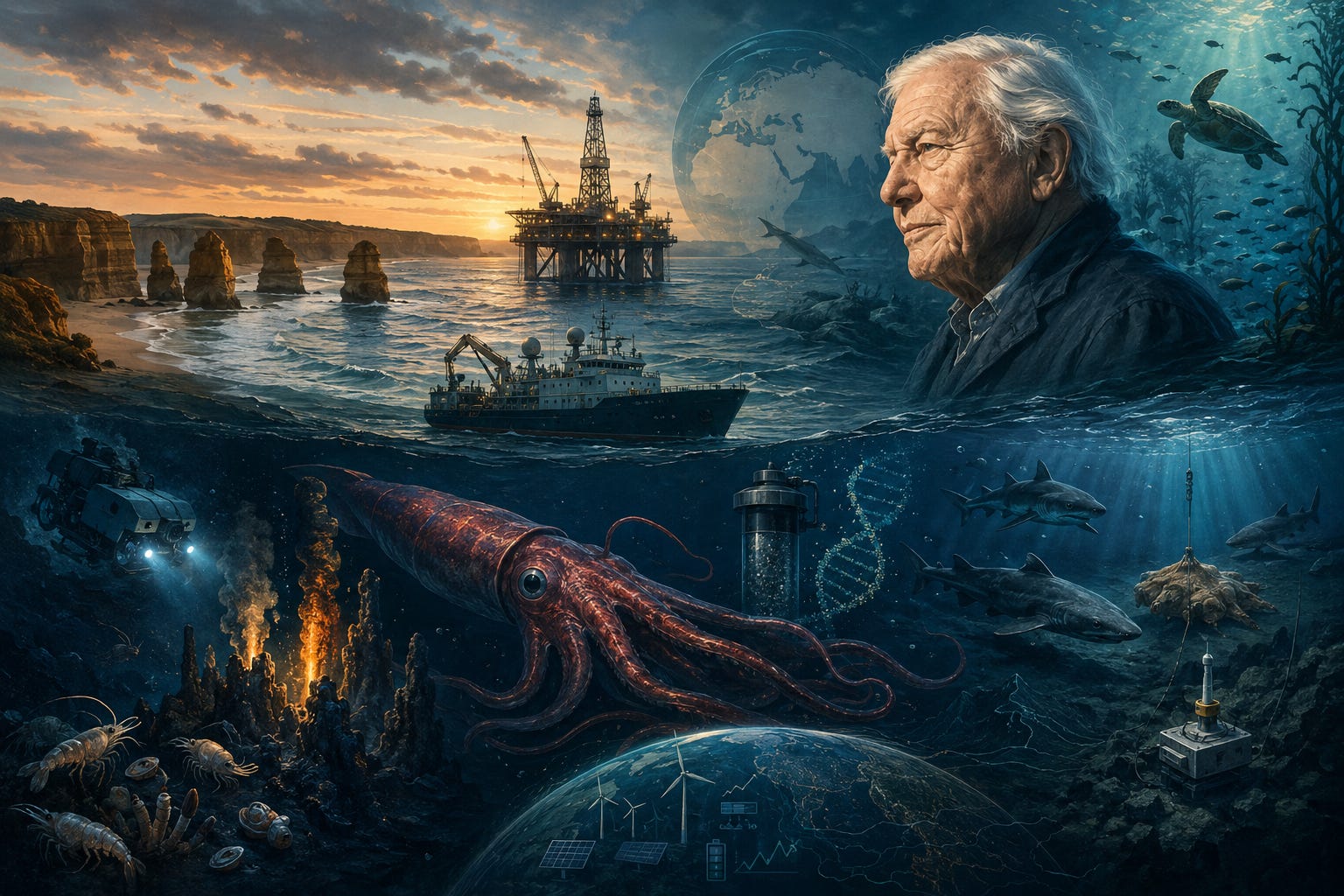
Somewhere off the Ningaloo coast of Western Australia, in a submarine canyon that drops to more than four and a half kilometres, a giant squid shed a few cells into the surrounding seawater. It may have brushed against a rock, expelled waste, or simply moved through the water column. The cells drifted. Months later, a team of scientists on the research vessel Falkor filtered a sample of that water, extracted the DNA it contained, and matched it to Architeuthis dux, the largest invertebrate on the planet. Nobody saw the animal. Nobody needed to. Its genetic signature was enough.
That story leads this week’s Deep Brief, alongside a new gasfield approval ten kilometres from the Twelve Apostles on Australia’s Great Ocean Road, and a reflection on what David Attenborough, who turned 100 yesterday, showed the world about the ocean and what governments have done with the knowledge since. Three deep dives. Three quick hits. One hard truth from the sea.
Deep Dives
A giant squid’s DNA has been found in Western Australian waters for the first time in over 25 years. It was one of 226 species detected by filtering seawater.
Scientists from Curtin University, the University of Western Australia, and the Western Australian Museum collected more than 1,000 water samples from the deep Cape Range and Cloates submarine canyons off the Ningaloo coast, roughly 1,200 kilometres north of Perth, at depths reaching 4,510 metres. They were looking for environmental DNA, the genetic material that every living animal sheds invisibly into the water around it through skin cells, waste, mucus, and reproductive material.
From those samples, the team identified 226 species across 11 major animal groups. Among them: the giant squid (Architeuthis dux), detected in six separate samples from both canyons, the first record of the species in Western Australian waters in more than a quarter of a century and the northernmost confirmed detection of giant squid in the entire eastern Indian Ocean.
Giant squid can grow longer than a school bus, typically between 10 and 13 metres, and weigh up to 275 kilograms. Their eyes, at up to 30 centimetres in diameter, are the largest of any animal on Earth. Despite their size and near-global distribution, they are almost never seen alive. Fewer than a dozen have been filmed in their natural habitat in the deep ocean.
The survey also detected Cuvier’s beaked whales, the deepest-diving mammals known to science, pygmy sperm whales, sleeper sharks, the faceless cusk eel, and the slender snaggletooth. Dozens of species had never been recorded in Western Australian waters before. Some of the DNA sequences did not match anything in existing genetic databases, meaning they may belong to species that have not yet been formally described.
The study, published this week in the journal Environmental DNA, was conducted aboard the Schmidt Ocean Institute’s research vessel Falkor. Lead author Georgia Nester, who carried out the research as part of her PhD at Curtin University and is now at the University of Western Australia, described the results as transformative. “With eDNA, a single water sample can tell us about hundreds of species at once,” she said. “That means we can dramatically expand our understanding of deep-water environments in a way that simply hasn’t been possible before.”
The implications stretch beyond Western Australia. Environmental DNA surveys are fast, non-invasive, and scalable. They do not require scientists to see, capture, or disturb any animal. A single filtered water sample from a deep-sea canyon can reveal the presence of species that traditional surveys using nets, cameras, or submersibles might never detect. For regions of the ocean that are too deep, too remote, or too expensive to survey by conventional means, which is most of the deep ocean, eDNA may be the only realistic way to establish what lives there.
“Deep-sea ecosystems are vast, remote and expensive to study, yet they face growing pressure from climate change, fishing and resource extraction,” said Zoe Richards, a co-author and associate professor at Curtin University. “You can’t protect what you don’t know exists.”
Australia has approved a new gasfield ten kilometres from the Twelve Apostles. The government that greenlit it has a 95 per cent renewable energy target.
The Victorian and Australian federal governments, both Labor, announced on Thursday that they had granted a production licence for Amplitude Energy’s Annie gasfield in the Otway Basin, off the coast of Victoria. The site sits roughly nine kilometres offshore from Peterborough and Port Campbell, on the Great Ocean Road, about twelve kilometres west of the Twelve Apostles, one of Australia’s most visited natural landmarks and a designated marine national park.
Federal Resources Minister Madeleine King said the project would supply gas exclusively to the domestic market, easing the risk of potential shortfalls on Australia’s east coast. Amplitude Energy estimates the field will supply about four per cent of east coast gas demand for five years. Gas from the Annie field, in water depths of roughly 55 metres, will be processed at the existing Athena plant. Production is expected by 2028.
The approval is the second major gas project Labor has authorised this term, following the 2022 Victorian election in which then-Premier Daniel Andrews campaigned heavily on reviving the State Electricity Commission and accelerating the transition to renewables. Victoria has a legislated target of 95 per cent renewable energy by 2035.
For environmentalists, the approval undercuts the government’s own climate ambitions. Approving new fossil fuel extraction while pursuing aggressive renewable energy targets sends contradictory signals. The argument from government is that the transition requires bridging fuel to maintain energy security during the shift from coal and gas to renewables, and that domestic gas supply reduces reliance on more carbon-intensive imports.
The counter-argument, made by conservation and climate groups, is that new gas infrastructure locks in emissions for the life of the asset and that alternative sources of energy security, including battery storage, demand management, and accelerated renewable build-out, are available and increasingly cost-competitive. The presence of the gasfield near a marine national park adds an environmental dimension beyond carbon: the risk of operational discharges, spills, and acoustic disturbance to a stretch of coastline that is nationally significant for both tourism and marine biodiversity.
This story will be familiar to readers of this newsletter. In Australia, as in the UK, the gap between what governments promise on climate and what they approve in practice continues to widen. Whether the Annie gasfield turns out to be a necessary bridge or an unnecessary lock-in depends on how fast the renewable transition actually moves, and on whether the government that approved it is held to its own targets.
David Attenborough turned 100 yesterday. The ocean he showed the world is in worse shape than when he started filming it.
David Attenborough was born on 8 May 1926. Yesterday, on his 100th birthday, he remains the most recognisable voice in nature broadcasting and one of the most trusted figures in public life anywhere in the world. His career spans the transition from black-and-white studio television to 4K underwater cinematography. His programmes, from The Blue Planet in 2001 to Ocean in 2025, have brought the deep sea, coral reefs, open ocean ecosystems, and the creatures that inhabit them into hundreds of millions of living rooms.
What Attenborough did, more than any other broadcaster, was show people the ocean as a living system rather than a backdrop. The Blue Planet and its sequel Blue Planet II revealed the complexity of marine ecosystems in ways that shifted public attitudes. Blue Planet II in particular is widely credited with sparking a global movement against single-use plastics, leading several countries to introduce bans or restrictions. His 2025 feature-length documentary Ocean, now streaming on Disney+, went further, including footage of bottom trawlers ploughing up the seabed off the UK coast.
The New Statesman, in a piece published to mark his birthday, argues that governments must honour his legacy with action rather than warm words and commemorative stamps. The piece, written by Greenpeace’s Will McCallum, calls on the UK to use the Global Ocean Treaty to protect areas of the Atlantic, to ensure its marine protected areas are genuinely managed, and to implement a full ban on bottom trawling.
The timing is pointed. Last week’s Deep Brief covered the UK Marine Strategy report, which found that 13 of 15 indicators of ocean health are failing, uncertain, or declining, despite 377 marine protected areas covering 38 per cent of UK seas. Attenborough’s legacy includes both what he showed us and the uncomfortable question of whether knowing about the ocean’s wonders and its decline has produced commensurate action. The evidence, on his 100th birthday, suggests it has not.
Attenborough himself has shifted from traditional broadcaster to something closer to a campaigner in recent years, using his authority to advocate for systemic change. His witness statement film A Life on Our Planet (2020) laid out both the problem and his proposed solutions. Whether those solutions are adopted is no longer a question for Attenborough. It is a question for the people who grew up watching his programmes and now hold the positions of power that could deliver them.
Quick Hits
The deepest hydrothermal vents on Earth sit nearly five kilometres below the Caribbean Sea, and they are teeming with life. The Beebe Vent Field, discovered in 2010 by the crew of the RRS James Cook in the Cayman Trough, lies at 4,968 metres depth. Water erupting from its black smoker chimneys reaches 401°C but does not boil because the pressure at that depth is roughly 500 times atmospheric pressure. Despite the extreme heat and total darkness, the vents support thriving communities of shrimp, snails, and microbial life that derive their energy from chemical reactions rather than sunlight, a process called chemosynthesis. Discover Wildlife published a detailed profile of the Beebe field this week, and it is worth reading for anyone interested in the conditions under which life can persist.
Researchers in China sank a cow carcass to 1,629 metres in the South China Sea to mimic a whale fall, and eight Pacific sleeper sharks showed up. The study, published in Ocean-Land-Atmosphere Research in June 2025 and resurfacing in coverage this week, documented the first recorded appearance of Pacific sleeper sharks in the South China Sea, significantly expanding the known range of a species typically associated with the cold deep waters of the Bering Sea, the Gulf of Alaska, and Baja California. The researchers at Sun Yat-sen University observed larger sharks tearing aggressively at the carcass while smaller individuals circled and waited, suggesting a feeding hierarchy. Every shark observed was female, raising the possibility that the South China Sea may serve as a nursery ground for the species.
Scientists in Halifax are testing whether adding alkaline minerals to seawater can help the ocean absorb more carbon dioxide. Planetary Technologies is running one of the world’s first coastal ocean alkalinity enhancement projects in Halifax Harbour, Canada, introducing alkaline minerals through the cooling water discharge pipe of a natural gas power plant. Researchers from Duke University deployed instruments in August 2025 to measure how the surrounding ecosystem is responding. Ocean alkalinity enhancement works by reducing seawater acidity, which increases its capacity to absorb and store atmospheric CO2 for centuries. The approach is gaining attention as a potential complement to emissions reductions, though questions about ecological impact, monitoring, and scale remain unresolved.
Hard Truth From The Sea
David Attenborough turned 100 yesterday. He spent a career showing people what lives in the ocean, and in doing so made it harder for anyone to claim they did not know. That knowledge has not translated into proportionate action. The UK still allows bottom trawling in its marine protected areas. Australia approves new gasfields within sight of its most famous coastline. And in a canyon off Western Australia, a giant squid leaves its DNA in the water for scientists to find, in a region so unexplored that more than 200 species had never been recorded there before. Attenborough’s gift was wonder. The question his centenary poses is whether wonder, on its own, was ever enough.
Paid subscribers fund the reporting that tracks what is changing in the ocean and why. If you want accountability journalism on the systems we depend on and the institutions responsible for protecting them.
See you next week.
-Luke
This tells us that despite advocacy to protect our oceans by a world figure, Governments, including our own are not listening and put political expediency above the planet’s survival. To say that they are venal would be an understatement.
awesome piece! especially the Halifax experiment sounds like it would a good idea to get updates from it when more information is shared.