


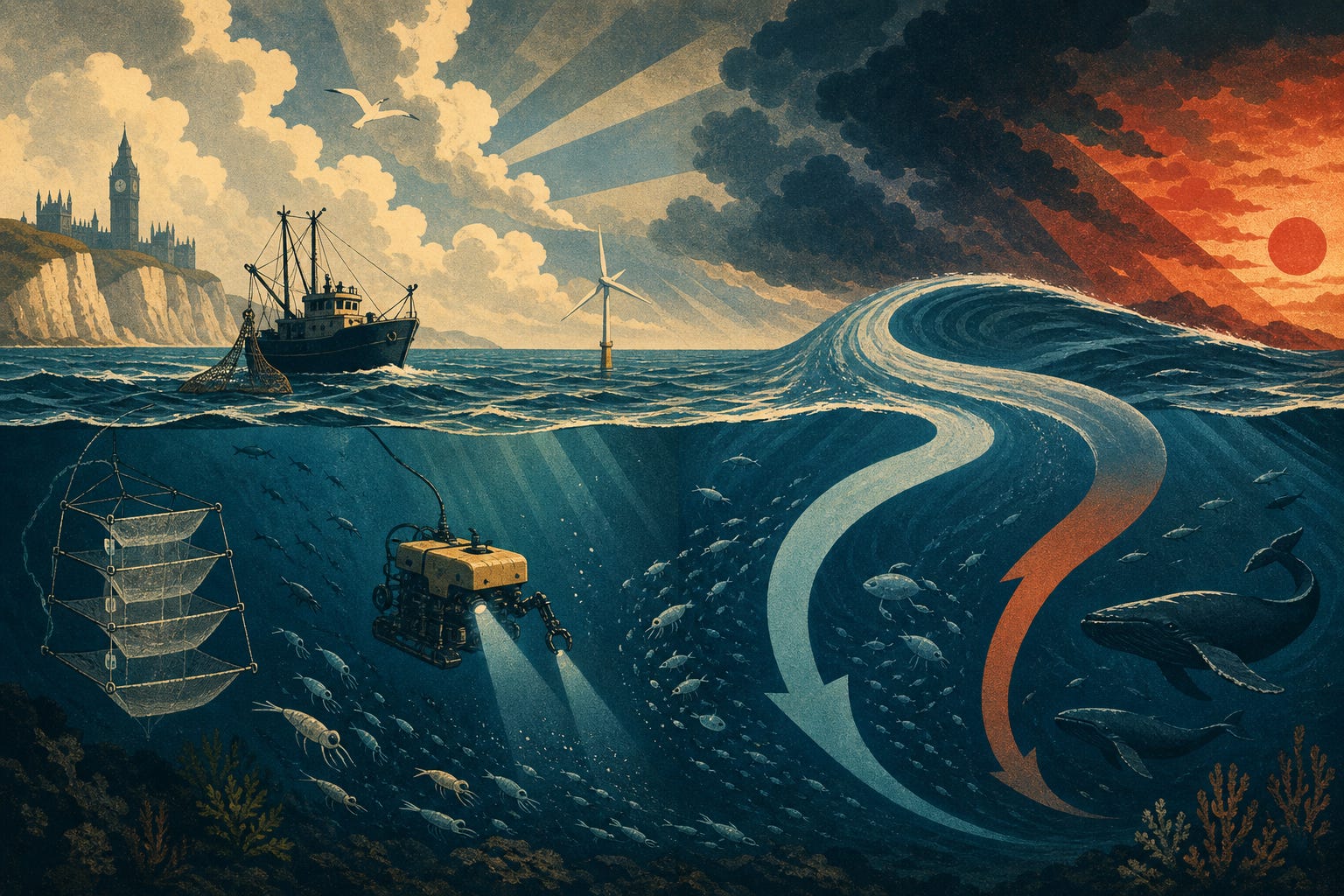
The UK protects 38 per cent of its seas by law. It has 377 marine protected areas. It committed, years ago, to achieving what the government calls “good environmental status” across 15 measures of ocean health. This week, the Department for Environment, Food and Rural Affairs published its latest assessment. Of those 15 measures, two are meeting the standard. The other 13 are failing, uncertain, or getting worse. The target date for achieving the standard was 2020.
That story opens this week’s Deep Brief, alongside a new study suggesting the Atlantic’s great overturning circulation could weaken by half this century, far more than previous models predicted, and two research expeditions that sent a robot and a net system into the deep Atlantic to track how the largest daily animal migration on Earth moves carbon out of the atmosphere.
Deep Dives
The UK protects a third of its seas. Its own government report says the ocean is still in decline.
The UK Marine Strategy report, published by Defra in April 2026, assesses the health of UK seas against 15 indicators covering everything from fish populations and seabed habitats to marine litter, underwater noise, and contamination of seafood. The benchmark is good environmental status, a standard the UK committed to reaching by 2020 under the UK Marine Strategy Regulations, which originally derived from the EU Marine Strategy Framework Directive.
Only two of the 15 indicators clearly meet that standard. Fish communities are deteriorating. Seabed habitats continue to decline. Marine bird populations are falling. Contamination levels in some species remain above safe thresholds. The assessment notes that while climate-related pressures, including rising sea surface temperatures, more frequent marine heatwaves, ocean acidification, and oxygen depletion, are evident across many indicators, most have not yet identified climate change as the primary driver of their current status. The primary drivers, for now, remain overfishing, habitat damage from bottom-contact fishing gear, pollution, and nutrient runoff.
The gap between the UK’s marine protection on paper and its ocean health in practice is the central tension. The country now has 377 marine protected areas covering 38 per cent of its waters, a figure that comfortably exceeds the 30 per cent target that governments agreed to at the UN Biodiversity Conference in 2022. The problem, as conservation groups have argued for years, is that designation without meaningful management achieves very little.
“Continued massive overfishing, refusal to ban bottom trawling even in supposedly protected areas and non-existent monitoring or enforcement means it’s hardly surprising that the seas are in such a bad state,” said Jonny Hughes, Fisheries Policy Lead at the Blue Marine Foundation.
Oceana UK echoed the criticism. Izzy Ross, Oceana’s fisheries campaigner, said MPAs had to be more than “lines on a map” and pointed out that the government’s own deadline for achieving good environmental status had passed five years ago.
The report itself acknowledges that “more remains to be done” and notes “encouraging signs of recovery” in some areas, though it does not specify which indicators are improving or by how much. Defra has not announced any new enforcement measures or management changes in response to the findings.
For readers of this newsletter, the UK report card is a case study in a pattern visible across many maritime nations: governments count protected areas as a measure of progress while the ecosystems inside those areas continue to decline. Protection that does not change what happens in the water is not protection. It is cartography.
A new study says the AMOC could weaken by half this century, far more than previous models predicted.
Three weeks ago, Deep Brief #36 covered research showing that the Atlantic Meridional Overturning Circulation (the word meridional just means running north to south) had weakened by roughly 10 per cent between 2004 and 2023, based on mooring array data from four locations across the Atlantic. That study, led by Qianjiang Xing at the University of Miami and published in Science Advances, provided the strongest direct observational evidence so far that the system is slowing.
This week, a separate team has published a study in the same journal that asks a different question: how much worse could it get?
The answer, according to a team led by Valentin Portmann at the Inria Centre de recherche Bordeaux Sud-Ouest in France, is significantly worse than most climate models have predicted. Their study projects that the AMOC could weaken by 51 per cent by 2100 under medium to high emissions scenarios. That figure is around 60 per cent higher than the average projection produced by standard climate models.
The reason for the discrepancy is methodological. Portmann’s team identified two systematic errors running through many of the most widely used climate models: they simulate the South Atlantic as not salty enough and the North Atlantic as too cold. Both biases cause the models to underestimate a key process in which dense, salty water sinks at the northern end of the system and drives the entire circulation. After correcting for both biases using a statistical technique called ridge-regularised linear regression, the projected weakening rose substantially and the uncertainty around the estimate dropped.
The study tested four emissions scenarios. Three of them, ranging from medium to very high, converged on a similar outcome of roughly 50 per cent weakening, suggesting that beyond a certain threshold of emissions, much of the damage may already be locked in by the heat the ocean has already absorbed. The most optimistic scenario, representing aggressive and sustained emissions reductions, produced a weakening of only around 20 per cent.
A 51 per cent weakening would not be a collapse, and the study’s authors are careful to distinguish the two. The Intergovernmental Panel on Climate Change has said it has medium confidence that a full AMOC collapse will not occur before 2100. What each additional weakening does, however, is push the system closer to a tipping point, the threshold beyond which the circulation reorganises into a fundamentally weaker state that could take thousands of years to reverse. Where that threshold sits is unknown.
The consequences of the kind of weakening Portmann’s study projects would include colder, harsher winters across Northern Europe, a southward shift of tropical rain belts threatening monsoon systems that hundreds of millions of people in West Africa and South Asia depend on for food, and accelerated sea level rise along the US East Coast. A 2025 study published in Geophysical Research Letters found that in a full collapse scenario, cold extremes could reach minus 20°C in London and minus 48°C in Oslo, even with greenhouse-driven global warming pushing temperatures up everywhere else.
“We have put a lot of heat into the ocean that is going to cool down over centuries,” Portmann told BBC Science Focus. “But on the other hand, you can say that before the tipping point, we can avoid a severe weakening with a strong reduction of CO2.”
Two research expeditions sent a robot and a deep-sea net system into the Atlantic to track how animals move carbon out of the atmosphere.
Every night, across the entire ocean, trillions of small animals rise from the deep toward the surface to feed. Before dawn, they descend again, carrying the carbon they consumed at the surface back down to depths of 200 to 1,000 metres, where it can be stored for decades to centuries. This daily cycle, called diel vertical migration (the word diel means happening over a 24-hour period), is the largest synchronised movement of biomass on the planet and a significant but poorly measured component of the ocean’s ability to absorb carbon dioxide from the atmosphere.
Two back-to-back expeditions aboard the Schmidt Ocean Institute’s research vessel Falkor (too), working in the Southwest Atlantic off the coast of Brazil and Uruguay, have been investigating the mechanics of this process and the broader question of how carbon moves through the ocean’s interior.
The first expedition, called “Animals as Living Bioreactors” and led by Anitra Ingalls of the University of Washington, focused on the animals themselves. The team used the remotely operated vehicle SuBastian and a system of deep-sea nets called MOCNESS (an acronym for Multiple Opening and Closing Net and Environmental Sensing System, essentially a stack of nets that can be opened and closed at specific depths to sample different layers of the water column) to collect animals at various stages of their nightly migration. Among the questions the researchers are pursuing is whether the gut microbiomes of migrating animals are transforming the food they eat at the surface into essential nutrients, including vitamin B12, for organisms living in deeper waters. Many of the animals collected are new to the South Atlantic record, and some are likely new species.
The second expedition, called SUBSEA (Subtropical Underwater Biogeochemistry and Subsurface Export Alliance), was led by Matthew Church of the University of Montana and focused not on animals but on phytoplankton, the microscopic algae that form the base of the ocean food web. Church’s team worked more than 200 miles offshore in the Southeastern Atlantic Gyre, one of the vast, nutrient-poor regions that make up more than half the ocean’s surface. These gyres are often described as ocean deserts because their surface waters contain so few nutrients, but Church’s team was looking beneath the surface. Phytoplankton living at depth in gyres, below the sunlit surface layer, may be playing a larger role in carbon cycling than scientists previously recognised.
Together, the two expeditions address a gap in climate science that has persisted for decades: how much carbon the ocean’s biological pump actually moves, and how much of that movement is driven by living animals rather than by the passive sinking of dead organic material. Estimates of the contribution of diel vertical migration to total carbon export have ranged from 10 per cent to as high as 80 per cent, depending on the region and the study. The uncertainty is enormous, and resolving it matters because the ocean’s capacity to absorb atmospheric carbon dioxide is central to every climate projection.
Quick Hits
A humpback whale named Timmy is being transported by barge from the Baltic Sea toward the North Sea after weeks of failed rescue attempts. The whale has been stranded in shallow waters near the German city of Lübeck since 3 March, far from its natural habitat in the Atlantic. Multiple attempts to guide it toward deeper water failed. In early April, German authorities gave up, saying they believed the animal could not be saved. Private entrepreneurs then stepped in, funding a rescue operation that lifted Timmy into a flooded cargo barge. The barge, towed by two tugboats, began its journey on 29 April, heading around the northern tip of Denmark via the Skagerrak strait toward the North Sea. The journey will take roughly three days. Scientists are divided on whether the whale is strong enough to survive the trip or will find its way to the open Atlantic if released. Fans are tracking Timmy’s journey in real time. “You could see that the whale fought and wanted to live,” Karin Walter-Mommert, one of the entrepreneurs financing the rescue, told the German newspaper Bild.
The world’s first purpose-built offshore platform for ocean thermal energy conversion has been installed in the Canary Islands. UK-based Global OTEC completed the deployment of its floating platform prototype this week, marking a milestone for a technology that has been discussed for decades but never scaled offshore. Ocean thermal energy conversion, or OTEC, generates electricity by harnessing the temperature difference between warm surface seawater and cold water drawn from the deep ocean. The technology offers continuous, baseload power without the intermittency problems of wind and solar, and it targets a specific market: tropical island nations where most electricity is still generated from imported diesel and heavy fuel oil. Global OTEC estimates that more than 25 gigawatts of existing fossil fuel capacity across tropical islands could eventually be replaced by OTEC systems. Whether the technology can move from prototype to commercial deployment remains the open question.
Hard Truth From The Sea
The UK protects 38 per cent of its seas and 13 of 15 health indicators are failing. The AMOC is weakening faster than the models predicted, and corrections to those models suggest the models were wrong in a direction that made things look better than they are. The ocean’s biological pump moves carbon from the atmosphere to the deep, and scientists are only now sending robots to measure how much. Each of these stories describes a version of the same problem: the distance between what we claim to know about the ocean and what we have actually bothered to measure. The ocean does not wait for our instruments to catch up.
Paid subscribers fund the reporting that tracks what is changing in the ocean and why. If you want accountability journalism on the systems we depend on and the institutions responsible for protecting them, please consider upgrading your subscription.
See you next week.
- Luke
As always essential reading shame the politicians don’t do so
Failure of enforcement is the same as deregulation.
Governments regulations are meaningless as long as private interests are allowed to operate outside the law.