


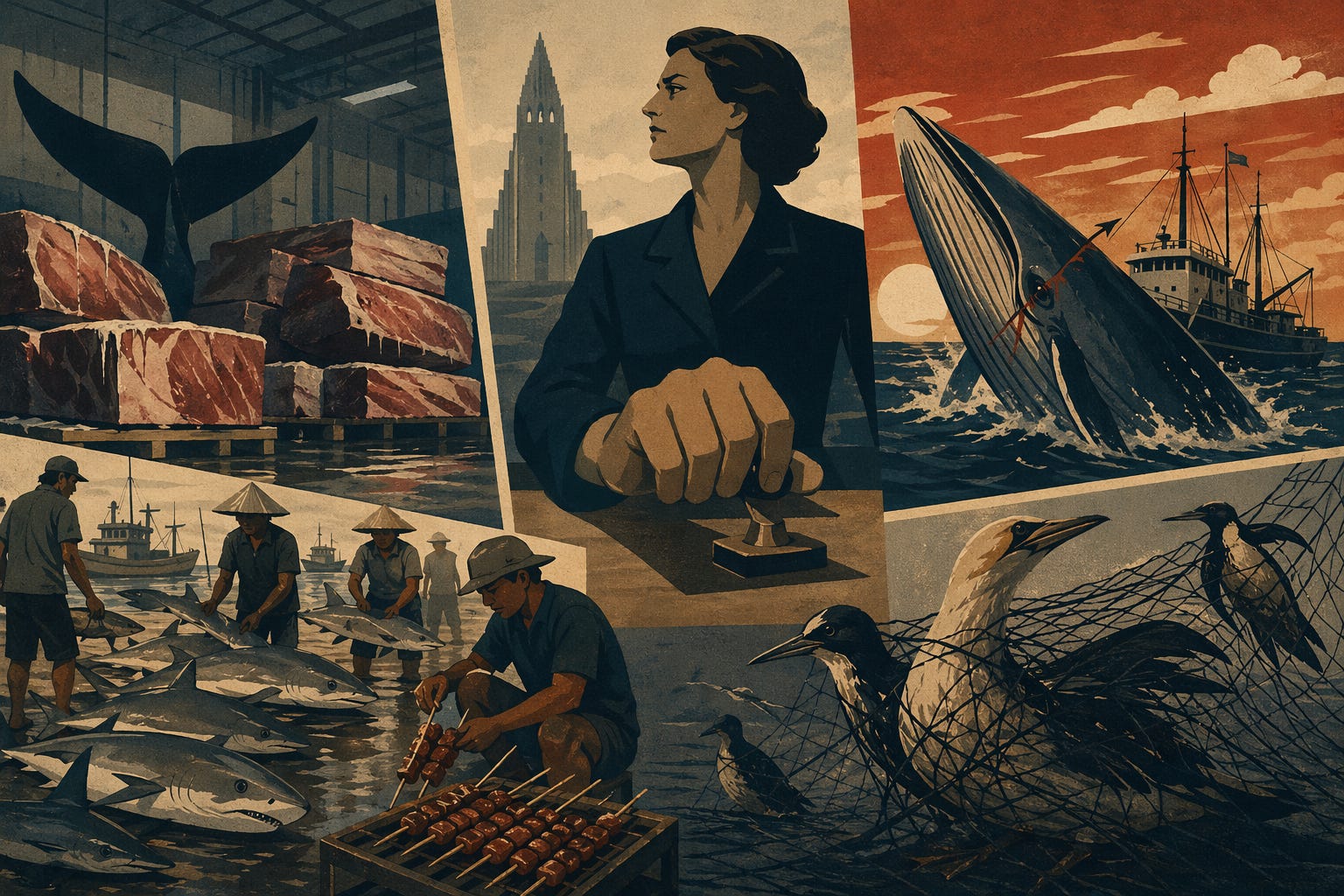
In a warehouse somewhere in Iceland, fin whale meat from the 2023 hunt is still sitting unsold. Japan, the only export market, has stopped buying it. The whaling company that killed those animals lost roughly $20 million over eight years of operations. The government has publicly committed to banning commercial whaling this autumn. And yet, earlier this month, that same company announced it intends to hunt fin whales again this summer. Whether it does depends on a single decision by a single minister who has already said the practice is not in the public interest.
That story leads this week’s Deep Brief, alongside a photojournalist’s account of Indonesia’s shark meat trade, where the world’s second-largest animal by global trade value now sells for 29 cents a skewer, and a legal challenge that could force France to confront the tens of thousands of seabirds dying in its fishing nets each year. Three deep dives. Three quick hits. One hard truth from the sea.
Deep Dives
Iceland’s government says it will end whaling. Hvalur hf. is betting it won’t.
Iceland’s whaling company Hvalur hf. has announced its intention to hunt fin whales in 2026, despite two consecutive seasons without a hunt, a government commitment to introduce legislation banning commercial whaling later this year, and an Icelandic warehouse full of unsold meat from the last hunt in 2023.
The decision now rests entirely with Hanna Katrín Friðriksson, Iceland’s Minister of Industries. Friðriksson has publicly stated that commercial whaling is not in the public interest and has confirmed that legislation to end the practice will be tabled this autumn. For conservation groups, that makes any decision to authorise a 2026 hunt difficult to justify.
“Not a single whale should die this summer for a practice the government itself has said it will end this autumn,” said Valgerður Árnadóttir, Chair of Hvalavinir, an Icelandic whale conservation organisation.
Fin whales are the second-largest animals on Earth and are listed as Vulnerable on the IUCN Red List. Iceland is the only country in Europe that still hunts them. Only three nations continue commercial whaling in defiance of the International Whaling Commission’s moratorium: Iceland, Norway, and Japan.
The Marine and Freshwater Research Institute has issued advice capping any fin whale catch at 150 animals, a reduction of roughly 20 per cent on previous quotas. Hvalur hf. holds a five-year licence issued in late 2024, with a combined annual quota permitting up to 400 whales.
The economics of Icelandic whaling have been deteriorating for years. Between 2012 and 2020, Hvalur hf. recorded combined losses of approximately three billion Icelandic krónur, around $20 million, from its whaling operations. Japan, historically the sole export market for Icelandic fin whale meat, has stopped importing it, weighed down by its own stockpiles and falling domestic demand. By contrast, whale watching generates an estimated $26 million annually for Iceland’s economy.
The welfare case is equally difficult to defend. In 2023, one in five fin whales shot required a second harpoon and suffered for up to 35 minutes before death, in what I have argued publicly constitutes a breach of Iceland’s own animal welfare legislation. WDC is calling on the Minister to revoke Hvalur’s licence immediately and to begin the formal process of withdrawing Iceland’s reservation to the International Whaling Commission moratorium.
Three previous ministers have opposed whaling and none succeeded in stopping it. The pattern is familiar: governments declare their opposition, promise legislation, and then allow another season to pass while the bills wait in a queue. Each time, more whales die for a product that nobody is buying.
Disclosure: I am Head of Hunting and Captivity at Whale and Dolphin Conservation. I am quoted in the Oceanographic article by Rob Hutchins that prompted this story. The analysis and framing here are my own.
In Indonesia, shark meat has quietly become bigger business than shark fins. A photojournalist went to see what that looks like.
Indonesia consistently ranks as the top shark-catching nation in the world. At the fish market in Tanjung Luar, a village on the island of Lombok, photojournalist Garry Lolutung documented what the trade looks like up close for Mongabay.
Fishing boats from nearby islands arrive each morning carrying fresh catches. Sharks are placed on the auction floor and sold for 600,000 to one million rupiah each, roughly $35 to $58. The sharks are supplied by longline vessels that deliberately target them, which is generally legal in Indonesia, and by gillnet fishers who take them as bycatch.
Twenty kilometres inland, in Rumbuk village, the meat is processed into smoked jerky, shredded fish, crackers, meatballs, fish cakes, and satay. A kilogram of shark meat in Rumbuk costs between $1.46 and $2.33. A skewer of shark satay costs 5,000 rupiah, which is 29 US cents. It is an affordable source of protein that has become a local staple.
The global picture has shifted. For decades, the shark fin trade dominated. Shark fin soup remains a luxury item in parts of East Asia, and fins are still by far the most valuable part of the animal per kilogram. What has changed is that shark meat has overtaken fins in both trade volume and total value. A 2021 WWF report placed the value of all shark and ray meat traded globally between 2012 and 2019 at $2.6 billion.
Indonesia is a major exporter of shark products, including meat, liver oil, and skin, and its bilateral trade with China represents the world’s fifth-largest flow for blue shark meat, according to a 2022 Oceana report. Researchers have identified significant discrepancies between Indonesia’s reported shark landings and its declared exports, and between its export figures and what its trading partners report importing. This points to a combination of illegal trade, inconsistent data collection, and high levels of domestic consumption.
Protections for sharks in Indonesia exist for some species. Whale sharks, sawfish, and manta rays are protected by law. Fishers in Tanjung Luar told Mongabay they would not hunt whale sharks, citing a long-standing belief that the animals bring good luck. For most other shark species, including threatened ones, hunting is legal.
Shark meat made national headlines in Indonesia in September 2025, when 16 students at a school in Ketapang district on the island of Borneo were poisoned by shark meat served through the national free school meals programme. Other countries, particularly Brazil, have faced scrutiny for including shark meat in school and institutional meals, because the flesh tends to contain high concentrations of heavy metals that can harm human health, especially in children.
Globally, shark and ray populations have declined steadily due to overfishing, combined with the animals’ slow growth and reproduction rates. The market in Tanjung Luar, where baby sharks lie on the auction floor beside adults and fins dry on racks in the sun, is one window into a trade that is accelerating even as the animals that sustain it disappear.
Three environmental groups have taken France to its highest court over the killing of tens of thousands of seabirds.
ClientEarth, Sea Shepherd France, and Défense des Milieux Aquatiques filed a complaint before the Conseil d’État on 21 April 2026, demanding that French authorities enforce existing EU laws on fishing sustainability and biodiversity protection. The groups allege that France has failed to collect adequate data on seabird deaths in fishing gear and has not implemented measures to reduce them, in breach of the Birds and Habitats Directives, the Technical Measures Regulation, and other European legislation.
Scientific extrapolations from available monitoring suggest that France may have the highest seabird bycatch figures in Europe, with an estimated 34,600 birds killed annually. The most affected species include the Balearic shearwater, a medium-sized seabird that breeds in the western Mediterranean and is classified as critically endangered on the IUCN Red List, the northern gannet, now classified as near threatened, and the common guillemot, classified as endangered. Longlines, gillnets, and pelagic trawls targeting commercial species including hake, sea bass, and tuna are the main killers.
Most of the birds drown without ever washing ashore, which is why the crisis has remained largely invisible to the public and to policymakers. Because most deaths happen underwater and the bodies sink, the scale of the problem only becomes clear through observer programmes on fishing vessels and statistical extrapolation, both of which the NGOs argue France has failed to maintain adequately.
The legal action complements an infringement procedure already opened by the European Commission against France for similar failings. The Commission has challenged France on this issue before, and France has not responded with the monitoring or mitigation measures required by European law.
One French fisherman, identified by the pseudonym Ludovic in the case briefing, described a worsening dynamic. Declining fish stocks have led some operators to leave nets in the water for longer, increasing the chance that birds and other non-target species become entangled. “The best way to avoid bycatch is to fish at night and haul the nets back before sunrise,” Ludovic told the briefing. He warned that current trends could create a cycle that depletes fish populations, protected species, and the future of fishing itself.
France oversees the world’s second-largest exclusive economic zone. The gap between that global reach and its failure to monitor what is dying in its own nets is the core of the legal challenge.
Quick Hits
Chile’s new president has suspended two vast marine parks that his predecessor created on his last day in office. Former President Gabriel Boric signed a decree on 10 March creating Juan Fernández II and Nazca-Desventuradas II, which together would have protected roughly 337,000 square kilometres of Pacific Ocean, around 10 per cent of Chile’s exclusive economic zone. President José Antonio Kast suspended the decree on his first day in office as part of a broader review of environmental measures. The region has one of the highest rates of endemic species in the world, higher than the Galápagos or Hawai’i, with 87 per cent of fish in the Juan Fernández archipelago found nowhere else. Conservation groups fear the protections could be weakened under pressure from fishing interests, particularly the semi-industrial swordfish fleet. If the parks survive, Chile would join Palau as the only countries to protect more than half their exclusive economic zones.
Singapore’s Resorts World Sentosa will stop sourcing wild dolphins and is suspending its captive breeding programme. The resort obtained 27 Indo-Pacific bottlenose dolphins from the Solomon Islands in 2008 and 2009. At least four died during transit or from infections. The facility still holds more than 20 dolphins, the youngest a seven-year-old male named Kenzo. An expert panel is being assembled to determine the animals’ future. Staff who spoke to Mongabay said they doubted the dolphins could survive in the wild after so long in captivity. An international movement against cetacean captivity for entertainment is growing, with Mexico, Canada, and France among the countries that have recently banned the practice.
More than 17 million Americans along the Atlantic and Gulf coasts are living in areas at the highest risk of flooding, according to a new study in Science Advances. Researchers at the University of Alabama used 16 factors related to hazard, exposure, and vulnerability, combined with three machine learning models and historical damage data from FEMA, to identify eight cities at greatest risk: New York, Norfolk, Charleston, Jacksonville, Miami, Mobile, New Orleans, and Houston. New York has the largest population at risk, with roughly 4.75 million people in the two highest risk categories. New Orleans has the highest proportional exposure, with 99 per cent of the city’s population at elevated flood risk. The lead author, Wanyun Shao, described the figures as “shocking” and “alarming.”
Hard Truth From The Sea
A minister in Reykjavik is deciding whether to authorise a hunt for an animal the government has already said it will stop killing. A warehouse of unsold whale meat sits in storage while the decision is made. In Indonesia, baby sharks lie on auction floors beside adults, feeding a trade that has grown even as the populations that sustain it have shrunk. In France, tens of thousands of seabirds drown in fishing nets each year, and nobody has to watch because the bodies sink. The ocean absorbs a great deal of what humans would rather not see. The question, as always, is whether the things we choose not to look at will still be there when we finally do.
Paid subscribers fund the reporting that tracks what is changing in the ocean and why. If you want accountability journalism on the systems we depend on and the institutions responsible for protecting them.
See you next week.
- Luke
So sad.
This, in general, makes for very sad reading. Finding ways to grow and sell alternate food to shark and not just shark, is the challenge. Too many people and not enough good. Inadequate government oversight or inadequately paid governance officials. The first world could spend less on arms and more on 3rd world support and dig up less fossil fuel.