


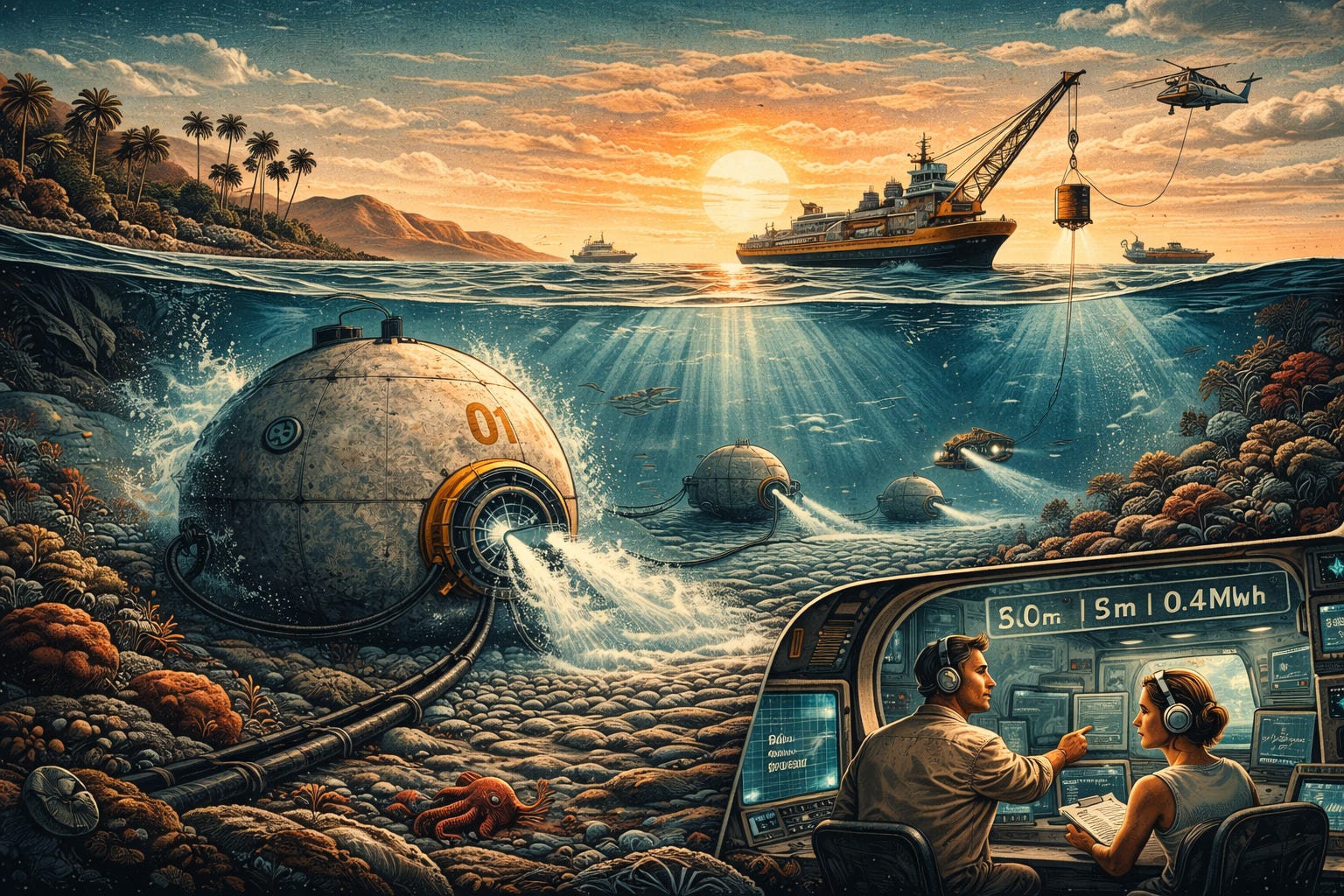
Six hundred metres below the surface of the Pacific, off the coast of Long Beach, California, a hollow concrete sphere the size of a small house will soon sit on the seabed. When electricity is cheap, a pump will force seawater out of it, leaving a vacuum inside. When electricity is needed, a valve will open, and the ocean’s own pressure will drive water back in through a turbine, generating power. The sphere is a battery, and the ocean is the charger. If it works, there are plans for fields of them.
This is the Good News Edition. Once a month, this newsletter reports on what is working: the engineering, the science, the governance, and the people who are building, measuring, and protecting, often in places nobody else is looking.
Deep Dives
The ocean floor as a battery. A German-American experiment off California could change how the world stores renewable energy.
The problem with solar and wind power has never been generation, it has been storage. The sun does not shine at night and the wind does not blow on command, so every country trying to run its grid on renewables eventually hits the same wall: what do you do with the surplus electricity when you have too much, and where do you find more when you run out?
One answer, tested successfully on a small scale in 2017 and now heading for its first full-size ocean trial, is to store that energy underwater in concrete spheres.
The StEnSea project, short for Stored Energy in the Sea, was developed by the Fraunhofer Institute for Energy Economics and Energy Systems Technology in Germany. The concept borrows from pumped hydroelectric storage, the most established form of grid-scale energy storage on Earth, which works by pumping water uphill into a reservoir when power is cheap and letting it flow back down through turbines when power is needed. Pumped hydro is efficient, reliable, and well understood. It also requires mountains, dams, and large tracts of land, which limits where it can be built and often generates public opposition.
StEnSea replaces the mountain with the ocean. A hollow concrete sphere on the seabed acts as the lower reservoir. The surrounding ocean acts as the upper one. When surplus electricity is available, it powers a pump that forces seawater out of the sphere, creating a pressure differential with the ocean outside. When the grid needs power, the valve opens, water rushes back in under the enormous pressure at depth, spins a turbine, and feeds electricity back to shore.
In 2017, the Fraunhofer team tested a three-metre prototype in Lake Constance in Germany. It worked. The system handled repeated charge-discharge cycles through the winter and proved the engineering was sound. The next step is a nine-metre sphere, weighing 400 tonnes, to be built using 3D concrete printing by Sperra, a US startup based in Long Beach, and deployed at a depth of 500 to 600 metres off the California coast by the end of 2026. The US Department of Energy has invested $4 million in the project. The German government is contributing roughly €3.4 million.
The prototype will store 0.4 megawatt-hours of electricity, enough to power a typical home for about two weeks. That sounds modest, but the technology is designed to scale. A park of six full-sized spheres, each around 30 metres in diameter, could deliver 120 megawatt-hours of storage and 30 megawatts of power output, cycling hundreds of times a year. The Fraunhofer team estimates a global storage potential of 817,000 gigawatt-hours across suitable coastal seabeds worldwide, based on depth, seafloor slope, and proximity to ports and grid infrastructure.
The efficiency of the system sits at around 75 to 80 per cent, slightly below pumped hydro on land. The lifespan of the concrete spheres is estimated at 50 to 60 years, with turbines and generators needing replacement roughly every 20 years. The estimated cost is 4.6 euro cents per kilowatt-hour stored, competitive with many existing grid-scale storage technologies.
There are unknowns. The California deployment is the first time the system will operate in saltwater at depth, which introduces corrosion, biofouling, and maintenance challenges that did not exist in Lake Constance. Environmental assessments from the lake trial suggested low impact under the conditions tested, but ocean ecosystems at 600 metres depth are different, and the effects of deploying large numbers of spheres on deep-sea habitats have not been studied. These are questions that need answering before any large-scale rollout.
The logic of the design is what makes it compelling. The deeper the water, the greater the pressure, and the more energy each sphere can store. The spheres can be manufactured on shore and towed to site. They require no land, generate no emissions in operation, use no rare materials, and sit out of sight on the seabed. If the California trial succeeds, the technology could pair directly with offshore wind farms, storing their surplus output within reach of the turbines that produce it.
One bay, 28 years, every week. The quiet science that makes Antarctic research possible.
It is 8.30 in the morning at Rothera Research Station on the Antarctic Peninsula, and the marine team is gathered for its daily briefing. Outside, Ryder Bay stretches into a pewter sky. Someone checks the weather. Someone checks sea ice conditions. Within fifteen minutes, a decision is made: it is a sampling day.
The Rothera Time Series, known as RaTS, has been running since 1997. Every five to seven days, weather and ice permitting, a small rigid inflatable boat pushes out from the station ramp into the bay, carrying Niskin bottles for water sampling and a CTD instrument that measures conductivity (a proxy for salinity), temperature, and depth as it descends through the water column. The team profiles to roughly 500 metres and collects water samples at 15 metres depth. They have been doing this, in one form or another, for nearly three decades.
What they are building is one of the most significant long-term ocean measurement records in Antarctica, and one of the very few that includes winter data from either pole. Almost all Antarctic ocean science happens in the austral summer, when ships can reach the continent and conditions permit fieldwork. RaTS runs year-round because Rothera is staffed through the winter, and because the marine team can reach Ryder Bay by boat or, when sea ice covers the surface, by sled. That winter coverage makes the dataset exceptionally valuable. The processes that control how the Southern Ocean absorbs heat and carbon dioxide, the formation of sea ice, the behaviour of phytoplankton, the timing of seasonal cycles, all of these look different in winter than in summer, and almost nobody else is measuring them.
The data has already shown that the ocean around the Antarctic Peninsula is sensitive to large-scale global climate patterns, including El Niño. Summer ocean surface temperatures in the region have increased by more than 1°C. Atmospheric temperatures on the peninsula rose by almost 0.4°C per decade in the second half of the twentieth century, making it one of the most rapidly warming regions in the Southern Hemisphere.
Rothera itself has undergone a transformation. The £670 million Antarctic Infrastructure Modernisation Programme, the largest UK government investment in polar science infrastructure since the 1980s, has delivered a new research vessel (RRS Sir David Attenborough), upgraded wharves, a new runway, and the Discovery Building, a £100 million facility that in April 2026 became the first building in Antarctica to achieve an Outstanding BREEAM sustainability rating, a standard met by fewer than one in a hundred accredited buildings globally. The building is on track to reduce the station’s carbon emissions by 25 per cent through combined heat and power generators, waste heat recovery, solar panels, and automated heating systems.
None of this makes headlines, and it is not meant to. Long-term monitoring is, by definition, unglamorous. It requires people willing to work long hours in a constantly changing environment, to exercise judgement about when conditions are safe enough to go out on the water, and to hand something precious on to the next person without hesitation. “It’s never your data set,” said Allie Mayall, a former marine team lead at Rothera, in the BAS blog post that prompted this story. “You’re just the person looking after it for that time being.”
That care is the infrastructure that everything else depends on. The climate models that predict ice sheet behaviour, the assessments that inform international policy, the studies that track how ecosystems respond to warming, all of them need continuous data from places like Ryder Bay. RaTS is a commitment as much as a monitoring programme, sustained across nearly three decades by the people who go south to keep it running.
On a Mediterranean beach, 3D-printed modules inspired by mangroves are trying to hold the coastline together.
The Gulf of Lion, along the southern coast of France, is losing sand. Storms strip it from beaches faster than natural processes can replace it. In the 2010s, local authorities spent millions of euros on beach replenishment, dredging sand from offshore and pumping it back onto the shore. The sand was supposed to last a decade, but storms stripped most of it away in less than five years.
Lineup Ocean, a French startup, is testing a different approach. Their SURFREEF project, deployed at the beach of Zénith in Palavas-les-Flots near Montpellier, uses submerged structures called UpBlock modules to break the energy of incoming waves before they reach the shore. The modules are 3D-printed from a bio-based material described as low-carbon shell mortar and are designed to mimic the way mangrove root systems dissipate wave energy naturally. Where traditional coastal engineering fights the ocean with seawalls and rock armour, the SURFREEF approach works with the water, reducing the force of waves gradually so that sand has a chance to accumulate rather than being stripped away.
The project is still in its early stages. A baseline mapping of the beach was completed using drone-mounted bathymetric LiDAR (a laser scanning system that measures the shape of both the water surface and the seabed beneath it), and the first demonstrator segment of UpBlock modules is being installed. The next data collection will happen after the first storm, when researchers will measure whether sandbanks have shifted in the way the models predict.
Lineup Ocean won the Eco-Enterprise Innovation Trophy at France’s national eco-enterprise forum in 2026 and received a trophée de reconnaissance from the municipality of Palavas-les-Flots. The SURFREEF project has been granted a five-year temporary occupation authorisation for the maritime public domain by the Hérault prefecture, and a larger project called BIOMIM’4SHORE, backed by €375,000 in French government funding through the i-Lab innovation competition, aims to deploy a full range of nature-based coastal resilience solutions across the town by 2027.
The engineering is modest in scale but interesting in principle. Rather than armouring the coast against the sea, it is attempting to rebuild the conditions under which the coast can protect itself. Whether the modules hold up under real storm conditions, and whether the ecological benefits (increased biodiversity, habitat creation on the submerged structures) materialise as hoped, remains to be demonstrated. The early results will matter for Mediterranean coastal communities that are running out of sand and running out of options.
Quick Hits
Forty-six countries, including major oil and gas producers, will gather in Santa Marta, Colombia later this month for the first international conference dedicated to transitioning away from fossil fuels. Co-hosted by the governments of Colombia and the Netherlands, the conference runs from 24 to 29 April and will bring together government representatives from countries including Canada, Australia, Brazil, Norway, Angola, and several Pacific island nations. The conference operates outside the UN consensus framework that has repeatedly failed to include fossil fuel language in COP final texts, using majority rule instead. One area of focus relevant to ocean governance: new analysis by Earth Insight shows that 19 per cent of the world’s Marine Protected Areas are already overlapped by active oil and gas blocks. The concept of Fossil-Free Zones, geographically defined areas where fossil fuel extraction is permanently off limits, will be central to discussions.
The EU and Iceland held their first annual high-level dialogue on ocean cooperation in Reykjavik on 17 April. Commissioner for fisheries and oceans Costas Kadis met with Iceland’s Minister of Industries Hanna Katrín Friðriksson to review progress under a Memorandum of Understanding signed in July 2025. Topics covered included Arctic governance, management of shared fish stocks in the North-East Atlantic, the blue economy, and mutual commitment to ratifying the High Seas Treaty. During the visit, Kadis travelled to Grindavík, the coastal town severely affected by volcanic eruptions since 2023, to meet with local fishing communities. Iceland is expected to hold a referendum before 2027 on reopening EU accession talks.
The UNFCCC Standing Committee on Finance has chosen “Financing Climate Action in Water Systems and the Ocean” as the topic of its 2026 Forum. The SCF Forum selects a different theme each year, and this is the first time the ocean has been chosen as the focus, a decision supported by submissions from UN-Water, UNICEF, and private sector actors including Fugro. The forum will feed into the 2026 UN Water Conference scheduled for 2 to 4 December in the United Arab Emirates. Combined with the Santa Marta fossil fuel conference and the ongoing BBNJ treaty implementation process, 2026 is turning into a year in which the institutional plumbing for ocean governance is being assembled faster than at any point in the past decade.
Hard Truth From The Sea
The good news in this edition is evidence that effort produces results, which is a different thing from optimism. A concrete sphere works as a battery because the physics was tested, refined, and funded over fifteen years. A monitoring programme in Antarctica exists because people kept going out on the water every week for twenty-eight years. A beach in the south of France might hold its sand because engineers studied how mangroves break waves and then 3D-printed the principle into concrete. Each of these stories started with someone deciding to do the work, and then keeping at it long after anyone was paying attention.
Paid subscribers fund the reporting that tracks what is working in the ocean and why. If you want accountability journalism on the systems that protect the ocean and the people building them.
See you next week.
- Luke
It’s great to hear there are some positive things being done.