


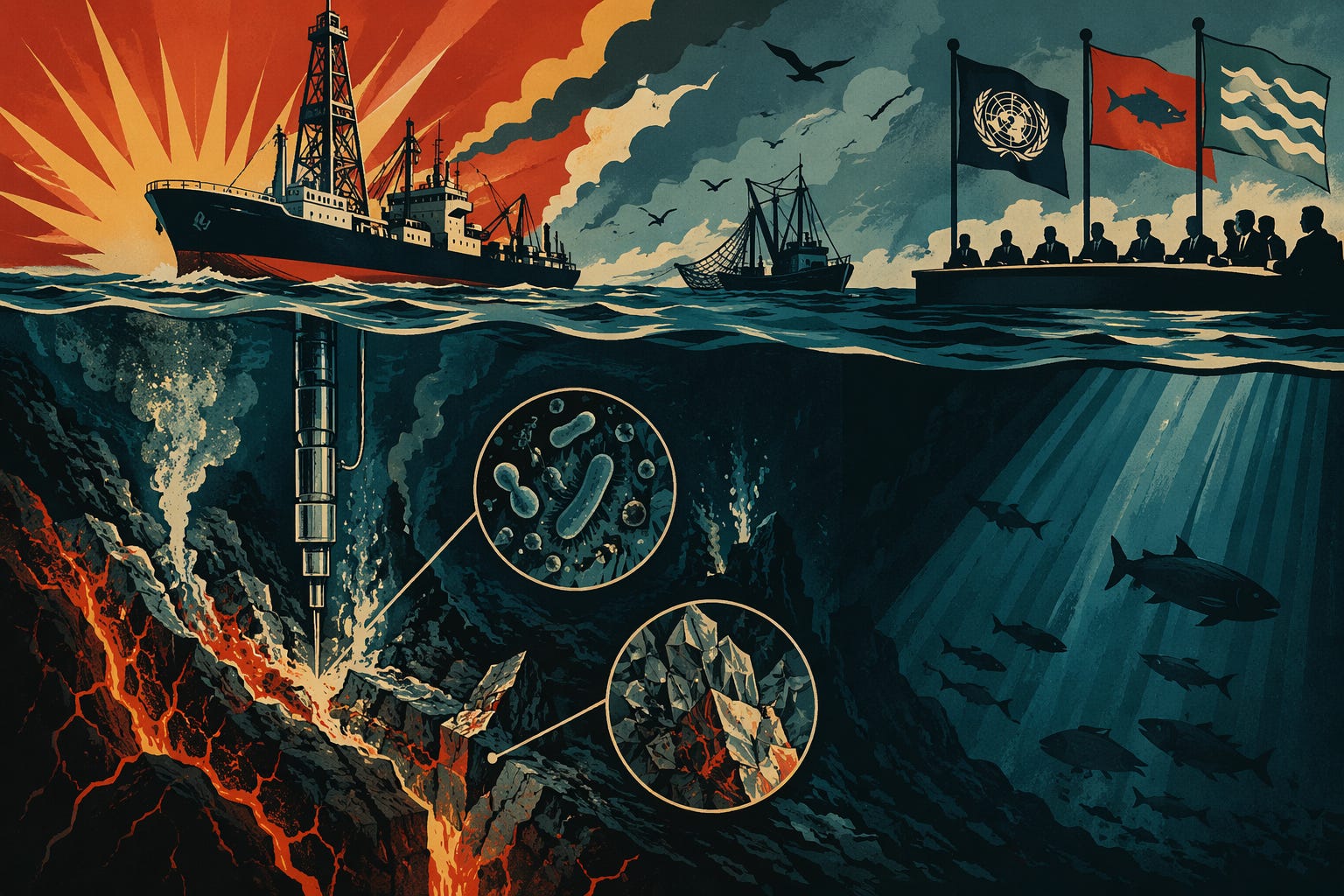
Somewhere in the mid-Atlantic, a kilometre below the seafloor, hot rock is slowly splitting water molecules and releasing hydrogen. Microbial communities are feeding on it in the dark. Carbonate veins are trapping carbon dioxide in solid mineral form. None of this requires sunlight. None of it requires the surface world at all. Scientists pulled up 1,268 metres of that rock this and published what they found. It is the deepest continuous sample of Earth’s upper mantle ever recovered from the ocean floor.
That story sits alongside research showing that 21% of the global ocean has grown darker in the past two decades, and a governance fight at the United Nations that could determine whether the High Seas Treaty’s promise of marine protected areas survives first contact with the fishing industry. Three deep dives. Three quick hits. One hard truth from the sea
Deep Dives
One fifth of the ocean is getting darker.
Between 2003 and 2022, 21% of the global ocean became darker. Light penetrated less deeply into the water. The zone where sunlight reaches, called the photic zone, where roughly 90% of all marine life lives, shrank. In more than 9% of the ocean, an area larger than Africa, the photic zone contracted by more than 50 metres. In 2.6%, it contracted by more than 100 metres.
These findings come from a study published last year in Global Change Biology by researchers at the University of Plymouth and Plymouth Marine Laboratory, and resurfaced this week through a feature in New Scientist. The team used two decades of NASA satellite data and numerical modelling to track annual changes in photic zone depth across the entire planet.
The causes differ by location. In coastal areas, increased rainfall linked to climate change washes more sediment and nutrients from agricultural land into the sea. Those nutrients feed plankton blooms, which reduce the amount of light passing through the water. In the open ocean, the drivers are less clear. Scientists point to changes in plankton communities driven by rising sea surface temperatures, shifts in ocean circulation, and the increasing frequency of marine heatwaves that alter the conditions phytoplankton need to grow.
The most pronounced darkening appeared in three areas: the top of the Gulf Stream, the Arctic, and the Antarctic. All three are regions already experiencing the most severe effects of climate change.
The implications cascade through the food web. Phytoplankton, the microscopic plants that form the base of almost all marine food chains, need light to photosynthesise. Zooplankton, the tiny animals that eat phytoplankton, use light cues to time their daily vertical migration, the largest movement of biomass on the planet. Fish, seabirds, and marine mammals depend on that migration for food. Coral reefs depend on light for survival. If the lit zone compresses, animals that need light are pushed closer to the surface, where they must compete for food and space in a shrinking habitat.
“If the photic zone is reducing by around 50 metres in large swathes of the ocean, animals that need light will be forced closer to the surface,” said Professor Tim Smyth, head of science for marine biogeochemistry and observations at Plymouth Marine Laboratory. “That could bring about fundamental changes in the entire marine ecosystem.”
The picture is not entirely one-directional. Around 10% of the ocean, more than 37 million square kilometres, became lighter over the same period. The researchers are still investigating why. The overall trend, though, is toward a darker ocean, and the speed and scale of the change are what concern scientists most.
Scientists drilled a kilometre into the ocean floor.
Working from the research vessel JOIDES Resolution, an international team recovered a continuous 1,268-metre-long core of mantle rock from beneath the seafloor at the Atlantis Massif, a geological formation near the Mid-Atlantic Ridge. Published this week in Science, it is the deepest section of Earth’s upper mantle ever sampled directly from the ocean floor.
The mantle is the layer of hot rock between the Earth’s crust and its core. It holds roughly two thirds of the planet’s mass. Until now, scientists had to piece together what it looks like from fragments: ancient mantle rock pushed up onto land, bits carried to the surface by volcanic eruptions, or small samples dredged from fracture zones. Earlier attempts to drill into oceanic mantle barely passed 200 metres and recovered less than half the rock they cut. This core changes that. It provides a nearly complete column from the mantle melting zone up into the base of the oceanic crust.
Most of the rock is a type called peridotite, the dominant rock of the upper mantle, which had been transformed by a chemical reaction called serpentinisation. When seawater percolates down through cracks and meets the hot mantle rock, it reacts with the rock’s original minerals, converting them into new mineral forms. That reaction splits water molecules and releases molecular hydrogen.
That hydrogen is not just a chemical curiosity. Less than a kilometre from the drill site sits the Lost City hydrothermal field, where warm fluids rich in hydrogen, methane, and small organic molecules vent from tall white mineral chimneys and support dense microbial communities in total darkness. Lost City has long been considered a modern analogue for the kind of environment where life may have originated on early Earth, and possibly on ocean worlds like Jupiter’s moon Europa or Saturn’s moon Enceladus. The new core shows that the full depth of mantle beneath this field is heavily serpentinised and cut by multiple generations of mineral veins, supporting the idea that the energy source for these ecosystems is persistent and deep.
The core also revealed abundant carbonate veins threading through the rock, especially where the transformed mantle rock meets intrusions of a denser rock called gabbro. Those veins record carbon dioxide that has been locked away in solid mineral form rather than remaining in seawater or the atmosphere. Similar reactions in mantle rock are being studied as natural models for long-term carbon storage. At the same time, geologists are investigating hydrogen from serpentinisation as a potential source of clean energy. Natural hydrogen accumulations have been documented in several geological settings, and serpentinised mantle rock is one of the main generators.
There is a final twist. The record-breaking hole was drilled in 2023 during International Ocean Discovery Program Expedition 399, near the end of the JOIDES Resolution’s long career. The ship spent nearly four decades as the world’s primary scientific ocean drilling vessel, helping build much of what we know about plate tectonics, past climate, and deep biospheres. In 2024, the US National Science Foundation confirmed that funding for the ageing drillship would not be renewed. The vessel has now ended operations, with no direct replacement yet in the water. This core is both a scientific milestone and a farewell.
The fishing industry is trying to rewrite the High Seas Treaty before it has been used once.
Last week’s Deep Brief covered the High Seas Treaty’s third Preparatory Commission in New York. This week, as that meeting neared its close, a fight emerged over text that could determine whether the treaty can deliver on its central promise: creating marine protected areas on the high seas.
Regional Fisheries Management Organisations, the 17 bodies that already oversee fishing in international waters, proposed amendments to the draft text being prepared for the treaty’s first Conference of the Parties, the summit where member countries will set the rules for how the treaty works in practice. According to Greenpeace, which is tracking the negotiations, the proposed changes would give RFMOs additional powers to block or delay marine protected area proposals and would significantly restrict the treaty’s ability to deliver ocean protection measures.
The proposed text, documented in a UN negotiating document designated CRP6, goes beyond the existing Article 5 of the treaty, which already states that the agreement cannot undermine existing fisheries rules. The amendments would, in Greenpeace’s analysis, shore up RFMO supremacy and give fishing industry interests the ability to stall and derail conservation proposals.
“The organisations that have presided over decades of destruction on the high seas have made a completely unacceptable power-grab which would dramatically weaken the Treaty’s ability to protect the ocean,” said Megan Randles, Greenpeace’s head of delegation to the UN talks.
This matters because the treaty’s value depends almost entirely on whether it can establish marine protected areas that include meaningful restrictions on fishing. If RFMOs can block those proposals, or impose conditions that drain them of substance, the treaty becomes a legal framework without practical force.
The context here is important. RFMOs would argue they are protecting established management systems that have improved significantly in recent decades. Some have. Tuna RFMOs, for example, now manage 87% of assessed tuna stocks sustainably, according to the FAO’s most recent global assessment. The broader picture is less reassuring. A 2010 analysis cited by Dialogue Earth found that 67% of 48 assessed high seas fish stocks were depleted or overfished. High seas catches have risen by more than 400% since the 1950s. The treaty was designed, in part, to fill the governance gaps RFMOs left open. Giving them blocking power over the treaty’s most significant tool risks letting the institutions that oversaw decades of decline dictate the pace of reform.
PrepCom3 was scheduled to conclude on 2 April. The outcome of this text fight will shape everything that follows at the treaty’s first formal summit, now expected by January 2027.
Quick Hits
Zooplankton are pumping microplastics into the deep ocean. Copepods, tiny crustaceans that dominate zooplankton communities across the global ocean, ingest microplastics from the surrounding water, package them into faecal pellets, and sink them through the water column. A study published in the Journal of Hazardous Materials by researchers at Plymouth Marine Laboratory measured the process for the first time in real time and estimated that copepods in the western English Channel transport roughly 271 microplastic particles per cubic metre of seawater per day. With more than 125 trillion microplastic particles estimated to have accumulated in the ocean, even small per-animal contributions add up fast. “Copepods don’t just encounter microplastics,” said Professor Penelope Lindeque. “They are like mini biological pumps, processing and repackaging the microplastics into their faeces, which sink through the water column and accumulate in underlying sediment.”
Forty-year-old canned salmon is telling scientists the ocean may be recovering. Researchers at the University of Washington opened 178 cans of salmon spanning four decades from the Gulf of Alaska and Bristol Bay, counted the parasitic worms embedded in the flesh, and found that levels of anisakids, a common marine roundworm, rose in pink and chum salmon over the study period. That sounds like bad news. It is not. Anisakids need multiple hosts to complete their life cycle, including marine mammals. Rising parasite numbers suggest the food web is intact and that marine mammal populations, protected since the Marine Mammal Protection Act of 1972, have recovered enough to sustain the parasites’ reproduction. The study, published in Ecology and Evolution in 2024, resurfaced this week. “Everyone assumes that worms in your salmon is a sign that things have gone awry,” said Chelsea Wood, a University of Washington fishery scientist. “I see their presence as a signal that the fish on your plate came from a healthy ecosystem.”
The EU has launched its European Ocean Board. Twenty-eight members from trade associations, academia, research institutes, NGOs, and youth organisations met for the first time on 31 March to begin implementing the European Ocean Pact, the EU’s strategy for ocean protection, blue economy, and coastal community support adopted in June 2025. The board is chaired by Costas Kadis, Commissioner for fisheries and oceans. It will advise the European Commission on ocean health, economic competitiveness, maritime security, and international ocean governance. The creation of the board signals that the EU intends its ocean strategy to have teeth beyond the document. Whether it delivers depends on what the board actually recommends and whether the Commission acts on it.
Hard Truth From The Sea
The ocean is getting darker. One fifth of its lit zone has contracted in twenty years. The rock beneath the seafloor is producing hydrogen and trapping carbon in processes that have run for hundreds of thousands of years without human involvement. The fishing industry is attempting to rewrite a treaty designed to constrain it before that treaty has been used once. Each of these stories describes the same tension: the ocean has systems that work. The question is whether the institutions humans have built to manage it will let them.
Paid subscribers fund the reporting that tracks what is changing in the ocean and why. If you want accountability journalism on the systems we depend on and the institutions responsible for protecting them, please do consider upggrading your subscription.
See you next week.
- Luke