


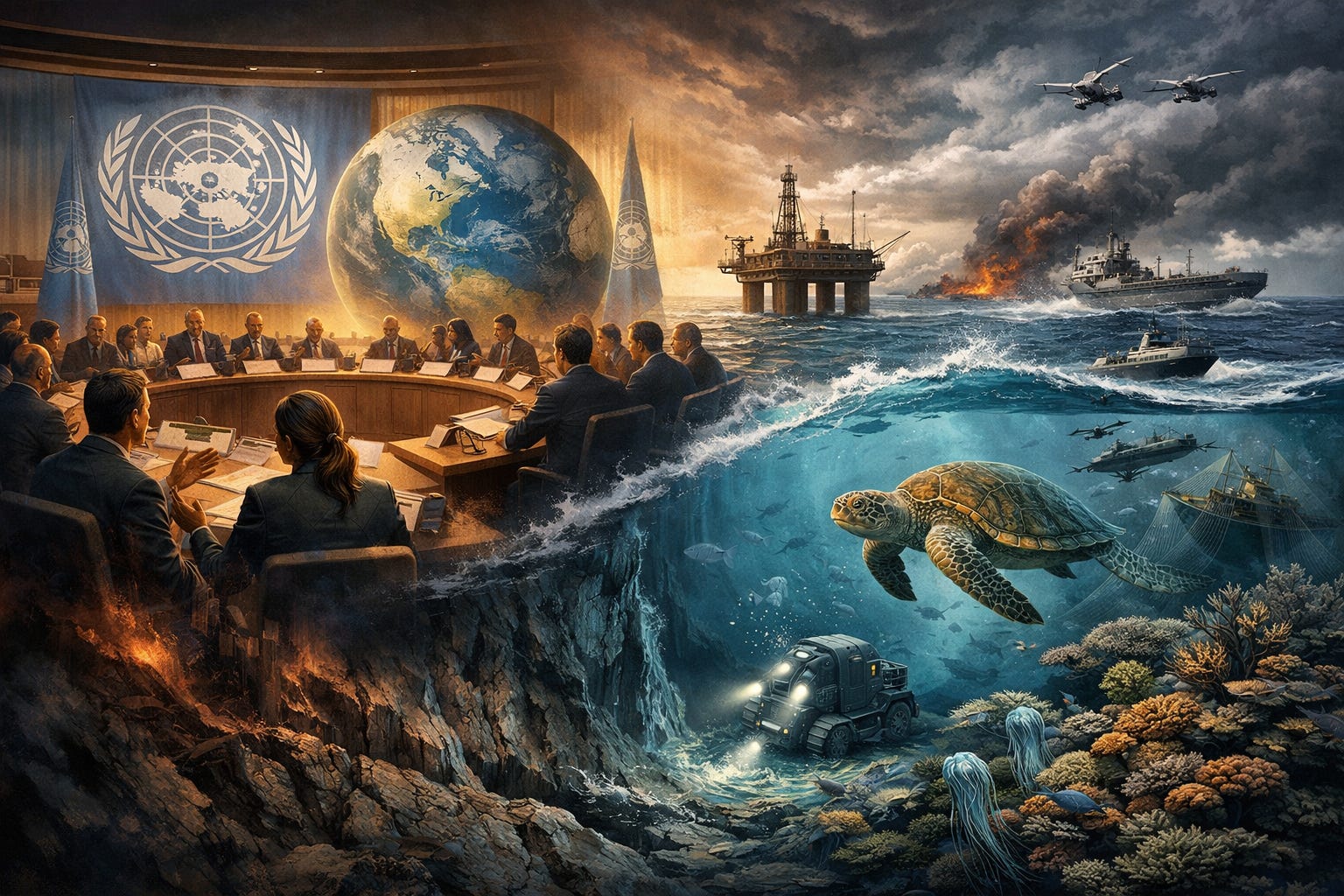
In a conference room at United Nations headquarters in New York this week, diplomats from more than 85 countries sat down to decide how the world’s first treaty for protecting the high seas will actually work. Outside, the rules-based international order the treaty depends on is under sustained attack. Inside, delegates debated committee structures, funding mechanisms, and decision-making procedures. The treaty is now law. The institutions to enforce it do not yet exist.
That meeting sits alongside a study revealing how the ocean seafloor processes carbon on a planetary scale, and research turning sea turtle shells into decades-long records of environmental stress. Three deep dives. Three quick hits. One hard truth from the sea.
Deep Dives
The high seas treaty is now law. Making it work is another matter entirely.
The High Seas Treaty, formally the Agreement on the Conservation and Sustainable Use of Marine Biological Diversity of Areas Beyond National Jurisdiction, entered into force on 17 January 2026. It took nearly 20 years to negotiate. It covers two thirds of the ocean, the vast expanse beyond any country’s exclusive economic zone, the 200-nautical-mile strip of sea that coastal nations control, where no single government has jurisdiction. For the first time, it provides a legal route for creating marine protected areas in international waters, requires environmental impact assessments for activities that could harm marine life, and establishes rules for sharing the benefits of marine genetic resources, the biological material from ocean organisms that can be used in pharmaceuticals, cosmetics, and other industries.
More than 85 countries have ratified it. The United States signed in September 2023 but has not ratified. President Biden transmitted the treaty to the Senate in December 2024, where it has not progressed. The current administration has not signalled intent to pursue ratification.
This week, the third and final Preparatory Commission is meeting in New York from 23 March to 2 April to hammer out the institutional architecture before the treaty’s first Conference of the Parties. That summit, where member countries will make binding decisions on how the treaty operates, must take place by January 2027. The agenda is procedural: rules of procedure, the structure of a scientific and technical body, the design of a central platform for sharing scientific data and technical support, and the governance of the treaty’s financial instruments.
Three funds sit at the centre of the financial architecture. One relies on voluntary donations to support developing country representatives attending meetings. A second is managed by the Global Environment Facility, an existing multilateral fund. A third “special fund” will draw mandatory contributions from developed countries, set at 50 per cent of their share of the treaty’s budget, alongside potential revenue from marine genetic resources and additional public and private donations. These financial obligations are now legally binding for ratifying states. The money is committed. It cannot flow until the fund’s governance, banking arrangements, and access procedures are established.
The practical challenges start with fishing. A clause in the treaty states it cannot undermine existing laws and organisations or override existing fisheries rules. Seventeen regional fisheries management organisations already oversee fishing across the high seas. Only in unregulated gaps will the treaty have clear authority to shape fishing rules. According to Dialogue Earth, citing FAO data, only about 5 per cent of global high seas fish catch comes from areas with no existing oversight. For everything else, the treaty must negotiate with existing bodies.
Then there is the question of how the treaty interacts with the International Seabed Authority, which governs deep-sea mining. Both bodies are developing environmental impact assessment frameworks. Countries that are parties to both instruments will need to ensure consistency between the two regimes. Any gaps between them could weaken protections rather than strengthen them.
Three countries are competing to host the treaty’s permanent secretariat: Belgium, Chile, and China. China’s bid for the city of Xiamen is particularly notable. Li Shuo, who directs the Asia Society Policy Institute’s China Climate Hub, described it as a significant escalation in China’s engagement with global governance, drawing parallels with Beijing hosting the UN biodiversity summit during the first Trump administration. Lynda Goldsworthy, a researcher on high seas and Antarctic governance at the University of Tasmania, told Dialogue Earth the bid was intriguing but raised concerns, given China’s reluctance to support marine protected areas in the Antarctic high seas.
Experts estimate it could take three years or more before the first marine protected area is established under the treaty. Conservation groups have already identified candidate sites, including the waters covering the Salas y Gomez and Nazca ridges off Chile and Peru, home to scores of endangered species. The distance between identifying a site and establishing legal protection is where treaties either deliver or quietly become irrelevant.
The ocean floor is processing carbon on a scale we could not measure until now.
A study published this week by researchers at the University of Manchester provides the first global-scale predictions of how dissolved organic carbon moves between seawater and marine sediments. Until now, this process was too computationally demanding to model at a planetary scale. The team, led by Dr Peyman Babakhani, solved the problem by training artificial intelligence to reproduce the behaviour of an existing computer model, one that simulates the physical and chemical processes of carbon cycling in ocean sediments. Once trained, the AI could be applied globally.
Dissolved organic carbon is the mix of natural chemicals floating in seawater. When it reaches the seafloor, some of it is absorbed by minerals in the sediment, some is returned to the water column, the full depth of water between the surface and the seafloor, and some is buried. These processes influence how much carbon the ocean stores over long timescales and how much cycles back into the water.
The study, published in *The Innovation*, found that 11 per cent of the particulate organic carbon, the tiny particles of organic matter that sink from the surface, arriving at the seafloor is returned to seawater as dissolved organic carbon. Twenty-four per cent is absorbed onto minerals. Most strikingly, the model predicts that about half of all the solid organic carbon locked in the upper metre of marine sediments got there not as sinking particles from the surface but as dissolved carbon that was absorbed onto minerals on the seafloor. That changes the picture of carbon storage in the deep ocean. It suggests that the interaction between dissolved carbon and mineral surfaces is a larger part of the ocean’s long-term carbon budget than previously recognised.
The methodological finding was almost as interesting as the science. The researchers tested several types of AI, from complex deep learning systems to simple algorithms. The simplest ones were the most accurate. Every time they made the AI more complex, the predictions got worse. That rarely happens in AI development. The old principle that simpler solutions tend to be better usually goes untested.
The framework can now be integrated into the large-scale computer models scientists use to simulate how the ocean and atmosphere work, allowing them to test how marine carbon reservoirs might respond to environmental change in the coming decades.
Sea turtle shells are recording decades of ocean stress. Scientists just learned how to read them.
Sea turtles grow continuously throughout their lives. As they do, their shells grow with them, laying down new tissue in layers. The oldest layers sit on the outside, the newest on the inside. Each layer incorporates chemicals from the surrounding water as it forms, creating a record of environmental conditions at the time.
Scientists have known this for years. The problem was that they could not tell how much time each layer represented. A seven-layer sample might cover seven months or seven years.
A study published this week in *Marine Biology*, led by Bethan Linscott at the University of Miami, solved that problem by borrowing a technique from archaeology. Linscott and her colleagues took shell samples from 24 stranded sea turtles, loggerheads and green turtles collected along the Florida coast between 2019 and 2022. They sliced the samples into sections one twentieth of a millimetre thick and dated each layer using radiocarbon, a naturally occurring form of carbon that decays at a known rate. They calibrated the measurements against the mid-20th century “bomb pulse”, a spike in radiocarbon from nuclear weapons testing that serves as a reference point in the marine environment. Using a statistical method normally applied to date sediment samples in archaeology, they calculated that each layer represents an average time span of seven to nine months.
With a reliable timeline, the researchers could compare the growth records of different turtles. They found periods when all the animals grew more slowly. Those slowdowns lined up with major environmental disturbances in Florida waters: harmful algal blooms known as red tides, and disruptive accumulations of Sargassum seaweed.
The implications go beyond turtles. If shell layers can be reliably dated, every stranded turtle becomes a potential record of environmental conditions stretching back years or decades. Scientists can match changes in foraging patterns and diet with specific environmental events, building a record of how marine ecosystems respond to climate change, pollution, and habitat degradation over time.
“The shells are effectively recording environmental stress in the ocean,” Linscott said.
Quick Hits
Every land animal on Earth descends from the ocean. A study in Nature mapped the genetics of how they got out. Researchers at the University of Bristol and the University of Barcelona compared 154 genomes across 21 animal groups to reconstruct the genetic changes behind 11 separate transitions from water to land over the past 487 million years. The transitions happened in three major waves. Arthropods went first. Land snails came last. The most revealing finding was convergence: separate evolutionary lineages, the family trees of entirely different animal groups, that had been separated for more than 500 million years independently evolved similar genetic solutions to the same problems, particularly managing water and salt balance, the fundamental challenge of life outside the ocean. Semi-terrestrial species, the small invertebrates that still depend on moist soil, shared the most adaptations. Fully terrestrial lineages like insects and vertebrates took more divergent paths, each evolving its own innovations. The study was published in Nature in November 2025 and resurfaced this week through The Conversation.
Ocean species are vanishing before scientists can identify them. An international team led by the University of Göttingen and the Leibniz Institute for Biodiversity Change Analysis has launched EuroWorm, a project to build the first comprehensive open-access genomic database of European marine annelids, the segmented worms found across nearly all ocean environments. These animals mix sediments, recycle nutrients, indicate pollution levels, and support marine food webs. The project will collect specimens from European locations where many species were originally described, identify them by physical form, photograph them at high resolution, and analyse them using advanced genomic tools. The database will be freely accessible worldwide, with the explicit goal of accelerating species discovery before extinction outpaces science. “We hope to accelerate the discovery of new species and biodiversity research worldwide, and thus counteract the ‘silent extinction’ of marine species,” said project leader Dr Jenna Moore.
An Arctic blast turned the Gulf of Mexico bright blue. In late January and early February, two winter storms drove Arctic air across Florida, dropping temperatures below freezing in parts of the state and chilling the shallow waters off the west coast. As the ocean cooled, denser cold water flowed offshore, stirring up calcium carbonate mud, the accumulated remains of marine organisms, from the West Florida Shelf. NASA satellites captured the transformation: deep azure waters turned a vivid pale blue across a wide area. Landsat 9 imagery revealed “hammerhead” eddies along the shelf slope, curling patterns formed as narrow streams of cold, sediment-laden water met the slower-flowing Gulf. The same fluid dynamics appear in dust storms on Mars. The event is not only visually striking. Carbonate sediment suspensions affect the ocean’s carbon cycle. These resuspension events usually happen during hurricanes. Scientists know far less about how winter cold fronts produce similar effects, and the difference matters for understanding local carbon sequestration, the process by which carbon gets locked into deep ocean storage.
Hard Truth From The Sea
This week, delegates in New York debated the procedural architecture of a treaty designed to protect two thirds of the ocean. They discussed committee structures and funding mechanisms while the multilateral system the treaty depends on faces its most serious challenge in decades. The treaty exists because more than 85 countries agreed it was necessary. Whether it delivers depends on whether that consensus survives contact with the institutions, competing interests, and geopolitical realities that have historically made high seas governance a promise rather than a practice.
Paid subscribers fund the reporting that tracks what is changing in the ocean and why. If you want accountability journalism on the systems we depend on and the institutions responsible for protecting them.
See you next week.
- Luke
Thank you Luke!
Thank you