


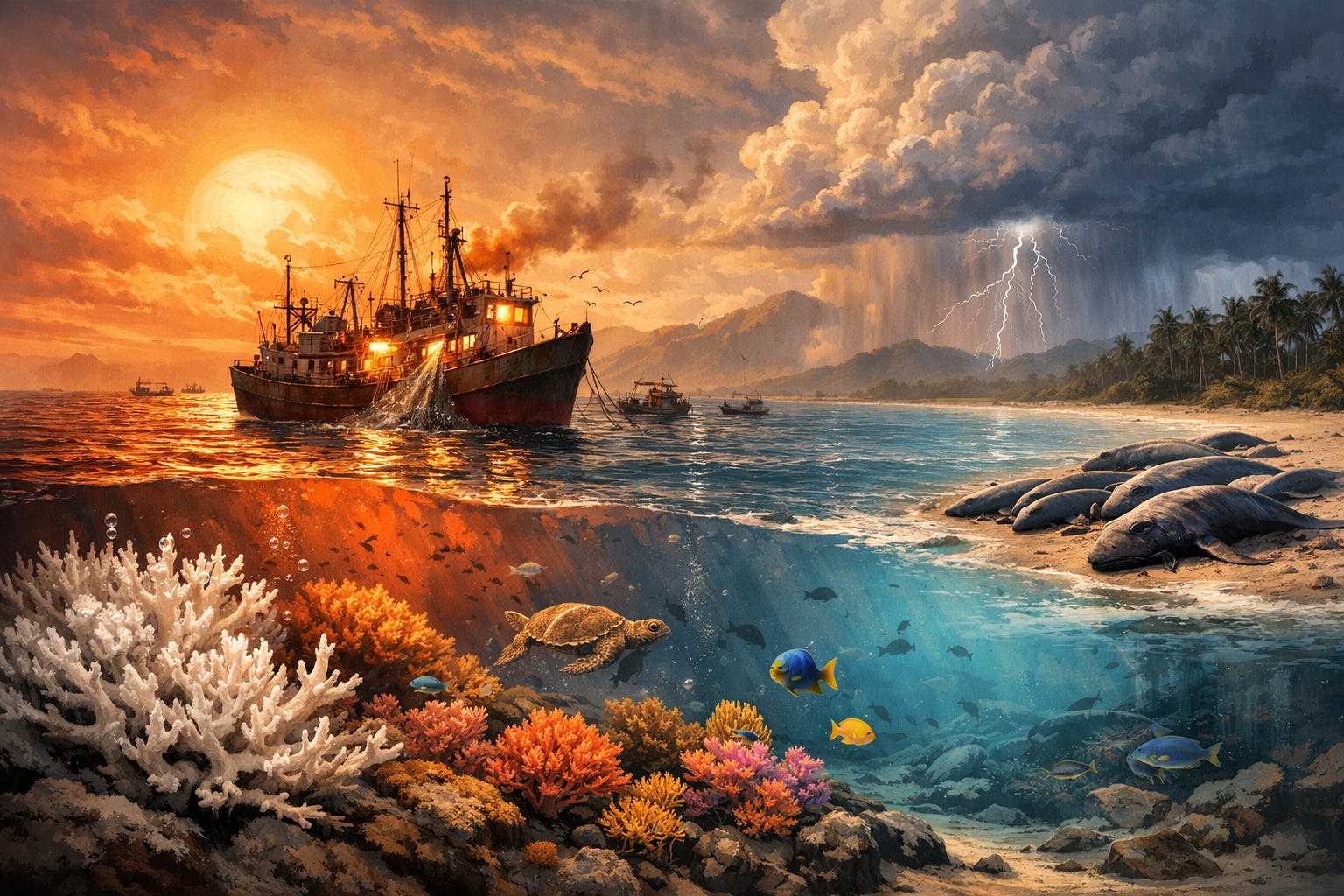
Coral reefs grew fastest at 25°C. The ocean is now warmer than that, and the atmosphere contains more carbon dioxide than at any point in the past 11,700 years. This week, a study spanning the entire history of human civilisation showed that the conditions under which reefs thrived no longer exist. That finding landed alongside escalating forecasts of a potentially very strong El Nino forming later this year, a $23.5 billion illegal fishing crisis laid bare at the World Ocean Summit, and a mass whale stranding in Indonesia that local scientists are calling a signal of deeper ecological trouble.
Three deep dives. Three quick hits. One hard truth from the sea.
Deep Dives
Coral reefs peaked at 25°C. We have already passed it
A study published this week in PLOS ONE examined coral cores, cylindrical samples drilled from reef structures that record thousands of years of growth, from 291 sites across the Pacific, Indian, and Atlantic Oceans. The cores date back 11,700 years to the beginning of the Holocene, the geological period that covers the entirety of human civilisation. The researchers used two different analytical methods to examine how environmental conditions influenced reef growth over that span.
The central finding: coral reef growth rates peaked at a sea-surface temperature of approximately 25°C, during a warm period between roughly 7,000 and 5,500 years ago. At that time, atmospheric carbon dioxide (CO₂), the greenhouse gas primarily responsible for warming the planet, was around 325 parts per million (ppm). To put that in context, current atmospheric CO₂ exceeds 425 ppm, roughly 30 per cent higher.
Sea-surface temperatures in many reef regions now regularly exceed 25°C. The study found that CO₂ levels above 335 ppm, combined with modern temperatures and the increasing frequency of marine heatwaves, are less than optimal for reef growth. The researchers describe this as an inhibition of reef capacity to keep pace with rising seas.
This is not a computer simulation about what might happen. It is a reconstruction of what actually happened over 11,700 years, using the physical record preserved in reef structures. The answer is clear: the conditions that built the world’s coral reefs no longer exist. We passed the optimal temperature. We passed the optimal CO₂ concentration. Reefs are now growing in conditions that the geological record shows are suboptimal, and those conditions are getting worse.
Why does CO₂ matter for reefs? Higher CO₂ in the atmosphere means more CO₂ dissolving into seawater, making it more acidic. More acidic water makes it harder for corals to build their calcium carbonate skeletons, the same material that forms the reef structure itself. At the same time, warmer water causes bleaching, where corals expel the tiny algae that live inside them and provide most of their energy. Bleached corals can recover if conditions improve quickly, but repeated bleaching kills them.
The study also found that when sea levels were rising during the Holocene, reefs grew faster, likely because rising water provided new space for coral to colonise. That relationship only holds when temperature and CO₂ remain within the range that supports reef building. When they do not, as now, sea-level rise becomes a threat reefs cannot outpace.
El Nino is loading. The forecasts just got worse
Multiple forecasting groups revised their predictions upward this week. What was a roughly 50/50 chance of El Nino developing by mid-year now looks increasingly likely, with some models projecting a very strong event for late 2026 and into 2027.
El Nino is a natural climate pattern in which the tropical Pacific Ocean warms significantly. It happens every two to seven years. The warming releases stored ocean heat into the atmosphere, temporarily driving up global temperatures. The last El Nino, in 2023-2024, helped make those two years the hottest ever recorded.
Climate scientist Zeke Hausfather at Berkeley Earth projects that a strong El Nino would have its largest effect on 2027 temperatures, potentially making it the warmest year on record. His central estimate for 2027 is approximately 1.57°C above the average temperatures of the 1800s, before fossil fuel burning began warming the planet. James Hansen’s team at Columbia University projects a peak of 1.7°C, though Hansen measures this as the highest 12-month average within the year rather than the calendar-year average Hausfather uses. The difference in method matters, but the direction is the same: both projections would surpass the 2024 record.
Several warning signs are already in place. Strong westerly winds in the western tropical Pacific are pushing warm water eastward, and large volumes of warm water are stored beneath the surface. The cool La Nina pattern, the opposite of El Nino in which the same region of the Pacific cools, ended quickly. Climate scientist Daniel Swain at the University of California described the emerging signal as potentially ‘very significant.’
For the ocean, El Nino means accelerated coral bleaching in waters that, as this week’s coral study shows, are already above the temperature at which reefs grow best. It means disrupted fisheries as species shift with changing currents. It means the cold, nutrient-rich water that normally rises to the surface off South America, supporting one of the world’s most productive fisheries, gets suppressed. For the Pacific island nations whose leaders spoke at this week’s World Ocean Summit, it means drought, food insecurity, and intensified pressure on the marine resources they depend on.
Forecasting accuracy for El Nino typically improves after the spring, when a well-documented drop in predictive skill, known among scientists as the ‘spring barrier,’ passes. By June, the picture will be clearer. What is already clear is that the system is primed.
Illegal fishing costs $23.5 billion a year. The World Ocean Summit asked what anyone plans to do about it
At the World Ocean Summit in Montreal this week, ocean leaders delivered a blunt assessment: international agreements to protect the ocean are piling up, but enforcement is not keeping pace.
The headline figure came from Niall O’Dea, Senior Assistant Deputy Minister at Canada’s Department of Fisheries and Oceans: roughly a third of the seafood on people’s plates comes from illegal, unreported, or unregulated (IUU) fishing. That is fishing that breaks the rules, goes unrecorded, or operates in areas where no rules exist. It drains an estimated $23.5 billion from the legal economy every year.
Papua New Guinea’s Minister for Fisheries, Jelta Wong, captured the enforcement gap in a single comparison: it is easier to locate and strike a target in Tehran than it is to monitor fishing in our own ocean.
The summit took place at a time when landmark international agreements are beginning to take effect. The High Seas Treaty, formally known as the Biodiversity Beyond National Jurisdiction (BBNJ) agreement, entered into force in January 2026. The World Trade Organization’s (WTO) agreement on fisheries subsidies, which aims to stop governments funding fishing that depletes stocks, took effect in its first phase in 2025, with negotiations on remaining provisions still underway. Governments have committed to protecting 30 per cent of the ocean by 2030. Speakers at the summit stressed that none of these commitments will work without investment in monitoring, enforcement, and financial mechanisms to support them.
The gap between ambition and enforcement is not new. What is new is the number of agreements that all depend on the same missing infrastructure: the ability to see what is happening in the ocean and act on it. Satellite monitoring, vessel tracking, and checks at ports exist but remain underfunded and unevenly applied. The EU’s OceanEye initiative, launched this month with €50 million in initial funding, is one attempt to close the observation gap. Whether monitoring capacity can scale fast enough to match what governments have promised is the question that hung over the entire summit.
Quick Hits
Ocean temperature patterns prevent global drought synchronisation. A study published this week in Communications Earth & Environment found that droughts rarely strike the entire planet at the same time. Synchronised drought, when multiple regions dry out simultaneously, affects only 1.8 to 6.5 per cent of global land at once, far less than earlier estimates suggested. The reason: shifting ocean temperature patterns, particularly the El Nino-La Nina cycle, create a patchwork of regional drought rather than one worldwide dry spell. For food security, this is important. It means crop failures in one region can be offset by harvests elsewhere, as long as trade and storage systems work properly. The researchers identified “drought hubs,” regions that repeatedly experience drought on different cycles, in Australia, South America, southern Africa, and parts of North America. Monitoring ocean temperatures could provide early warning of which hubs are next.
Mass pilot whale stranding in Indonesia. Fifty-five short-finned pilot whales stranded on 9 March near Kupang in East Nusa Tenggara province. Villagers and authorities worked past midnight to rescue 34, but 21 died. Post-mortem examinations were carried out immediately. Local scientists point to the region’s shallow waters and narrow bays, which can disrupt the echolocation, a form of biological sonar, that pilot whales use to navigate. Pilot whales are highly social; when one individual enters shallow water, the rest follow. Environmental organisations are calling for a broader investigation into whether the stranding reflects ecological disruption linked to climate change, shifting prey distribution, or ocean noise from shipping and industry. Indonesia’s Ocean Health Index score remains at 65 out of 100, indicating significant room for improvement in how the country manages and protects its marine environment.
Ocean data is being wasted. At the World Ocean Summit, Canada’s Chief Science Advisor Mona Nemer warned that too much ocean research data is collected for a single project and then filed away, never reused or combined with other datasets. The real value of ocean data, she argued, comes from connecting it: linking data on acidification, biodiversity, shipping, and pollution to build a fuller picture of what is happening and inform decisions. Governments need to fund not just data collection but the tools and expertise to make that data usable by others. This connects directly to the EU’s OceanEye initiative and the broader problem: ocean governance cannot function without ocean observation, and observation is only as good as the systems for sharing what it finds.
Hard Truth From The Sea
Coral reefs grew best at 25°C and 325 ppm of CO₂. We are now above 425 ppm and warming fast. A potentially very strong El Nino is forming in the Pacific, which will push temperatures higher still. The institutions responsible for managing these pressures met this week in Montreal and admitted they cannot monitor their own ocean.
Eleven thousand years of geological data show the conditions that built coral reefs. We have left those conditions behind. The question is no longer whether reefs are under threat. It is whether the speed of change will outpace the speed of response. This week’s evidence suggests it already has.
Paid subscribers fund the reporting that tracks the gap between what the ocean needs and what institutions deliver. If you want accountability journalism on the ocean, and the systems failing to protect it.
See you next week.
- Luke
Best ocean blog I've come across. Thank you!
A masterpiece in writing that is clear, concise and very informative. The message is hopefully getting through. It is good that agreements are in place to address over-fishing, but effective monitoring is a big job.