


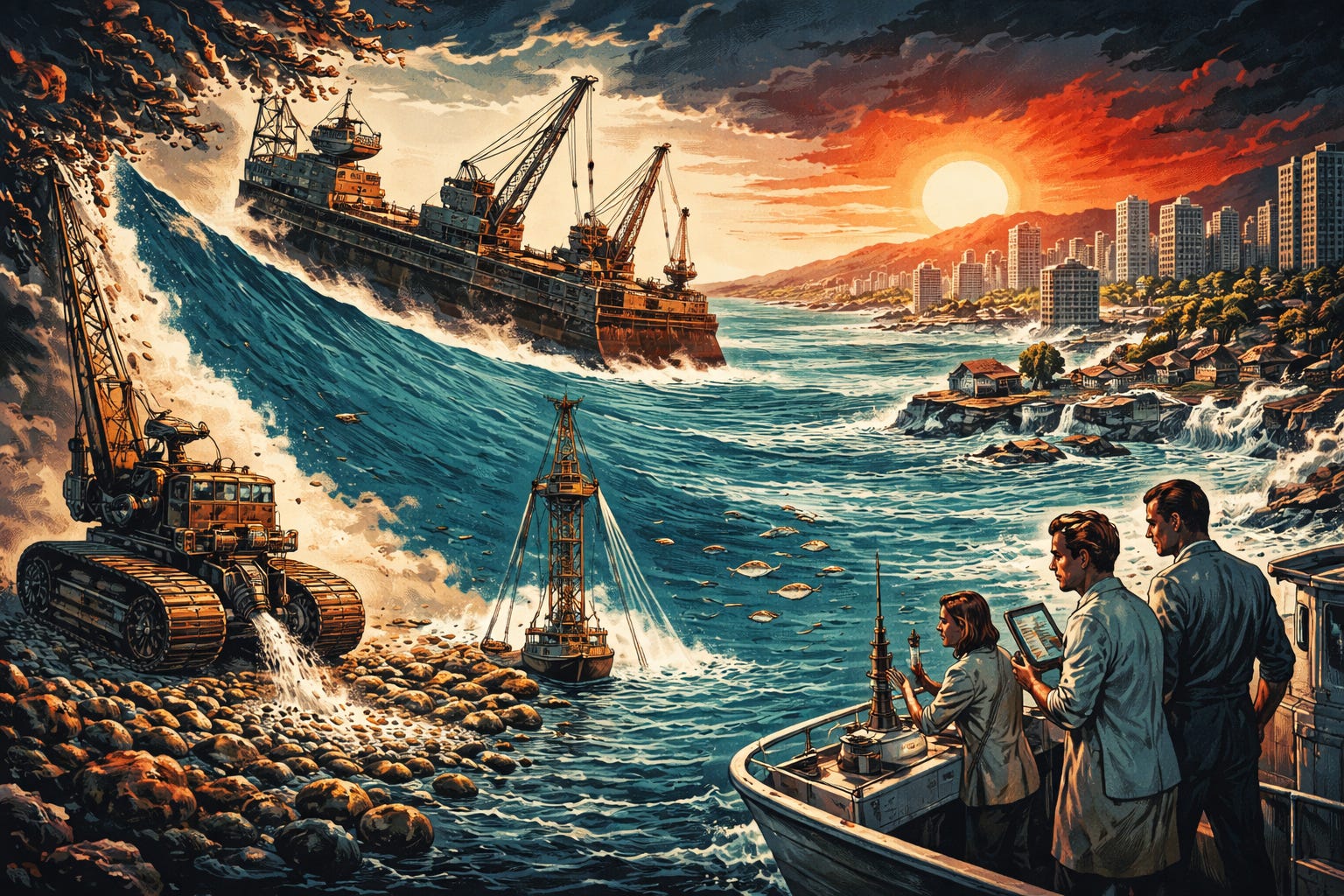
Pick a coastal city. Any coastal city. The sea level there is probably higher than the models say. On average, around 30 centimetres higher. In parts of the Indo-Pacific, more than a metre higher. A study published this week in Nature found that 90 per cent of coastal hazard assessments over the past 15 years used modelled estimates of sea level rather than actual measurements. The starting point was wrong. Every projection built on it was optimistic.
That finding sits alongside two other stories this week. The international body responsible for regulating deep-sea mining just spent two weeks trying to finish the rulebook. It failed. The company that wants to mine is not waiting for the rules. And in the Gulf of Maine, researchers tested whether adding chemicals to the ocean could help it absorb more carbon dioxide. The science is preliminary. Companies are already selling credits for the same technique.
Three deep dives. Three quick hits. One hard truth from the sea.
Deep Dives
The mining code that never arrives
The International Seabed Authority (ISA) was created to regulate mining of the deep seabed in international waters. It has been trying to finalise the rules, known as the Mining Code, for years. This week, the ISA’s Legal and Technical Commission, the preparatory body that reviews technical and legal questions before they reach the decision-making Council, wrapped up two weeks of work in Kingston, Jamaica. The code is still not ready for adoption. The Council, which is the body that would actually approve the rules, convenes on Monday for a session running 9 to 19 March. It inherits the same unresolved questions. The full 31st Session stretches all the way to July, when the Assembly meets. That timeline tells you something about the pace of progress.
The backdrop makes this failure more consequential than previous ones. In April 2025, President Trump signed an executive order directing the National Oceanic and Atmospheric Administration (NOAA) to accelerate permits for deep-sea mining under the US Deep Seabed Hard Mineral Resources Act (DSHMRA), a largely dormant 1980 law. In January 2026, NOAA issued a final rule modernising the application process. The Metals Company (TMC) filed for a commercial recovery permit covering 65,000 square kilometres of the Clarion-Clipperton Zone, a vast area of Pacific seabed rich in potato-sized rocks called polymetallic nodules that contain nickel, cobalt, copper, and manganese.
The US is not a party to the United Nations Convention on the Law of the Sea (UNCLOS), the treaty that established the ISA, and does not recognise the ISA’s authority over its nationals. The ISA has opened an investigation into whether TMC and its international subsidiaries are complying with the Convention. Delegates discussed revoking TMC’s existing exploratory permits but stopped short. ISA Secretary-General Leticia Carvalho put it plainly: what prevents unregulated exploitation is rules, and the ISA has yet to agree on them.
The governance framework is fracturing. China and the EU have criticised the US approach. Around 30 ISA member states support a moratorium or precautionary pause on mining. TMC’s exploration contracts through its Nauru and Tonga subsidiaries expire in July 2026 and January 2027 respectively. The company is simultaneously pursuing permits from a country that rejects the ISA’s jurisdiction while holding contracts issued by it. Legal scholars at the European Journal of International Law have described this as a system-breaking contradiction.
Mining the deep seabed carries documented environmental risks: sediment plumes that can travel hundreds of kilometres, destruction of habitats that take millions of years to form, and biodiversity loss in ecosystems we barely understand. TMC’s own test showed a 30 per cent decline in biodiversity and abundance in the affected area. Recovery timescales for abyssal ecosystems are measured in decades to centuries, if recovery occurs at all.
The deep-sea mining question is no longer primarily scientific. It is a governance question. Whether the seabed is a common heritage resource managed by the international community or a frontier open to whoever moves first is being decided right now, by default, because the ISA cannot finish the job it was created to do.
Sea levels are higher than we thought. The maths changes everything
A study published this week in Nature analysed 385 peer-reviewed coastal hazard assessments published over the past 15 years and found a systemic problem: 90 per cent relied on modelled estimates of sea level rather than direct measurements from satellites and tide gauges.
When the researchers compared those model-based assumptions against satellite observations at 90-metre resolution, they found that global coastal sea level is on average around 30 centimetres higher than assumed. In some regions, predominantly in the Indo-Pacific and the Global South, the difference exceeds one metre. The models estimate sea level using the Earth’s gravitational field, but that does not account for tides, winds, ocean currents, temperature, and salinity, all of which affect the actual height of the water along coastlines.
The consequences compound. With a hypothetical one metre of sea-level rise, the study estimates 31 to 37 per cent more land would fall below sea level than current assessments project, affecting 48 to 68 per cent more people, raising exposure estimates to between 77 and 132 million.
This is not a new projection of future sea-level rise. It is a correction to the starting point from which all projections are calculated. If you are measuring how much water is coming, it matters where the water already is. Coastal adaptation plans, climate finance allocations, and infrastructure investment decisions built on the lower starting point are systematically underestimating risk.
Philip Minderhoud, an author of the study at Wageningen University, described the reliance on modelled sea level rather than measured data as a methodological blind spot. The paper calls for re-evaluation of existing coastal impact assessments worldwide.
The first open-ocean alkalinity experiment is incomplete yet already being commercialised
Scientists at Woods Hole Oceanographic Institution (WHOI) presented preliminary results this week from LOC-NESS, the first controlled open-ocean trial of ocean alkalinity enhancement. The principle is straightforward: more alkaline seawater can absorb more carbon dioxide from the atmosphere, locking it away in dissolved form. The trial, conducted last summer in the Gulf of Maine, involved adding sodium hydroxide to surface waters to test whether this works at sea rather than just in a laboratory.
The results, presented at the Ocean Sciences Meeting 2026 in Glasgow: between 2 and 10 tonnes of CO₂ were drawn into the ocean during the four-day monitoring period. Modelling suggests the treated patch of water could absorb up to 50 tonnes over a year. The research team found no measurable impact on the marine organisms they studied, including bacteria, phytoplankton (the tiny algae that form the base of the ocean food web), and lobster larvae.
Those findings carry important caveats. The trial did not examine long-term impacts. It did not assess effects on organisms near the seafloor. And project lead Adam Subhas acknowledged to New Scientist that the team has yet to estimate the emissions involved in manufacturing and transporting the sodium hydroxide, meaning it remains unclear whether the trial achieved net carbon removal, that is, whether it removed more CO₂ than it created.
The LOC-NESS researchers are academic scientists, not a company. They stress this distinction. The private sector is not waiting. Microsoft and Google have signed agreements with Ebb Carbon for carbon offsets through alkalinity enhancement at desalination plants in Saudi Arabia. A Canada-based company announced the world’s first carbon credits for ocean alkalinity enhancement last year, selling over 600 tonnes of claimed removal to Shopify and British Airways.
The gap between cautious, small-scale science and commercial deployment is already wide and growing. As oceanographer Jannes Koelling at the University of Washington noted, history is full of examples where new technologies were deployed at scale before their environmental consequences were understood.
Quick Hits
EU launches OceanEye with €50 million
At the European Ocean Days in Brussels this week, Commission President Ursula von der Leyen formally launched OceanEye, a new ocean observation initiative first announced at the 2025 UN Ocean Conference in Nice. The EU will contribute €50 million from its Horizon Europe research programme for 2026-2027 and is calling for an international monitoring alliance. The initiative builds on the Copernicus Marine Service and the European Digital Twin of the Ocean. Von der Leyen described ocean monitoring as “vital planetary infrastructure” that needs stable, structured funding rather than voluntary cooperation. The goal is a fully operational European ocean observation system by 2030. Whether OceanEye delivers meaningful monitoring or joins the long list of EU announcements that sound better than they perform depends on whether member states and international partners commit real resources at the pledging event scheduled for September.
AI project to map vulnerable deep-sea ecosystems across the Atlantic
The Deep Vision project, led by Plymouth Marine Laboratory and the University of Plymouth, will use artificial intelligence to analyse thousands of hours of seafloor video footage and produce the first comprehensive maps of vulnerable marine ecosystems across the Atlantic. The project, funded by the Bezos Earth Fund, targets deep-sea corals, sponges, and other filter-feeding organisms that provide habitat for countless species, store carbon, and support food webs in the deep ocean. Policymakers currently lack maps showing where these ecosystems exist in international waters, making it nearly impossible to designate meaningful marine protected areas under the new High Seas Treaty, formally known as the Biodiversity Beyond National Jurisdiction (BBNJ) agreement. If Deep Vision delivers, it becomes the scientific foundation for the first generation of protected areas in the high seas. The treaty’s first Conference of the Parties is expected later this year.
Fish biomass study from last week’s Deep Brief is gaining traction
The Chaikin et al. study documenting a 7.2 per cent decline in fish biomass, the total weight of living fish in a given area, for every 0.1°C of seabed warming, covered in Deep Brief #30, has become one of the most-accessed recent papers at Nature Ecology & Evolution. The finding that marine heatwaves can temporarily inflate fish numbers in colder waters, masking long-term decline, has particular relevance for fisheries managers setting catch limits. Worth reading alongside this week’s sea-level correction: another case where the starting assumptions behind policy are worse than we thought.
Hard Truth From The Sea
The ISA’s preparatory commission just finished two weeks of work and the Mining Code still is not ready. The Council starts Monday. The US is not waiting. Scientists have shown that sea levels are higher than we assumed. So adaptation plans are built on underestimates. Researchers cannot yet confirm whether ocean alkalinity enhancement achieves net carbon removal. So companies are already selling credits for it.
In each case, the pattern is the same… action is outpacing understanding.
The institutions designed to govern these decisions are slower than the actors who want to exploit them, and the science that should inform these choices is still catching up to the scale of the questions being asked.
The ocean does not wait for consensus. Neither, it turns out, do the people who want to profit from it.
The distance between what we know and what we are doing grows wider every week. Paid subscribers fund the journalism that measures it. If you want accountability reporting on the ocean, and the institutions failing to protect it.
See you next week.
- Luke
Your posts are essential reading - thank you
From the whale spirit in me and all the forms of Life and beauty in every layer of Earth’s seas, thank you for your work. ♥️🐋