


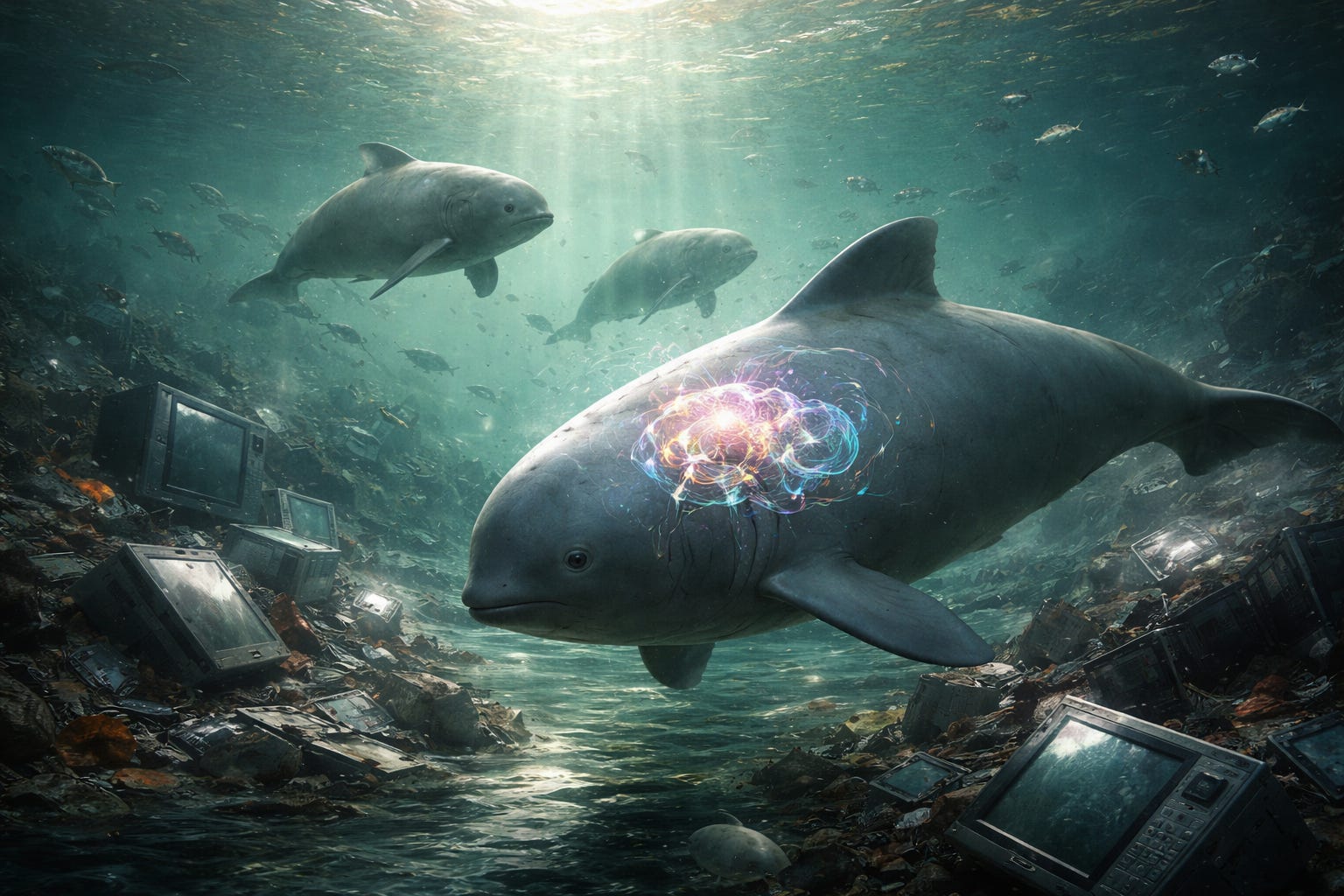
Somewhere in the South China Sea, a finless porpoise is carrying liquid crystal monomers from a discarded television screen in its brain tissue. It is not alone. This week, researchers documented for the first time that chemicals from household electronics are crossing the blood-brain barrier in marine mammals. That study landed alongside new research quantifying how fast the ocean is losing fish to long-term warming, and a UNESCO report revealing that the climate models guiding global emissions policy are built on a carbon sink we cannot accurately measure.
Three deep dives. Two quick hits. One hard truth from the sea.
Deep Dives
The ocean is heating. The fish are disappearing. The maths is worse than we knew.
A study published this week in Nature Ecology & Evolution analysed over 700,000 estimates of biomass change across more than 33,000 fish populations in the northern hemisphere between 1993 and 2021. The researchers, led by Shahar Chaikin at the Museo Nacional de Ciencias Naturales in Spain, isolated the effect of long-term, sustained seabed warming from short-term disruptions like marine heatwaves.
The headline number: a 7.2 per cent decline in fish biomass, the total weight of living fish in a given area, for every 0.1°C of seabed warming per decade. In the worst cases, long-term warming was associated with annual biomass declines of up to 19.8 per cent.
Here is the part that should alarm anyone involved in fisheries management. Marine heatwaves can temporarily increase biomass in colder waters by up to 176 per cent as species shift toward more comfortable temperatures, the range in which they can grow and reproduce effectively. That looks like good news on a quota spreadsheet. It is not. Those surges are temporary. If fisheries managers raise catch limits based on heatwave-driven abundance, they risk collapsing populations once conditions normalise or long-term warming catches up.
At the warm edges of species ranges, the picture is worse. Heatwaves there drove biomass crashes of up to 43.4 per cent.
The study also points to a governance headache that no single country can solve. As species track their thermal comfort zones, they cross national boundaries. A population declining in one country may be increasing in another. Static management models, the kind most fisheries regulators still use, cannot account for this. The researchers call for international coordination and joint resource-management agreements. Given the state of multilateral fisheries negotiations, that call will land somewhere between aspiration and fantasy.
The underlying mechanism is straightforward. Long-term warming is not a spike that ecosystems can absorb and recover from. It is a sustained pressure that compounds year after year. The noise of extreme events has been masking a signal that this study now quantifies with uncomfortable precision.
We do not understand the ocean’s largest climate function well enough to plan around it.
The ocean absorbs roughly 25 per cent of global CO₂ emissions. That single fact underpins virtually every national climate plan, every emissions target, and every adaptation strategy currently on the table. A new report from UNESCO’s Intergovernmental Oceanographic Commission, released this week at the Ocean Sciences Meeting 2026, says we do not understand this process well enough to rely on it.
The Integrated Ocean Carbon Research report, compiled by 72 authors across 23 countries, finds that scientific models estimating the ocean’s carbon uptake diverge by 10 to 20 per cent globally, and by more in certain regions. The gaps stem from limited long-term observational data and incomplete understanding of how warming, changing circulation, shifts in plankton populations, and human activities are altering the carbon cycle.
If the ocean absorbs less carbon in the future than models assume, more CO₂ stays in the atmosphere and warming accelerates. Current emissions targets, built on the assumption that the ocean will keep doing its job, could be systematically optimistic.
The report lays out a roadmap: better models, stronger monitoring in data-limited regions, and cross-disciplinary research connecting ocean carbon science to policy decisions.
We are making trillion-dollar climate decisions based on a carbon sink that scientists say they cannot accurately quantify within a 10 to 20 per cent margin. That is not a rounding error. That is a structural uncertainty at the foundation of global climate strategy.
Your old TV is in a dolphin’s brain.
Research published this week in Environmental Science & Technology provides the first evidence that liquid crystal monomers, the chemicals that make laptop, television, and smartphone screens work, are accumulating in the tissues of dolphins and porpoises, including their brains.
Researchers at City University of Hong Kong analysed tissue samples from Indo-Pacific humpback dolphins and finless porpoises collected between 2007 and 2021 in the South China Sea. They screened blubber, muscle, liver, kidney, and brain tissue for 62 individual liquid crystal monomers. They found them across multiple tissue types, with the highest concentrations in blubber. The finding that matters: these chemicals crossed the blood-brain barrier, the body’s defence system that stops most harmful substances reaching the brain, in both species.
The pathway is dietary. Earlier studies had already identified these chemicals in the fish and invertebrates that dolphins and porpoises eat. The pollutants enter coastal environments through household dust, wastewater, and e-waste, move through the food web, and accumulate in top predators.
In laboratory tests, several of the most common compounds altered gene activity in cultured dolphin cells, affecting DNA repair and cell division. The researchers describe this as evidence of potential neurotoxic risk, though they note further investigation is needed.
There is a sliver of a trend in the right direction. As manufacturers have shifted from LCD to LED displays, concentrations in porpoise blubber appear to have begun declining. That does not undo the accumulated contamination or address the 62 million tonnes of e-waste produced globally in 2022, roughly 80 per cent more than in 2010.
The study’s scope is limited to two species in one region. Whether similar contamination is present in dolphin and whale populations elsewhere remains unknown. For an industry where end-of-life disposal remains poorly regulated, and for governments that have not yet classified these compounds for environmental risk, this is the kind of evidence that should accelerate both.
Quick Hits
EU renews Pacific ocean partnership, at less than half the original budget.
The European Union signed the second phase of its Pacific-EU Marine Partnership (PEUMP) programme in Suva, Fiji this week, committing €20 million through 2030 to support ocean governance, fisheries management, and illegal, unreported, and unregulated (IUU) fishing enforcement across Pacific Island countries and Timor-Leste. Phase 1, launched in 2018, had a budget of €45 million with co-financing from Sweden. Phase 2 is less than half that, and Sweden does not appear in the announcement. The programme covers 15 Pacific countries and Timor-Leste. No public evaluation of Phase 1 outcomes was available at the time of writing. For context: the Western and Central Pacific tuna fishery was valued at US$6.1 billion in 2023. The EU’s contribution covers education, training, and technical assistance, not enforcement capacity or fleet monitoring at the scale the region needs.
Ocean Sciences Meeting 2026 is underway.
The biennial Ocean Sciences Meeting opened this week, bringing together marine researchers from around the world. Beyond the UNESCO carbon sink report covered above, the meeting covers topics including ocean deoxygenation, deep-sea ecosystem mapping, and polar ocean dynamics. Worth watching for papers that may shape the next round of implementation discussions for the Biodiversity Beyond National Jurisdiction (BBNJ) treaty, the new international agreement governing the high seas. The first Conference of the Parties is expected later this year, making 2026 a pivotal year for translating treaty text into functioning institutions.
Hard Truth From The Sea
Every one of this week’s stories shares the same structural problem: we are making decisions about the ocean based on what we assume rather than what we know. We assume fish stocks will hold. We assume the carbon sink will continue absorbing. We assume our waste stays where we put it. We assume small cheques solve large problems.
The ocean is not operating on our assumptions. It is operating on physics, chemistry, and biology. This week, all three sent the same message: the gap between what we think is happening and what is actually happening is growing wider, not narrower.
See you next week.
- Luke
I would like to know thoughts on the forced removal of the 26 oil rig jackets off California. Once oil is shut down, what remains is just the steel lattice jacket which supports massive marine ecosystems- so why force them to be removed and destroy over 1 billion Kg of unique marine life and habitat?? Kind of like removing a telephone pole that supports rare bird life because somebody once hated the phone company... I really want to know thoughts on this