


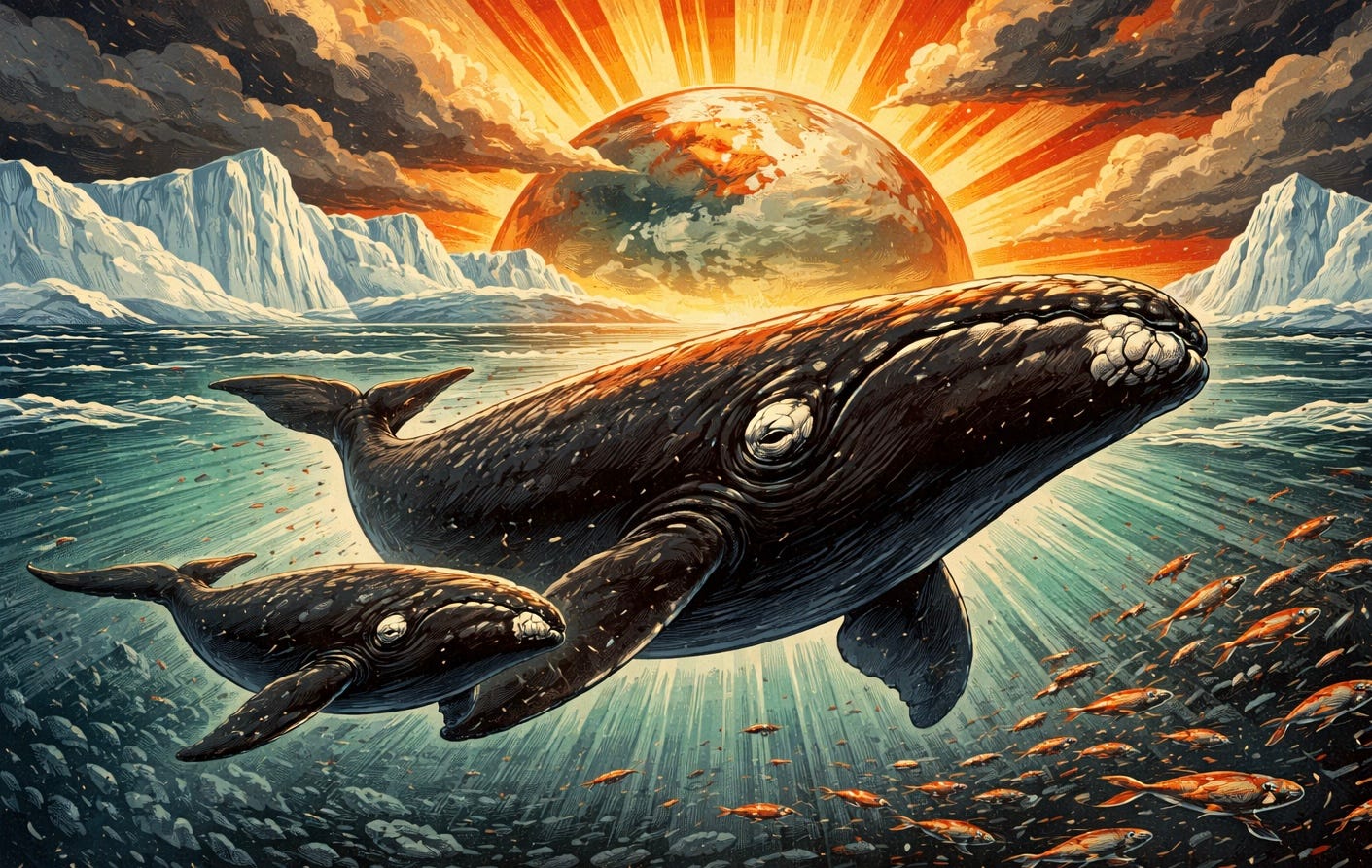
Somewhere off the coast of South Australia, a female southern right whale who should have calved this year did not. She is not alone. Across three continents, three separate populations of the same species are showing the same reproductive decline, driven by the same collapsing food web.
That finding, drawn from 34 years of individual whale identification data published this week, sits alongside new research mapping exactly when climate change will overwhelm Antarctic ecosystems, an emerging El Niño that could push 2027 to record temperatures, and a European Commission building new ocean governance architecture while researchers argue the old one is already obsolete.
None of these stories made the front page. All of them will shape ocean policy for the next decade.
Three deep dives. Three quick hits. One hard truth from the sea.
Deep Dives
The whales that can’t afford to breed.
A study published this week in Scientific Reports documents a significant reproductive decline in southern right whales off southwest Australia, using over three decades of individual identification data. Mean calving intervals have increased from 3.4 years to 4.1 years since 2015, and the proportion of females calving on a normal three-year cycle has dropped sharply. The researchers found that longer calving intervals coincide with declining Antarctic sea ice concentration and shifts in primary productivity across both high-latitude and mid-latitude foraging grounds. Their model explains 54 per cent of the variation in reproductive output through environmental variables alone. This matters beyond one species. Southern right whales are capital breeders, meaning they fast throughout the calving season and depend entirely on energy reserves built during Antarctic feeding. When the food web shifts underneath them, they cannot compensate fast enough. The study’s authors describe this as a ‘threshold warning.’ Three separate southern right whale populations across the Southern Hemisphere, in Australia, South Africa, and Argentina, are now showing the same pattern. These are not isolated population problems. This is the Southern Ocean food web telling us something is structurally wrong.
Antarctica’s ecological clock is ticking, and the countdown varies by species.
A study published this week in Nature Climate Change maps when climate change signals will emerge from natural variability across Antarctic sea ice, phytoplankton, krill, fish, and penguins, region by region and season by season. The findings challenge a common assumption: that physical changes will come first and biological impacts will follow. The research shows the opposite in several cases. Climate signals in fish and penguin populations are projected to emerge from historical variability earlier than in sea ice and the base of the food chain, because these species amplify environmental shifts through their life histories. The picture is not uniformly bleak. Spring krill growth may increase in some regions even as summer growth declines. The Weddell Sea could temporarily improve for fish and krill under moderate ice loss while remaining habitable for Emperor penguins. The Ross Sea appears to function as a climate refuge into the late twenty-first century. Eastern Antarctic regions face the earliest and most severe changes. For anyone following CCAMLR negotiations or Southern Ocean MPA proposals, this study provides the scientific architecture for where protection matters most and when it becomes too late.
El Niño is loading. 2027 could break the temperature record.
NOAA and Australia’s Bureau of Meteorology have both flagged climate models forecasting El Niño development in the Pacific later this year. If it forms at moderate to strong levels, its peak influence would land on 2027 global temperatures rather than 2026.
How hot? Climate scientist Zeke Hausfather projects approximately 1.57°C above pre-industrial levels. James Hansen’s team projects 1.7°C. The difference matters less than the direction: both would set a new record.
The probability of El Niño developing by mid-year versus ENSO remaining neutral is currently around 50/50. Several precursors are already in place: intense westerly wind bursts in the western tropical Pacific, record warm water stored at depth, and the rapid collapse of the current La Niña. What makes this different from previous cycles is the background. The last three years have already ranked among the warmest on record. Fossil-fuel-driven warming is now, in the words of one researcher, “overtaking year-to-year variability.” For the ocean, El Niño means accelerated coral bleaching, disrupted fisheries, and altered currents. For Ocean Rising’s readers, it means the policy window for climate adaptation in marine systems is narrower than it appeared twelve months ago.
Quick Hits
Europe builds an Ocean Board. The European Commission announced the creation of the High-Level European Ocean Board on 11 February, calling for applications from up to 25 experts to advise on implementation of the European Ocean Pact launched in June 2025. Members will serve for up to five years. The Board will shape EU ocean governance, ocean observation initiatives, and alignment between policy and private sector action. Applications close in four weeks. Whether this becomes a meaningful governance body or another advisory committee depends entirely on who gets appointed and what authority they carry.
Climate-ready MPAs: the redesign argument. A study in npj Ocean Sustainability argues that marine protected areas need fundamental restructuring to survive climate change. Drawing on expert workshops across Europe, the researchers outline four strategic priorities: climate-informed spatial planning incorporating connectivity and refugia, participatory governance, cross-sector legal alignment, and sustainable long-term financing. The paper notes that over 80 per cent of EU marine protected area only marginally regulates human activity. Static boundaries drawn around ecosystems that are shifting poleward under warming is a governance model with an expiry date. The question is whether policymakers will redesign before the boundaries become meaningless.
Abu Dhabi’s ocean recovery claim. At the World Governments Summit in Dubai, Abu Dhabi’s Environment Agency chief told Euronews that fisheries stocks had rebounded to 100 per cent by end of 2025 after falling to what she described as 8 per cent seven years earlier, through science-led regulation and enforcement. She pointed to 50 million mangrove saplings planted in five years, coral reef rehabilitation, and a target of 100 million mangroves by 2030. The numbers are striking, though the baseline and methodology behind the fisheries figure were not specified in public remarks. Independent verification would be worth pursuing, given how rare a full stock recovery is in any jurisdiction. If accurate, the methodology matters more than the headline.
Hard Truth From The Sea
Three southern right whale populations on three different continents are showing the same reproductive decline. The food web underneath them is changing faster than they can adapt.
We built international frameworks to protect these animals from harpoons. We have nothing equivalent for protecting them from a collapsing food web.
The whaling moratorium saved the species from us. It cannot save them from what we have done to their ocean.
Investigations like this take time. Paid subscribers make them possible. If you want accountability journalism on what is happening to the ocean, and why,
This is challenging news. Thanks for all this info.