


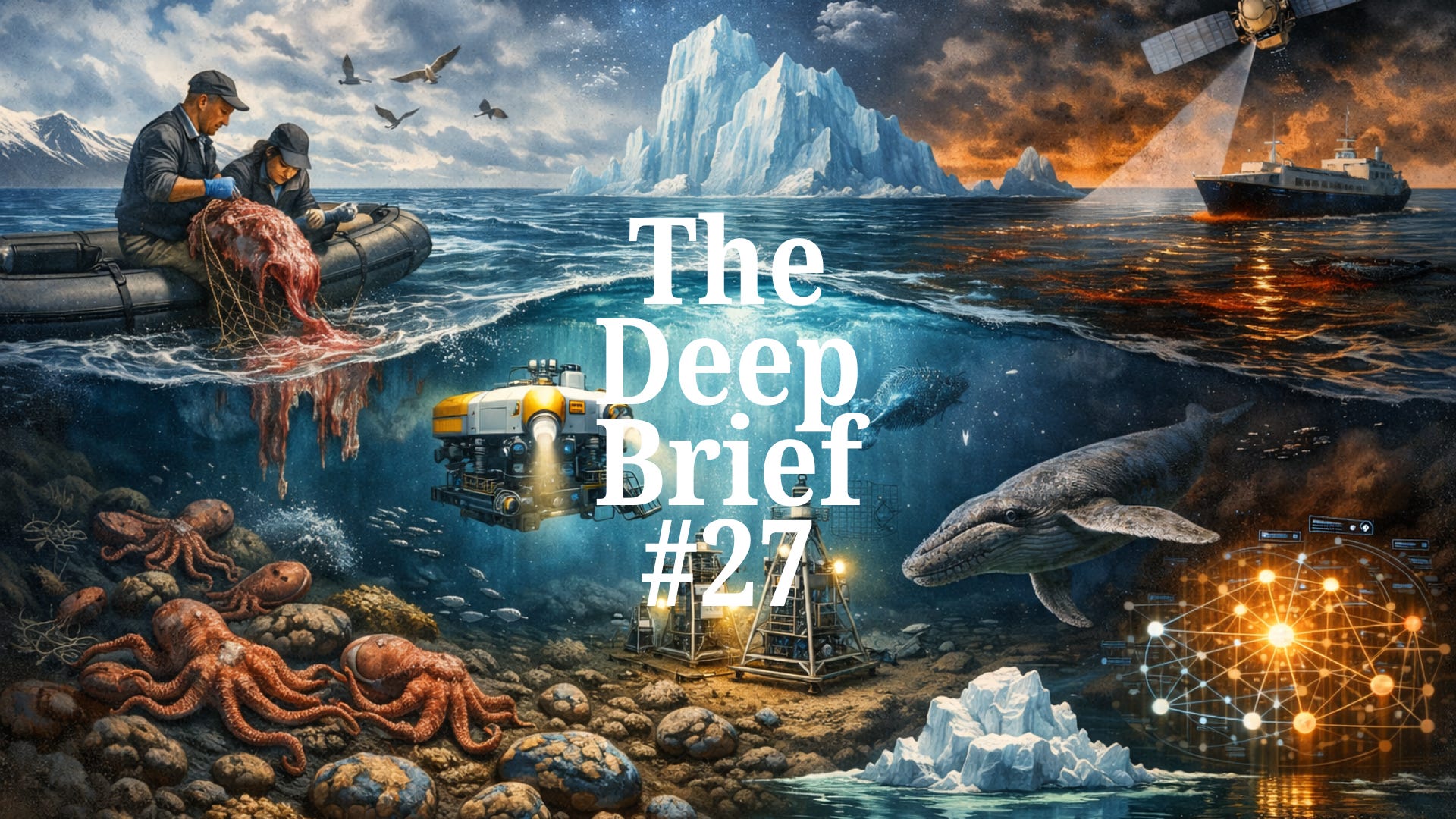
The ocean story this week is about what we measure, and what we miss.
When researchers applied the first standardised measure of ocean equity to the UN Ocean Conference declaration, it scored 44%, the lowest of six cases they tested. A scientist whose discovery threatened the deep-sea mining industry is spending $5.2 million to prove he was right. His original research was funded by a mining company. That company now attacks his findings. Off Hawai’i, researchers pulled a 136kg whale placenta from the water, one of the few fully intact specimens ever collected. They will test it for microplastics, mercury and forever chemicals to understand what contaminants reach calves before they are born.
In other news, 233,000 octopuses were landed in UK waters this year. The last bloom of this scale was 1950. Scientists have calculated the coldest ocean temperature in Earth’s history. And a new AI system can detect oil spills from satellite images with 98% accuracy.
Three deep dives. Three quick hits. One hard truth from the sea.
Deep Dives
One tool, one score, one question
Governments have been promising equitable ocean governance for years. Now a team of researchers has built a tool to measure whether those promises mean anything.
A study published in Nature on 28 January introduces the Ocean Equity Index. Equity, in this context, means fairness: who gets a say, who benefits, and who bears the costs when decisions are made about the ocean. The index scores ocean initiatives against twelve criteria across three domains.
The first domain is recognition: are affected communities acknowledged, and are their rights respected? The second is participation: do they have meaningful influence over decisions, and is information accessible to them? The third is distribution: who gains the benefits, and who bears the costs?
The researchers tested the index on six case studies spanning local to global scales. In Denmark, a wind energy company’s process for assessing environmental impacts scored 78%. In French Polynesia, a traditional reef management system called rāhui, led by local communities and fishers, also scored 78%. A fish-drying project in Tanzania scored lower on transparency because project information was available only in English, not Swahili.
When they applied the index to the UN Ocean Conference declaration, it scored 44%, the lowest of the six cases.
That number needs context. Consensus documents negotiated among 193 countries with competing priorities are not implementation plans. A lower score may reflect the difficulty of multilateral agreement rather than deliberate exclusion. The index itself acknowledges that different contexts require different approaches. The UN was not contacted for comment on the researchers’ assessment.
The index is one framework, developed by one research team, tested on six cases. Other assessors using different criteria might reach different conclusions. What matters is that a tool now exists where none did before.
The High Seas Treaty promises equitable benefit-sharing. The global biodiversity agreement signed in 2022, which commits countries to protecting 30% of land and sea by 2030, includes similar equity commitments. The question has always been how anyone would know if those promises were being kept. Now there is at least one way to ask.
The index is freely available online with a scoring form included in the publication.
Read the study via Nature
What a whale leaves behind
Researchers from the Pacific Whale Foundation were on their boat when they spotted something strange floating at the surface. At first, they thought it was debris.
It was a whale placenta. Approximately 136 kilograms of tissue, including a large portion of umbilical cord. According to the Foundation, one of the very few fully intact whale placentas ever measured and weighed.
‘This tissue typically sinks quickly after being released from the mother,’ says Jens Currie, Pacific Whale Foundation’s chief scientist. There was no sign of mother or calf nearby. Mothers and calves are thought to move away rapidly after birth, likely to avoid predators attracted by the afterbirth.
The specimen represents an opportunity. Whale placentas are biological archives… tissue that records what the mother was exposed to during pregnancy. Scientists rarely get the chance to study them.
The team is now working with the University of Hawai’i’s Health and Strandings Lab and Griffith University to analyse the tissue. Their focus: contaminants. Microplastics. Mercury. PFAS, the so-called forever chemicals that do not break down in the environment.
‘Placental tissue offers a unique opportunity to better understand how these substances are distributed within the body and the extent to which developing calves may be exposed to contaminants before birth,’ says Currie.
According to the Foundation, approximately one percent of the tissue was subsampled. The majority has been retained intact and will be returned to the ocean.
The Foundation says it worked with Kiaʻi Kanaloa, a group of Indigenous Hawaiian cultural practitioners, to develop protocols for handling the specimen. In Hawaiian culture, taking a sample like this carries significance. Currie describes the work as approached ‘with care, restraint and respect.’
The whale’s iʻo, its flesh, will be returned to the sea at the spot it was found. The Foundation says Kiaʻi Kanaloa provided the cultural protocol, including ceremonial prayers and hoʻokupu, the traditional Hawaiian practice of offering gratitude.
Whether this approach represents a model for other institutions to follow is a question that goes beyond this single case. What is clear is that one organisation is trying to do something different.
Read more via BBC Wildlife
The $5.2 million question beneath the Pacific
Four thousand metres below the surface, in waters where no light penetrates, something may be producing oxygen.
If confirmed, it would challenge assumptions about the deep ocean, long thought to be oxygen-consuming rather than oxygen-producing.
The claim comes from Andrew Sweetman, a marine ecologist at the Scottish Association for Marine Science. In 2024, his team deployed instruments to the Clarion-Clipperton Zone, a region of the Pacific Ocean east of Hawai’i. The seafloor there is carpeted with polymetallic nodules, which are potato-sized, metal-rich rocks that are the target of a proposed deep-sea mining industry.
The instruments showed oxygen levels rising, not falling. Sweetman’s hypothesis: the nodules themselves are acting like batteries, generating enough electrical charge to split seawater into hydrogen and oxygen.
The discovery was funded in part by The Metals Company, a Canadian firm seeking to mine those nodules for cobalt, nickel, and manganese. After the paper’s publication, the company published a preprint (a paper shared publicly before undergoing formal peer review) challenging the findings. They argue the oxygen readings could be explained by trapped air bubbles or instrument error.
Independent researchers have also raised questions. Matthias Haeckel at Germany’s GEOMAR institute found no oxygen production in his own deep-sea chambers. ‘This sort of back and forth in papers is just normal science,’ says Adrian Glover, a deep-sea ecologist at the Natural History Museum in London.
This week, Sweetman announced a follow-up investigation. The Nippon Foundation, a Tokyo-based charity with no commercial interest in deep-sea mining, is funding the research with $5.2 million. His team has built two new landers capable of diving to 11 kilometres, equipped with sensors to detect whether water molecules are being split.
The expedition leaves in May. Results are expected in June, with further laboratory analysis taking months.
Sweetman plans to join a GEOMAR cruise later this year to compare methods directly. ‘We’ve used these instruments over the last 20 years and every time we’ve deployed them, we’ve never had bubbles,’ he said at a press conference last week.
The scientific question remains unresolved. The governance question does not.
The International Seabed Authority, the UN body that regulates mining in international waters, is developing rules for deep-sea mining. Companies are seeking permits. If nodules produce oxygen that supports deep-sea ecosystems, removing them could have consequences we have not anticipated.
We do not know if dark oxygen production is real or instrument artefact. We do know that the industry is moving faster than the science.
Read more via Nature News
Quick Hits
Year of the Blooming Octopus
The Wildlife Trusts have declared 2025 the Year of the Blooming Octopus after record numbers of Octopus vulgaris appeared off England’s south coast.
Approximately 233,000 octopuses were landed in UK waters, roughly 13 times the usual amount. The last bloom of this scale was in 1950. Similar events occurred in the 1930s and 1899.
Researchers attribute the bloom to mild winters and warm springs that allowed more larvae to survive. Sea temperatures in the Southwest are 1.5 to 3°C higher than usual.
Whether climate change is making blooms more frequent or more intense remains unknown. Bryce Stewart at the University of Plymouth notes that past blooms also coincided with unusually warm conditions.
With another mild winter forecast, a second consecutive bloom remains possible.
Read more via Wildlife Trusts
The coldest ocean ever recorded
Scientists have calculated the coldest ocean temperature in Earth’s history: minus 15°C, plus or minus 7°C.
The measurement comes from 700 million years ago, during the Snowball Earth period when ice covered most of the planet. Researchers analysed the chemical makeup of ancient rock formations to work out what temperature the ocean must have been when those rocks formed.
The oceans would have been more than four times saltier than today, concentrated by three-quarters of the water freezing into ice. That high salt content lowered the freezing point enough for some liquid water to persist.
How did life survive? Theories include hydrothermal vents, meltwater ponds on ice, or migration to ice margins. Bacteria living in similarly cold, salty conditions have been found beneath Antarctic ice today.
Read the study via Nature Communications
AI can now spot oil spills from space
A new AI system can detect oil spills in satellite radar images with 98% accuracy, according to research published this week in Scientific Reports.
The system analyses images from the European Space Agency’s Sentinel-1 satellites, which can capture ocean surfaces in all weather conditions, day or night. The challenge has always been distinguishing real spills from natural phenomena that look identical on radar. The new system shows which parts of an image triggered the alert, allowing human operators to verify results.
Oil spills require rapid response to limit ecological damage. Automated detection could enable real-time monitoring of shipping lanes and vulnerable coastlines.
Read the study via Scientific Reports
Hard Truth from the Sea
One team built a tool to measure fairness in ocean governance. When they used it, the UN scored 44%. That is one assessment, not a verdict, but it is more than existed before.
One scientist is spending $5.2 million to resolve a question his critics say he got wrong. The answer matters for an industry that is not waiting.
One organisation says it handled a rare specimen with cultural guidance and scientific restraint. Whether others will follow that example remains to be seen.
The pattern this week is the slow, imperfect work of trying to measure what matters and trying to do it well. Numbers without context are noise. Claims without checking are just opinions dressed up as facts. The real work happens when you build tools, test ideas, and show your process.
That is the Deep Brief for this week. If you found it useful, share it with someone who needs to know what is happening below the surface.
Stories like this take time. Paid subscribers make them possible. If you want to see more accountability journalism on the ocean, please upgrade today!
See you next week.
- Luke