


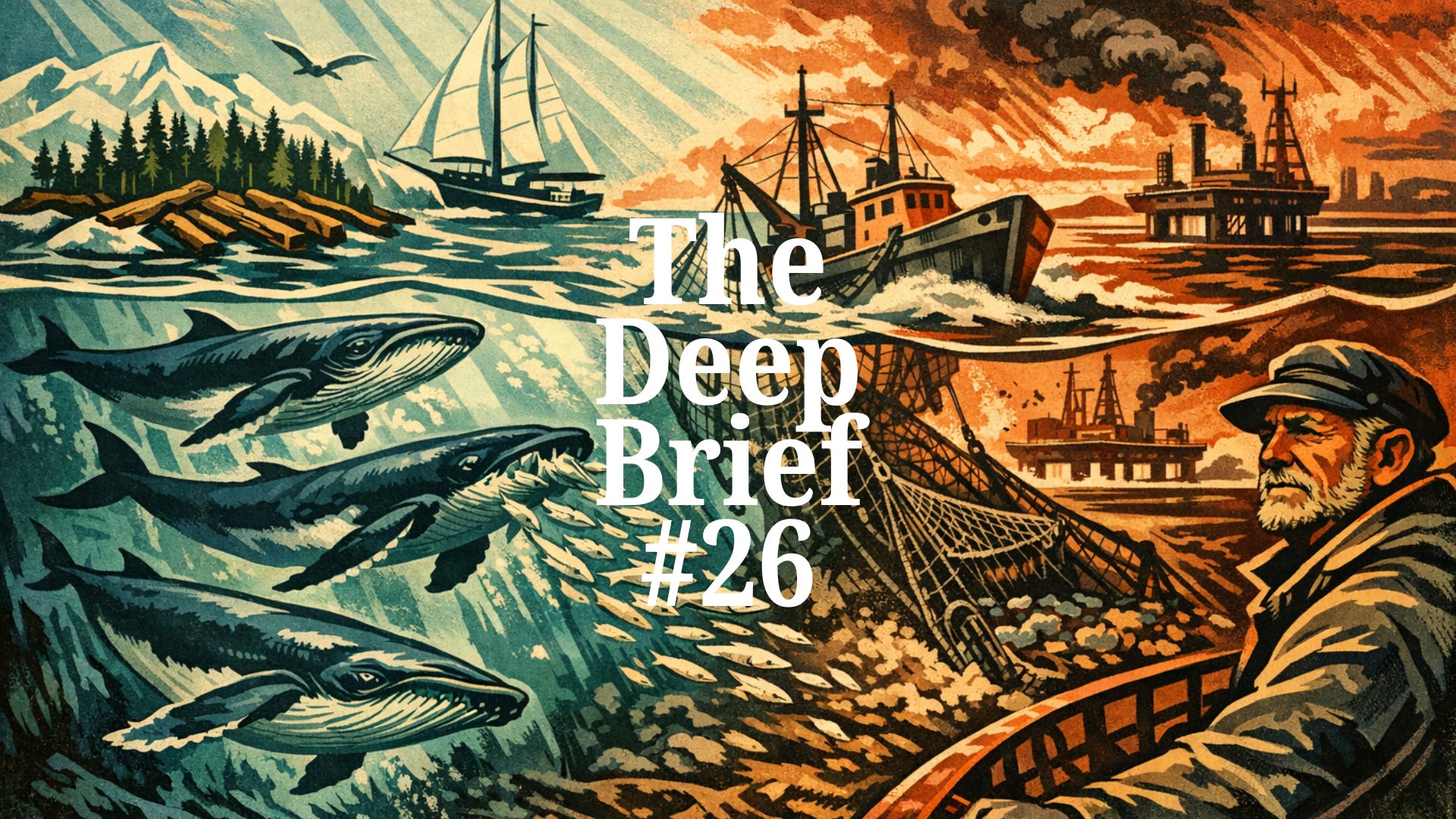
The ocean story this week is about adaptation under pressure, and the systems that keep failing.
Whales in the North Atlantic are changing what they eat. A 28-year study reveals that as krill declines, fin, humpback and minke whales have shifted to fish-based diets and are increasingly avoiding competition by staying in separate feeding niches. It is a sign of resilience. It is also a sign of an ecosystem running out of margin. Scotland has designated 37% of its waters as marine protected areas. Bottom trawling continues in 95% of them. A promised consultation on enforcement has been delayed again. Fishermen who watched their grounds destroyed over decades are still waiting for protections that exist only on paper.
In other news, a new sail-powered research platform is attempting to democratise ocean science by removing the financial and environmental barriers that keep vital research from happening. Researchers propose sinking boreal trees to the Arctic Ocean floor to store carbon for millennia, though similar ventures are already selling carbon credits without robust verification. Ireland’s ocean economy is worth €8.4 billion annually, a reminder of what is at stake in waters where policy continues to lag behind rhetoric.
Three deep dives. Three quick hits. One hard truth from the sea.
Deep Dives
Whales are running out of food. They are adapting. For now.
Three decades of data from the Gulf of St Lawrence reveal that North Atlantic whales are fundamentally changing what they eat.
A study published this week in Frontiers in Marine Science analysed 1,110 skin samples from fin, humpback and minke whales collected between 1992 and 2019. Researchers tracked chemical markers in the skin samples, signatures that act as dietary fingerprints, revealing what whales ate and where they sit in the food web.
The findings show an ecosystem under pressure. Fin whales fed primarily on krill in the 1990s. By the 2000s they had switched to capelin, herring and mackerel. By the 2010s they had shifted again to sand lance and northern krill. Humpbacks maintained their fish-heavy diet throughout. Minke whales ate mostly fish but increased their krill consumption later in the study, suggesting they exploit whatever niche opens up.
The clearest signal of stress is the collapse in dietary overlap between species. In the 2000s, humpbacks and minke whales shared 56% of their feeding niche. By the 2010s, that figure had dropped to 9%. Fin and minke whales showed similar divergence: 42% overlap falling to 29%.
Resource partitioning is what happens when food becomes scarce and species divide up what remains to avoid direct competition. It is not cooperation. It is survival strategy.
‘This strongly suggests a decline in resource availability and increased competition at both intra- and interspecific levels,’ said lead author Charlotte Tessier-Larivière of Canada’s Maurice Lamontagne Institute.
The Gulf of St Lawrence is warming faster than most of the world’s oceans. Arctic krill, a foundation species for these waters, appears to be declining. The whales are intelligent, mobile animals with the capacity to adapt. The concerning part is that they are being forced to.
Whether this adaptation holds depends on forage fish populations: capelin, herring, mackerel, sand lance. These species now sustain all three whale populations. If they decline too, the margin for error disappears.
Read the study via Frontiers in Marine Science
Scotland’s marine protected areas protect almost nothing
Scotland has designated 37% of its waters as marine protected areas. Bottom trawling and scallop dredging continue in roughly 95% of coastal waters, including within those protected zones.
An investigation by the Associated Press profiles fishermen who have watched Scotland’s seabeds destroyed over four decades. The story traces the damage back to 1984, when a longstanding three-mile ban on bottom trawling around much of the coast was repealed. Fish landings in areas like the Clyde collapsed. Many species are now a fraction of their historical levels.
Bally Philp has fished for more than 30 years. He started on trawlers in the late 1980s, where his job was shovelling dead bycatch overboard. He resolved to fish with baited traps instead, a method that causes minimal habitat damage and allows unwanted catch to survive. That choice has meant limiting himself to the shrinking number of areas where such fishing remains viable.
‘The inshore archipelagos on the West Coast of Scotland used to be full of fish,’ Philp told AP. ‘We have no commercial quantities of fish left inshore at all.’
The Scottish government had indicated it would launch a consultation on fisheries management measures for coastal protected areas in late 2025. In December, officials announced the consultation would be delayed at least six months, citing upcoming parliamentary elections and late delivery by external contractors.
A 2023 Marine Conservation Society analysis found that banning bottom trawling in UK offshore protected areas could deliver a net benefit of up to £3.5 billion over 20 years, accounting for increased carbon storage, pollution removal, nutrient cycling and recreation opportunities. The economic case for protection is stronger than the case for continued destruction.
Philp, who comes from three generations of fishers, says he will be the last in his family to make a living this way. He taught his two sons how to fish but has discouraged them from making it a career.
‘We’re at the arse end of something that was once really good,’ he said. ‘Unless we can turn that around, why would anyone want their kids to do this?’
Read the investigation via Associated Press
A sail-powered platform for ocean science
The greatest obstacles to understanding marine life are often not scientific. They are financial, logistical and environmental. Research vessels are expensive. Time at sea is scarce. Fuel-intensive expeditions carry a footprint that sits uncomfortably alongside conservation goals. For many scientists and NGOs, the ocean remains out of reach.
Ocean Roamer is a response to that reality.
Launched this month by marine biologist Charlie Young and her partner Alexis d’Hennecourt, Ocean Roamer is a sail-powered expedition platform designed to make ocean research more accessible without compromising ambition. Operating at the intersection of science, conservation and storytelling, the project offers a different model: smaller, leaner, lower-impact, and built around collaboration.
‘We’ve witnessed firsthand how much vital ocean research is held back not by a lack of expertise or motivation, but by the financial, logistical and environmental barriers of working at sea,’ Young says. ‘Ocean Roamer is our response to that challenge. We want to help democratise access to ocean science.’
The model is already delivering results. Last year, the team partnered with Beneath The Waves to conduct the first comprehensive survey of shark populations in the southern Bahamas. During a six-week expedition, they deployed baited remote underwater video systems across three remote island chains, producing over 100 hours of footage and more than 1,000 hours of fieldwork. A scientific paper is now being co-authored from the findings.
In February, Ocean Roamer will partner with the Turks and Caicos Whale Project on a humpback whale research expedition. The region plays a critical role as a breeding and nursery ground for North Atlantic humpbacks, yet large areas of the Caicos Bank remain understudied. The expedition will collect baseline data through photo-identification, behavioural observations and acoustic monitoring.
‘This mission is particularly urgent as tourism activity in the region continues to increase, while formal protections for whales and their habitats are currently limited,’ Young explains. Following the expedition, Ocean Roamer plans to support a targeted advocacy campaign for stronger regulations.
The platform is built around three pillars: capability, literacy and story. Expeditions generate baseline data on wildlife and ecosystems, addressing critical gaps in understanding. Alongside data collection, the team documents work through film, photography and audio, translating research into narratives that travel beyond academic journals.
‘If we want meaningful conservation outcomes, people need to understand not just the threats the ocean faces, but why certain places and species matter, and what is truly at stake if we fail to act,’ Young says. ‘Real power sits with people: with public awareness, engagement and collective will.’
The long-term ambition is to grow beyond a single vessel into a fleet of small, sail-powered platforms positioned across key ocean regions. By reducing transit times and building regional knowledge, the model aims to maximise time where it matters most… in the field.
Read the full feature via Oceanographic Magazine
Quick Hits
Sinking trees in the Arctic: concept or carbon credit?
Researchers at Cambridge University have proposed chopping mature boreal trees, floating them down Arctic rivers, and sinking them to the deep ocean floor where cold, oxygen-free conditions would preserve the wood for millennia.
A paper published in npj Climate Action calculates that managing just 1% of boreal forest this way could remove one gigatonne of CO₂ annually. The concept is elegant. The barriers are enormous: coordination between geopolitical rivals, massive logging in remote wilderness, unanswered questions about Indigenous rights and deep-sea ecosystem impacts.
This matters because similar schemes are not waiting for answers. Running Tide has permits to sink 50,000 tonnes of biomass off Iceland and 450,000 tonnes in international waters. Multiple companies are selling carbon credits for ocean biomass sinking despite the European Commission stating that the science is not robust enough for such credits.
Read the paper via npj Climate Action
King Charles launches Antarctic ocean initiative with krill company
The Sustainable Markets Initiative, founded by King Charles III, has launched an Ocean Stewardship Initiative with an initial focus on supporting one of the world’s largest proposed marine protected areas in Antarctica.
The initiative backs the Argentina-Chile proposal at CCAMLR, the international body that governs Antarctic marine resources, to protect 70% of the Antarctic Peninsula. It was developed in partnership with Aker BioMarine and Aker QRILL Company, major players in the Antarctic krill fishery, with advice from the Marine Stewardship Council.
The Antarctic MPA proposal has been stuck at CCAMLR for years, blocked by Russia and China. This initiative cannot change that. What it can do is position krill extraction as compatible with conservation, a framing that benefits companies whose business model depends on continued access to Antarctic waters.
Whether this represents genuine progress or industry positioning depends on what happens when krill extraction and conservation goals conflict.
Read more via Nutraceutical Business Review
Ireland’s ocean economy: €8.4 billion and growing
Ireland’s ocean economy generated €8.39 billion in turnover in 2024, contributed €3.53 billion in gross value added, and supported over 49,000 direct jobs according to a new report from the Marine Institute. Including indirect impacts, the total economic contribution rises to €17.35 billion and more than 109,000 jobs.
Tourism, shipping and seafood remain the largest sectors. Emerging areas include marine renewable energy, blue biotechnology and advanced marine technology.
The numbers are a reminder of what is at stake in waters where policy continues to lag behind economic reality.
Read more via The Fishing Daily
Hard Truth from the Sea
Whales are not sharing food. They are dividing up what remains because there is not enough to go around.
Scotland is not protecting its seas. It is designating them on paper while allowing destruction to continue.
Meanwhile, a sail-powered vessel is doing what institutions have not: getting scientists into the field, generating data, and turning it into stories that travel.
The pattern holds. Where systems fail, people improvise. Where funding dries up, smaller platforms fill the gap. Where science stays locked in journals, storytelling breaks it out.
Resilience happens when the infrastructure does not exist and people build it anyway.
That’s the Deep Brief for this week. If you found it useful, share it with someone who needs to know what is happening below the surface.
Stories like this take time. Paid subscribers make them possible. If you want to see more accountability journalism on the ocean, please upgrade today!
See you next week.
- Luke