


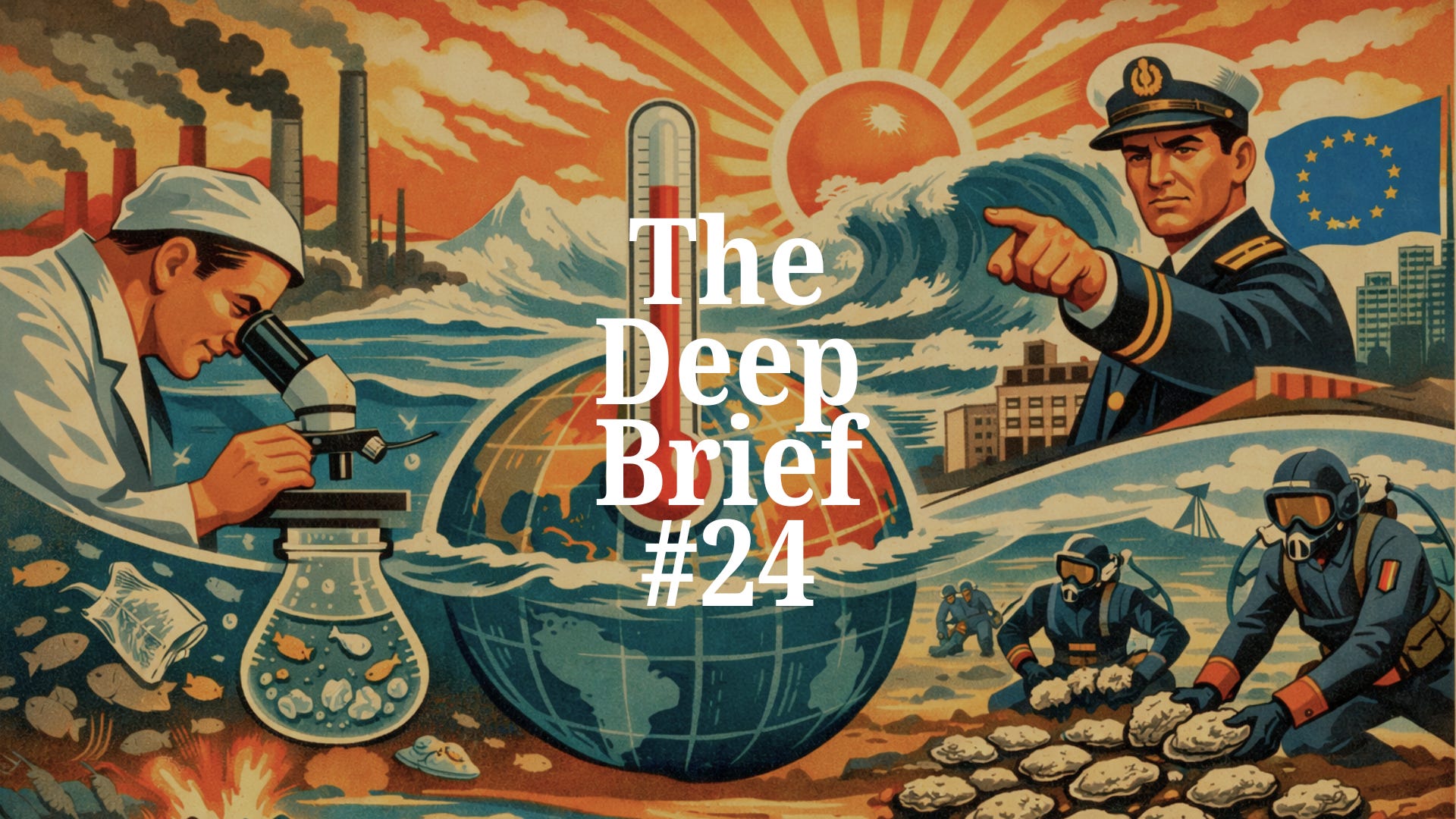
The ocean story this week is about records being broken and systems being tested.
New research argues that microplastics may be impairing processes that support ocean carbon dioxide uptake, a connection that has received less attention than other major climate drivers. Global upper ocean heat content has set another record, extending a nine-year run of record highs. Scientists report an increase of about 23 zettajoules in 2025, comparable to several decades of global primary energy use.
On the policy front, Cyprus has assumed the rotating presidency of the EU Council at a consequential moment for European ocean governance. Oceana and other advocates argue that some industry groups are using ‘simplification’ arguments to seek weaker or delayed implementation of environmental rules. In Northern Ireland, thousands of oysters have been deployed to the seabed in a first for restoration work of this kind in the region. New research also links slower seafloor spreading to a substantial sea level fall, on the order of tens of metres, between about 15 and 6 million years ago, alongside climate-driven effects. The ocean has many masters, and not all of them are human.
Three deep dives. Three quick hits. One hard truth from the sea.
Deep Dives
Microplastics may be weakening the ocean’s carbon sink
We talk about the ocean as a carbon sink. We talk less about what happens when we fill that sink with plastic.
A new synthesis of existing research argues that microplastics may be impairing the ocean’s ability to absorb carbon dioxide, one of Earth’s most important climate buffers. The review synthesises dozens of studies published since 2010 and makes a case that plastic pollution and climate change interact in ways that deserve to be analysed together, not treated as separate problems with separate solutions.
The biological carbon pump is the natural suite of processes that move carbon from surface waters into the deep ocean. Microplastics may be interfering with it at multiple points. Some studies suggest they alter the sinking behaviour of particles that carry carbon downward, changing where carbon gets released back into seawater. Others suggest microplastics affect phytoplankton physiology, with knock-on effects for carbon cycling. Degrading plastics may also release gases, although real world rates remain uncertain.
The scale of plastic pollution is not uncertain. Global production exceeds 400 million tonnes per year. About half is designed for single use. Less than 10% is recycled, depending on how you measure it. The authors argue that plastic pollution is now relevant to climate mitigation, even where the net effect size is still being quantified. That framing matters. It means the conversation about plastic is no longer just about turtles and beaches. It’s about whether one of our best natural defences against warming is being quietly degraded.
Read the paper in Journal of Hazardous Materials: Plastics
Another year, another ocean heat record
The world’s oceans absorbed more heat in 2025 than in any year in the instrumental record. Again.
An international team of more than 50 scientists from 31 research institutions reports that ocean heat content in the upper 2,000 metres increased by about 23 zettajoules, extending a nine year run of record highs. That number is hard to visualise. It is comparable to several decades of global primary energy use. It is enough to make the comparison feel absurd.
The warming is not uniform. About 16% of the global ocean area reached record high ocean heat content, with parts of the Atlantic, Pacific, and Southern Ocean highlighted as fast warming regions. Global mean sea surface temperature in 2025 was about 0.5°C above the 1981 to 2010 average. Warmer oceans increase evaporation and add moisture to the atmosphere, which raises the likelihood of heavier rainfall in some settings while shifting circulation patterns that influence drought risk in others.
Some analyses suggest ocean warming has accelerated in recent decades compared with the late twentieth century, although the exact rate depends on the dataset and the period chosen. The implications are well understood: marine heatwaves become more intense and longer lasting, thermal expansion contributes to sea level rise, and extra heat and moisture can strengthen storms. The uncertainty is no longer what the ocean is doing. The uncertainty is what people choose to do next.
Read the study in Advances in Atmospheric Sciences
EU fisheries laws face a major test
Cyprus has taken the rotating presidency of the EU Council at a high-stakes moment for European ocean policy. Over the next six months, the European Commission is expected to conclude its evaluation of the Common Fisheries Policy and decide whether to propose changes. The EU Ocean Act remains under development. The BBNJ High Seas Treaty is due to enter into force on 17 January 2026.
Oceana and other advocates say some industry groups are using ‘simplification’ arguments to seek weaker or delayed implementation of existing fisheries and environmental protections. The conservation group warns that rolling back safeguards could create regulatory uncertainty and undermine hard-won progress in fisheries recovery. The political pressure around environmental law is real and visible across multiple EU files. Whether it succeeds depends in part on what happens in the next six months.
Cyprus is home to EU Commissioner Costas Kadis, whose remit includes oceans. It also sits in a rapidly warming region with recognised pressures from invasive species and long-running concerns about fish stock status in parts of the wider Mediterranean. The country will face competing pressures from industry, member states, and civil society as it chairs these negotiations. How it navigates them will set the tone for European ocean policy through the rest of the decade.
I’ll be watching this closely. Expect more on the EU fisheries situation in the coming weeks.
Read more via Oceanographic Magazine
Quick Hits
Northern Ireland deploys its first seabed oysters
Ulster Wildlife has placed 2,000 adult European oysters and more than 30,000 juveniles onto the seabed in Belfast Lough, a first for Northern Ireland. European oysters disappeared from the Lough over a century ago, with overfishing and degraded water quality widely cited as drivers. The project followed the identification of a small surviving population in recent years.
Oysters filter water, stabilise sediments, and help build reef habitat that can support fish and invertebrates. The team calls them ‘small but mighty ocean superheroes.’ They are also a reminder that restoration is possible if you start before the last ones are gone.
Tectonics, not just climate, shaped an ancient sea level fall
New research argues that a major slowdown in seafloor spreading between about 15 and 6 million years ago contributed substantially to falling sea levels, on the order of tens of metres, alongside climate-driven effects. The study reports that plate-driven crust production slowed by about 35%, increasing ocean basin volume through reduced crust formation at mid-ocean ridges.
Climate remains central to modern sea level rise. Deep time reminds us that the ocean container itself can change shape, slowly, over millions of years, in ways that have nothing to do with ice or temperature.
Marine carbon removal is not ready to scale safely
A report released during COP30 in Belém cautions that marine carbon dioxide removal approaches are not ready to scale safely. The European Marine Board and partners highlight that robust monitoring and verification safeguards are not yet in place.
The ocean may play a role in carbon removal in the future. Emissions cuts remain the priority. Removal without governance creates new risks while offering false comfort.
Hard Truth from the Sea
The ocean took on enough additional heat in 2025 to match several decades of global primary energy use. It absorbs a large share of human-produced carbon dioxide and most of the excess heat trapped by greenhouse gases. Plastic waste is now widespread across marine systems, from surface waters to sediments.
The ocean is doing heavy lifting for climate stability while political systems argue over whether to weaken the rules meant to protect it.
That isn’t resilience, it’s borrowed time.
That’s the Deep Brief for this week. If you found it useful, share it with someone who needs to know what is happening below the surface.
See you next week.
- Luke
Based on the physical and chemical properties of microplastics and these are recently introduced to climate and ecosystems, the particles would disrupt any process they are concentrated. As in oceans, similar disruptions in atmosphere, blood, sea shells, plant nutrient uptake and assimilation. As with any system change good or bad, understanding, communication, timing always a challenge. Luke, you are finding a good balance of need to know, without overwhelming me - curious yes. Balanced with insight into competing interests tactics summarized in a manner that doesn’t leave me alarmed - concerned yes. Narwhals and plankton have a voice, potentially a chance with your advocacy - substack possibly the just right echo chamber.
In the heart of the great Pacific, a story is taking place that may change the way you see everything.
https://www.albatrossthefilm.com/