


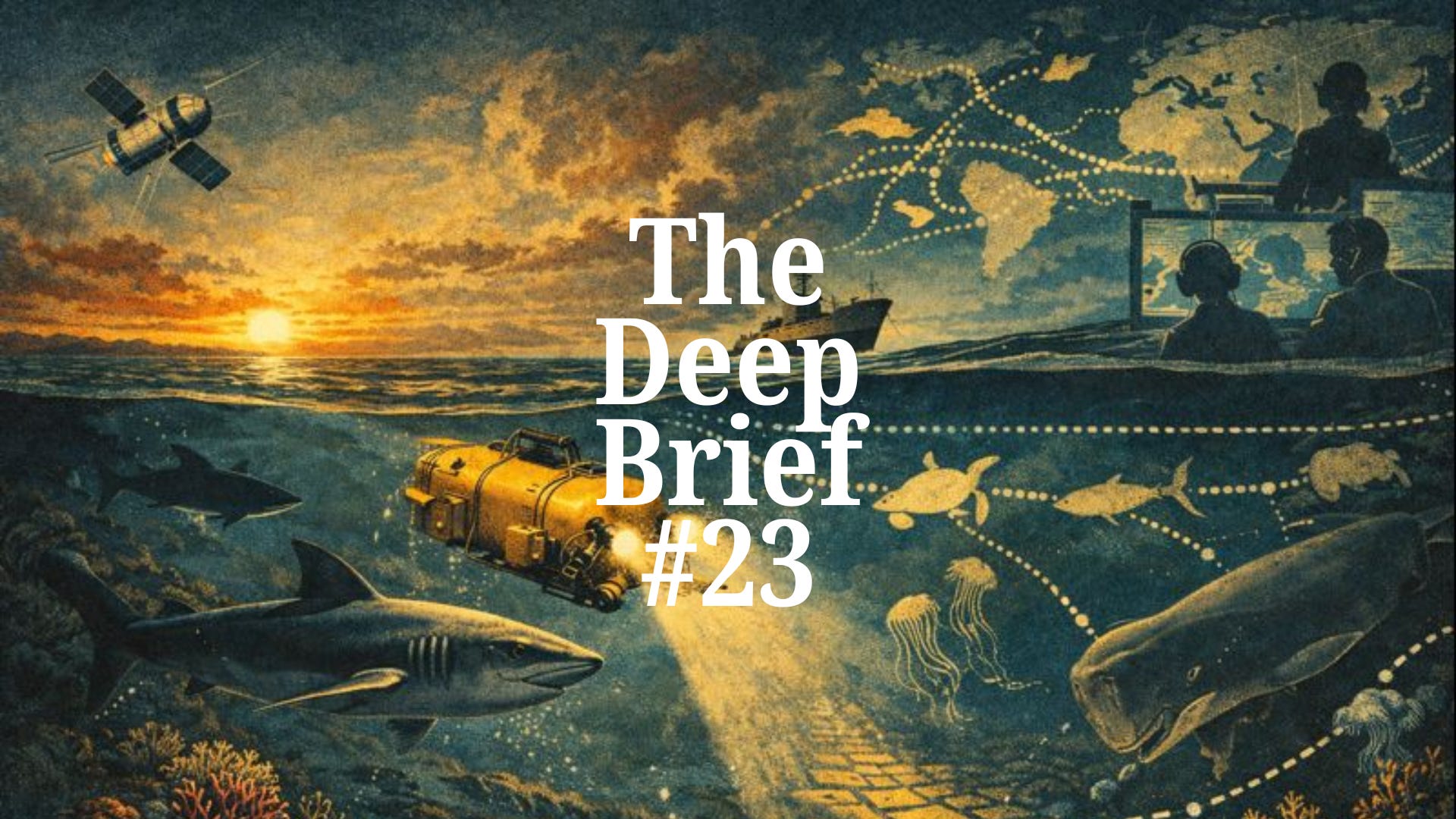
As we move into a new year, the ocean story this week is about the gap between what we know and what we’re deciding.
Iceland has become the first nation to treat ocean current collapse as a national security threat. Scientists have identified the missing link in the deep ocean food web, a connection we didn’t know we were missing. An international team has mapped the migratory routes of more than 100 marine species, revealing how little we understood about where they go.
A 2025 study confirmed what should stop us cold: we have visually explored less than 0.001 percent of the deep seafloor. We are making policy for an ocean we have barely seen.
Three deep dives. Three quick hits. One hard truth from the sea.
Deep Dives
Iceland treats ocean current collapse as a national security threat
Iceland has become the first country to classify the potential collapse of a major ocean current as an existential risk. The Atlantic Meridional Overturning Circulation (AMOC), the conveyor belt that pulls warm water northward and keeps Europe’s winters mild, is now on the agenda of Iceland’s National Security Council.
‘It is a direct threat to our national resilience and security,’ said Climate Minister Jóhann Páll Jóhannsson. ‘This is the first time a specific climate-related phenomenon has been formally brought before the National Security Council as a potential existential threat.’
Research suggests the AMOC could collapse between 2025 and 2095, with the most likely tipping point around 2057. As Greenland’s ice sheet melts, cold freshwater is pouring into the North Atlantic and threatening to shut the system down. If it fails, Northern Europe faces temperatures not seen since the last Ice Age. Rainfall patterns across Africa, India, and South America would destabilise. Marine ecosystems would collapse.
Ireland has briefed its prime minister. Norway is funding new research. Britain has committed £81 million to understanding when the tipping point might arrive.
Iceland is not waiting to find out.
‘The science is evolving quite rapidly and time is running out,’ said Stefan Rahmstorf of Germany’s Potsdam Institute. ‘The tipping point may well be quite close.’
The deep ocean’s missing link has been found
For years, scientists wondered why large sharks spend so much time in the ocean’s twilight zone, the dim layer between 200 and 1,000 metres that holds more biomass than any other part of the ocean. The zone is dominated by tiny organisms. What were apex predators doing there?
The answer: hunting mid-sized fish that nobody was tracking.
Researchers at Woods Hole Oceanographic Institution used satellite tags to follow bigscale pomfret for the first time. They found these fish are permanent residents of the twilight zone, rising to shallower waters at night to feed and descending during the day. They are the link between the surface food web and the deep.
‘We always talk about the mesopelagic layer like it’s this giant buffet for big predators, but we’ve been skipping over the species in the middle,’ said WHOI biologist Camrin Braun. ‘If we don’t understand them, we’re basically trying to solve a puzzle with the middle pieces missing.’
The tracking was only possible because researchers partnered with commercial longline fishers, who tagged the fish as part of their operations. Without that collaboration, the data would not exist.
Coral reefs are setting the clock for ocean microbes
Coral reefs do not just host life. They schedule it.
Research from the Hebrew University of Jerusalem has revealed that reefs actively structure the daily rhythms of microbial communities in surrounding waters. By sampling every six hours across both winter and summer in the Gulf of Aqaba, researchers found patterns invisible to standard surveys.
Reefs consistently hold fewer bacteria and microalgae than open water, evidence of constant grazing and filtering. After sunset, populations of tiny predators surge by up to 80 percent. Genetic traces of the dinoflagellates living inside coral tissues peak at midday, tracking the sun.
‘These daily microbial rhythms were as strong as, and sometimes stronger than, seasonal differences,’ said lead researcher Dr Herdís Steinsdóttir.
The implication is practical: microbial rhythms could serve as early warning systems for reef stress, signalling trouble long before bleaching becomes visible. Only if we sample at the right time of day.
Three Quick Hits
New map reveals migratory connections of 100+ marine species. An international team has released Mico, an interactive map synthesising movement data from more than 100 species of birds, mammals, turtles, and fish. It connects nearly 2,000 critical habitats and shows how little we understood about where marine animals actually go. The map has already been used by seven UN bodies. Explore it here
Mosasaurs hunted dinosaurs in freshwater rivers. Isotope analysis of teeth found in North Dakota confirms that mosasaurs, the apex predators of Cretaceous oceans, also lived in rivers. Some grew to 11 metres. Carbon signatures suggest they fed on drowned dinosaurs. The finding rewrites assumptions about where these animals could survive. Read the study
Blue bonds tripled. The ocean is still $150 billion short. Blue bonds raised €13 billion between 2018 and 2023, triple the previous decade. They still represent less than 0.5 percent of sustainable debt. Ocean conservation needs $174 billion per year. SDG 14, Life Below Water, remains one of the least-funded global goals. The capital exists. It is going elsewhere. Learn more
One Hard Truth
We are governing an ocean we have not seen
In 67 years of deep-sea exploration, humans have visually surveyed between 0.0006 and 0.001 percent of the deep seafloor.
The upper estimate is 3,823 square kilometres. Slightly larger than Rhode Island. A tenth the size of Belgium. That is all we have seen.
In 2022, researchers exploring the Papahānaumokuākea Marine National Monument, one of the largest protected areas on Earth, discovered a formation on the seafloor that looked like a yellow brick road. ‘This is the road to Atlantis,’ one scientist said on the radio. It was fractured volcanic rock, its geometry shaped by ancient eruptions. The reaction tells you something: even scientists are still finding things that look like nothing they expected.
We have explored roughly 3 percent of that monument’s seafloor. The monument is larger than all US national parks combined.
We debate deep-sea mining rules for ecosystems we have never observed. We model carbon cycles in zones we have barely sampled. We set policy for places we cannot describe.
The ocean does not wait for us to understand it. The decisions do not wait either.
Iceland looked at the AMOC and concluded that uncertainty is not a reason to delay. It is a reason to act. The question is whether anyone else reaches the same conclusion before the window closes.
See you next week.
- Luke
Thank you.
I haven’t been following for long, but I’m curious where your beautiful illustrations come from? Can you credit the artist?