


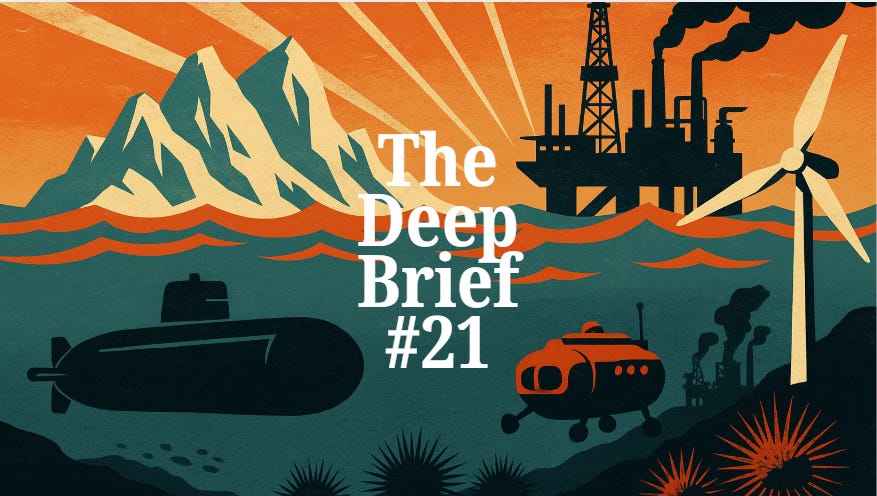
The ocean story this week is about hidden engines and exposed contradictions.
Scientists are uncovering carbon-fixing processes in the deep ocean that nobody predicted. A robot lost under Antarctic ice for eight months returned with data that rewrites our understanding of ice shelf vulnerability. Meanwhile, a global pandemic is silently wiping out sea urchins from the Caribbean to the Canary Islands, threatening coral reef recovery worldwide.
And as Europe invests €30 million to make wave energy bankable, BP celebrates its seventh major fossil fuel project of the year. The energy transition remains a contest.
Three deep dives. Three quick hits. One hard truth from the sea.
Deep Dives
The deep ocean is fixing carbon in ways nobody expected
The deep ocean’s carbon-fixing system works differently than scientists assumed for decades. Researchers at UC Santa Barbara found that ammonia-oxidising archaea, long thought to dominate carbon capture in the sunless depths, are doing far less of the work than expected. Instead, heterotrophic microbes, organisms typically seen as consumers of sinking organic matter, are contributing significantly to carbon fixation at depth. The finding reshapes how we understand carbon storage in Earth’s largest long-term reservoir and has implications for climate modelling. If heterotrophs can fix carbon even where specialised autotrophs are scarce, deep-ocean ecosystems may be more resilient than assumed. More questions follow: which microbes are responsible, what pathways are they using, and how does this fixed carbon move through the ecosystem?
Robot float survives eight months under Antarctic ice, returns with critical data
An Argo float deployed near Totten Glacier drifted south, vanished beneath the Denman and Shackleton ice shelves for eight months, and resurfaced with nearly 200 profiles from waters never before measured. The data reveals a mixed picture: the Shackleton ice shelf remains insulated from warm water capable of melting it from below. The Denman Glacier, which holds enough ice to raise sea levels by 1.5 metres, is more precarious. Warm water is already reaching beneath it. Small changes in that warm water layer could accelerate melt rates and trigger unstable retreat. The float also measured conditions in the boundary layer immediately beneath the ice, providing information that will improve climate models and reduce uncertainty in sea level projections. Deploying more floats along the Antarctic continental shelf could transform our understanding of how much ice the ocean will take.
A silent pandemic is pushing sea urchins toward extinction
A mass mortality event has driven populations of diadem sea urchins across the Canary Islands to historic lows since 2022. In Tenerife, numbers have fallen by 99.7%. Larval production and juvenile recruitment have nearly ceased. Similar die-offs have been recorded in the Caribbean, Mediterranean, Red Sea, and western Indian Ocean. Scientists believe a waterborne ciliate pathogen, first identified in Caribbean urchins, is responsible. Sea urchins are ecosystem engineers: by grazing algae, they protect slow-growing corals and calcifying species. Without them, coral reef recovery becomes far harder. Researchers have developed genetic tests for early detection, but for populations already infected, there is no cure. The question now is whether the pathogen will reach the Pacific.
Three Quick Hits
Boaty McBoatface reveals how seabed shape drives ice shelf melt. University of East Anglia researchers used an autonomous underwater vehicle to survey beneath the Dotson Ice Shelf in Antarctica. They found that the shape of the seabed matters more than current speed in determining how warm water reaches ice. The gradient of the bedrock is the key factor in upward heat transport, which could reshape modelling of ice shelf collapse. Learn more
Complex life began evolving in Earth’s oxygen-free oceans nearly a billion years earlier than thought. University of Bristol researchers used molecular clock analysis to show that crucial cellular features emerged in ancient anoxic seas long before atmospheric oxygen became abundant. The finding rewrites assumptions about what conditions early life required and ties evolutionary biology directly to ocean chemistry. Read the study
Europe invests €30 million to scale wave energy in UK waters. CorPower Ocean will lead the POWER-Farm EU project, backed by €19 million from Horizon Europe, to validate wave energy technology at commercial scale in Scotland. Wave energy could supply up to 17% of electricity in key EU countries by 2050 and deliver over £30 billion to the UK economy under high-ambition scenarios. The UK has 25GW of practical wave deployment potential. BP’s seventh oil project this year took two months less than planned. Wave energy is still waiting for its first government contract. Learn more
One Hard Truth
The fossil fuel industry is not slowing down
This week BP announced its seventh major upstream project of 2025: the Atlantis Drill Center 1 expansion in the Gulf of Mexico. The project adds 15,000 barrels of oil equivalent per day. It came online two months ahead of schedule. BP plans to reach one million barrels of oil equivalent per day from US production by 2030.
This is not news in the sense of being unexpected. It is news in the sense of being ignored.
The same week brought €30 million for wave energy and breakthrough research on ocean carbon storage. These stories share column space with an industry moving faster, spending more, and planning further into the future than almost any renewable sector.
The contradiction is not hidden. It sits in plain sight.
BP’s press release celebrates delivering new barrels at pace and with lower production costs, in service of growing long-term value for shareholders. The company operates five production hubs in the Gulf and holds interests in four more. It is planning additional expansions through 2030 and beyond.
Energy transition language has become common in corporate communications. So has expansion. The two exist in parallel, not in sequence.
If you want to understand the pace of climate action, do not read the pledges. Read the project announcements. Count the wells. Track the barrels. The numbers tell you what the words do not.
The sea urchin pandemic, the Antarctic data, the BP expansion. Stories like these take time to find and explain properly. Paid subscribers make that possible.
The sea has no voice of its own. It needs ours.
Why Readers Subscribe
Early access to podcast episodes and transcripts
Monthly 5,000-word investigative reports
Exclusive Q&As and behind-the-scenes dispatches
Ad-free, independent ocean journalism
Thank you to every Founding Member and paid subscriber who makes this possible.
See you next week.
— Luke
You got great great writing skills! Anyway how I can support you with labor?
The Case for Plant Based
https://sustain.ucla.edu/food-systems/the-case-for-plant-based/
Eat more plants. The planet will thank you for it.
https://www.senseifarms.com/news/eat-more-plants-the-planet-will-thank-you-for-it