

The Act That Means Nothing
An insider account of what happens when Parliament passes a law and then discovers it doesn’t know how to use it.

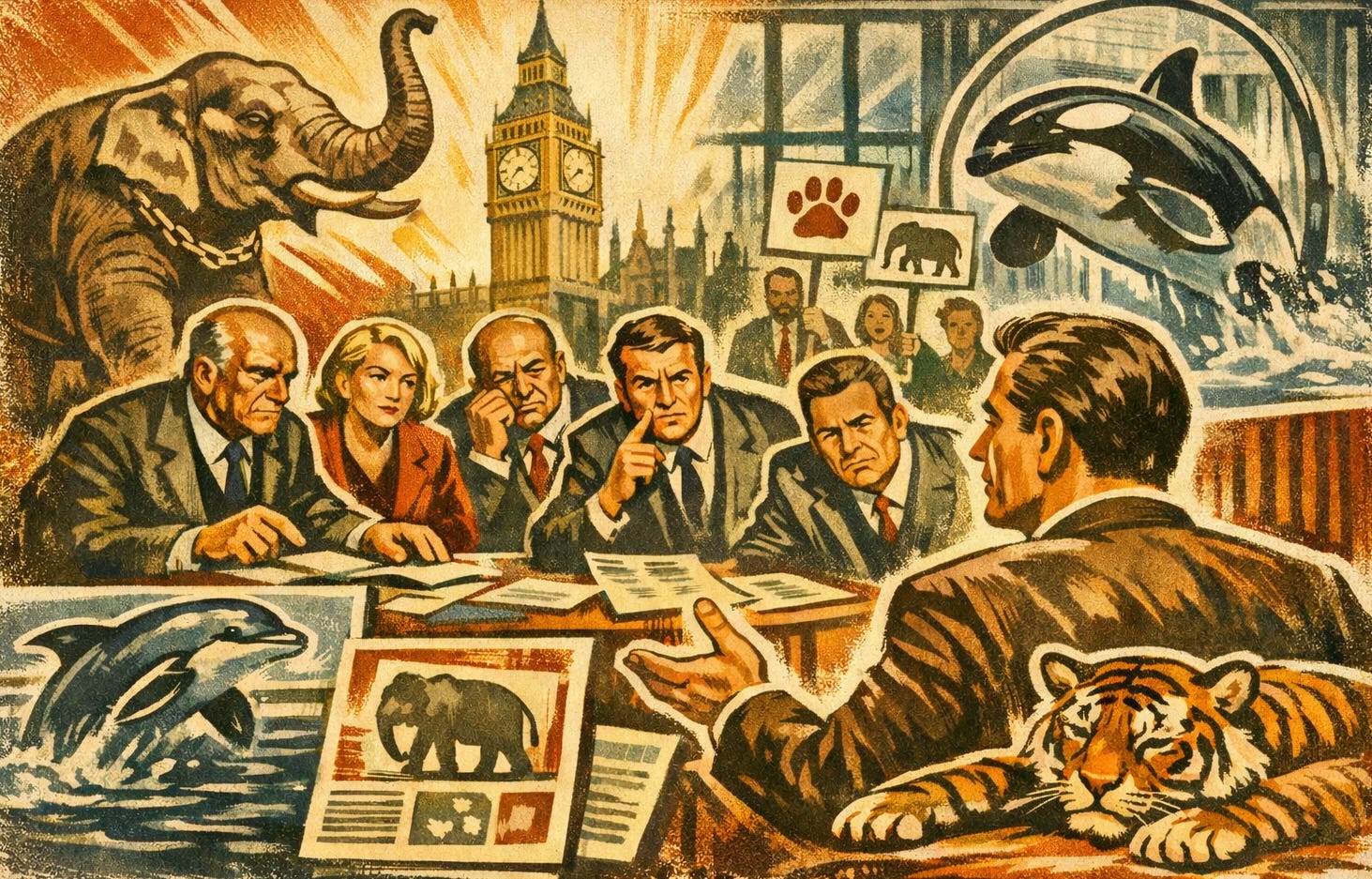
In Westminster last week, I found myself in an unusual position.
I was the one being asked for solutions.
Over the course of several hours, I spoke with more than a dozen MPs about the Animals (Low-Welfare Activities Abroad) Act 2023. These are the people who voted for it, championed it, celebrated when it passed. Some of them had faced constituents who wrote to them about it, who signed the petition, who genuinely believed that when the Act received Royal Assent in 2023, something had changed.
Almost none of them could quite explain what had gone wrong. Several of them asked us, the coalition of animal welfare organisations standing in Parliament with signs and briefing documents, what they should do next.
That is the story. Not a broken promise. Something more structural than that, and in some ways more troubling.
The Win
The campaign that produced the Animals (Low-Welfare Activities Abroad) Act was, by any measure, a genuine popular movement.
1.2 million people signed a petition calling for a ban on UK firms marketing holiday venues that exploit animals. The Bill passed with cross-party backing, championed by Conservative MP Angela Richardson in the Commons and Lord Black of Brentwood in the Lords. Labour supported it. The Liberal Democrats supported it. Animal welfare organisations from across the sector, each focused on different species and different battles, stood behind it together.
When it received Royal Assent on 18 September 2023, the headlines said the UK had banned the advertising and sale of low-welfare animal tourism. Elephant rides. Dolphin shows. Tiger cubs drugged for tourist photographs. The British public had asked Parliament to act, and Parliament had acted.
Except it hadn’t. Not really. Not yet.
The Small Print
The Animals (Low-Welfare Activities Abroad) Act 2023 does not ban anything.
What it does is create a framework under which future bans could be introduced, through secondary legislation, if and when the government chooses to use it. The Act names no species. It specifies no activities. It sets no timetable. It creates no obligation on any minister to act.
Secondary legislation is the follow-up law that fills in the details: it names the species, specifies the banned activities, creates the enforcement mechanism. Without it, the framework law is a locked door. As of today, March 2026, that door has never been opened. A UK travel company can still legally advertise elephant rides in Thailand, swimming with captive dolphins in Mexico, or interactions with drugged big cats in South Africa. Two and a half years after Parliament said no, the answer is still yes.
This was not a secret. In the Lords debate on the Bill in July 2023, Baroness Bakewell of Hardington Mandeville spotted it directly. She raised concerns about loopholes, about enforcement, about the gap between framework and function. Lord Benyon, then the Minister, acknowledged the constraints. His response, broadly, was this: let us not make the perfect the enemy of the good. Get it on the statute book. Trust that the rest will follow.
The rest has not followed.
Two Years of Nothing
In September 2025, Lord Randall of Uxbridge asked the government a simple question in the Lords: when do you intend to introduce the activity regulations that would make this Act function?
The minister who answered was Baroness Hayman of Ullock, the Parliamentary Under-Secretary at DEFRA. She had supported the Bill from the Labour benches when it passed. She was now the person responsible for implementing it.
She could not give a date.
She said the process was proving ‘more complex than I would have liked.’ She said the government needed to determine which activities to prioritise, whether advertised activities met the criteria for low welfare, and whether enforcement bodies could identify the party placing advertisements. All of this, she acknowledged, was challenging, because much advertising originates outside the UK.
These are not unreasonable observations. They were also entirely predictable from the text of the Act on the day it passed. The political moment was there. The legislative infrastructure was not. Parliament moved anyway.
What followed was two years of inaction under the Conservative government that passed the Act, and then, after the July 2024 election, continued inaction under Labour. Duncan McNair, founder of Save the Asian Elephants and leader of the Low-Welfare Act Coalition, is unambiguous about where responsibility now sits. ‘Successive Secretaries of State have thus far failed to table the required regulations,’ he told me. ‘Environment Secretary Steve Reed, having made pledges of support for the Act before his party was elected to power, now seems intent on ignoring the law and is talking about industry-led, non-legislative action.’ If that characterisation is accurate, it would hand control back to the travel industry whose voluntary measures were insufficient before the Act existed.
Lord Black, who had piloted the legislation through the Lords, said he was ‘profoundly disappointed.’ He reminded the chamber of Andrea Taylor, a 20-year-old killed by an elephant at a Thai resort in 2000, one of at least 700 tourists and others killed by elephants connected to the tourism industry, according to figures cited by Lord Black drawing on Save the Asian Elephants research. He asked whether it was not unacceptable that, until the law was implemented, there would be more Andrea Taylors.
The minister agreed it was unacceptable. She still could not give a date.
In the Room
I was in Parliament on 4 March as part of a coalition that included Whale and Dolphin Conservation, Save the Asian Elephant, PETA, World Animal Protection, Born Free Foundation, and other organisations. We were there to make the case, directly to MPs, that the time for complexity had passed.
What I did not expect was to find, in the parliamentary record, a sequence of events that tells a different story about why the Act has not moved. That sequence begins with a funded trip to Tenerife, a reception on the parliamentary estate, and a document featuring an orca on the chairs of a parliamentary reception. Paid subscribers read the full investigation below.
