


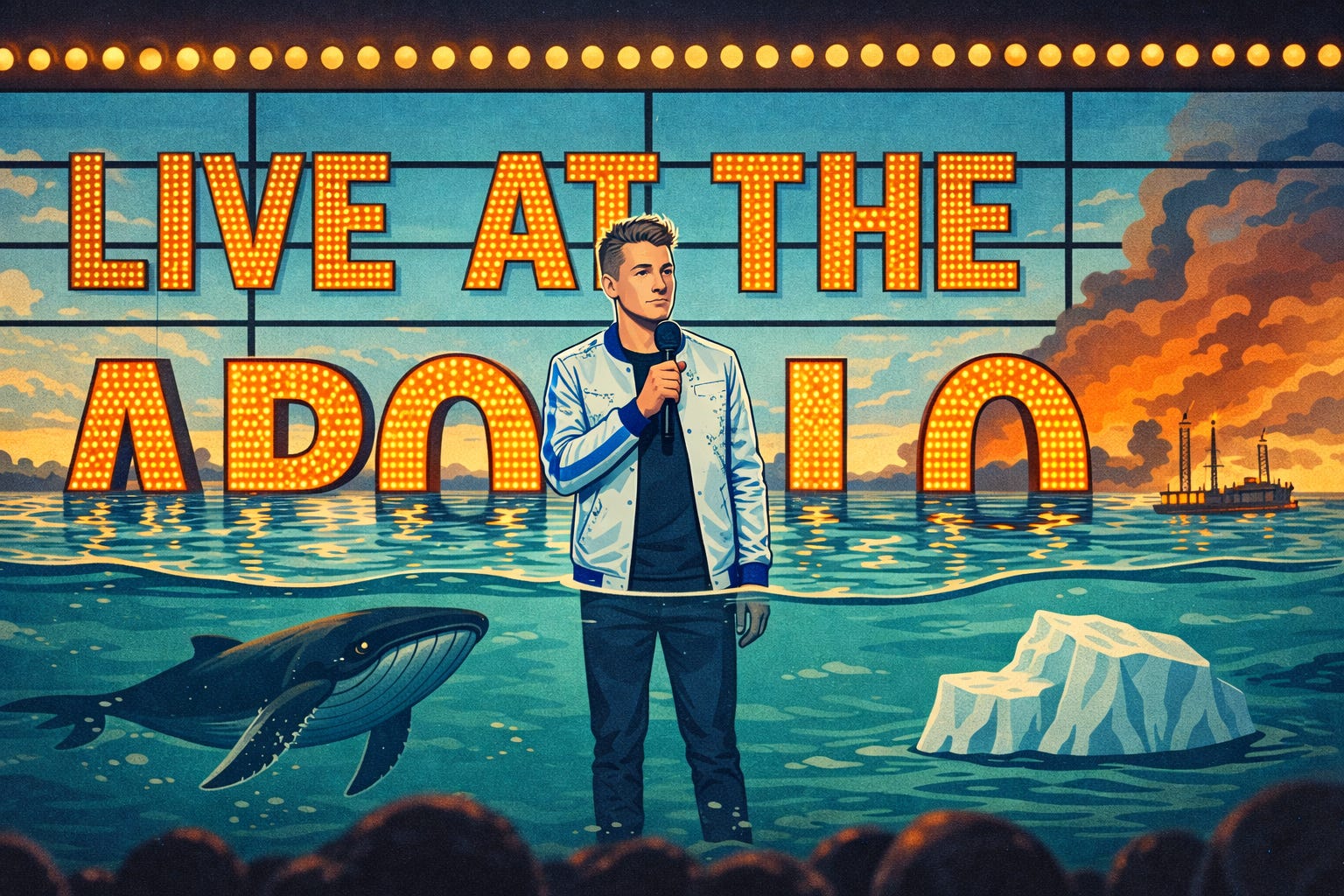
A comedian walks on stage and tells a joke about the end of the world. The room goes quiet. Not the good kind of quiet, the kind where you can hear chairs shifting, where people are looking at their drinks, where the air itself seems to thicken with discomfort.
This is the moment Stuart Goldsmith has learned to love.
‘I found it incredibly challenging to get people to laugh about climate for all the sorts of reasons you can imagine,’ he tells me. ‘Fear, complicity, complexity. That sort of fascinated me.’
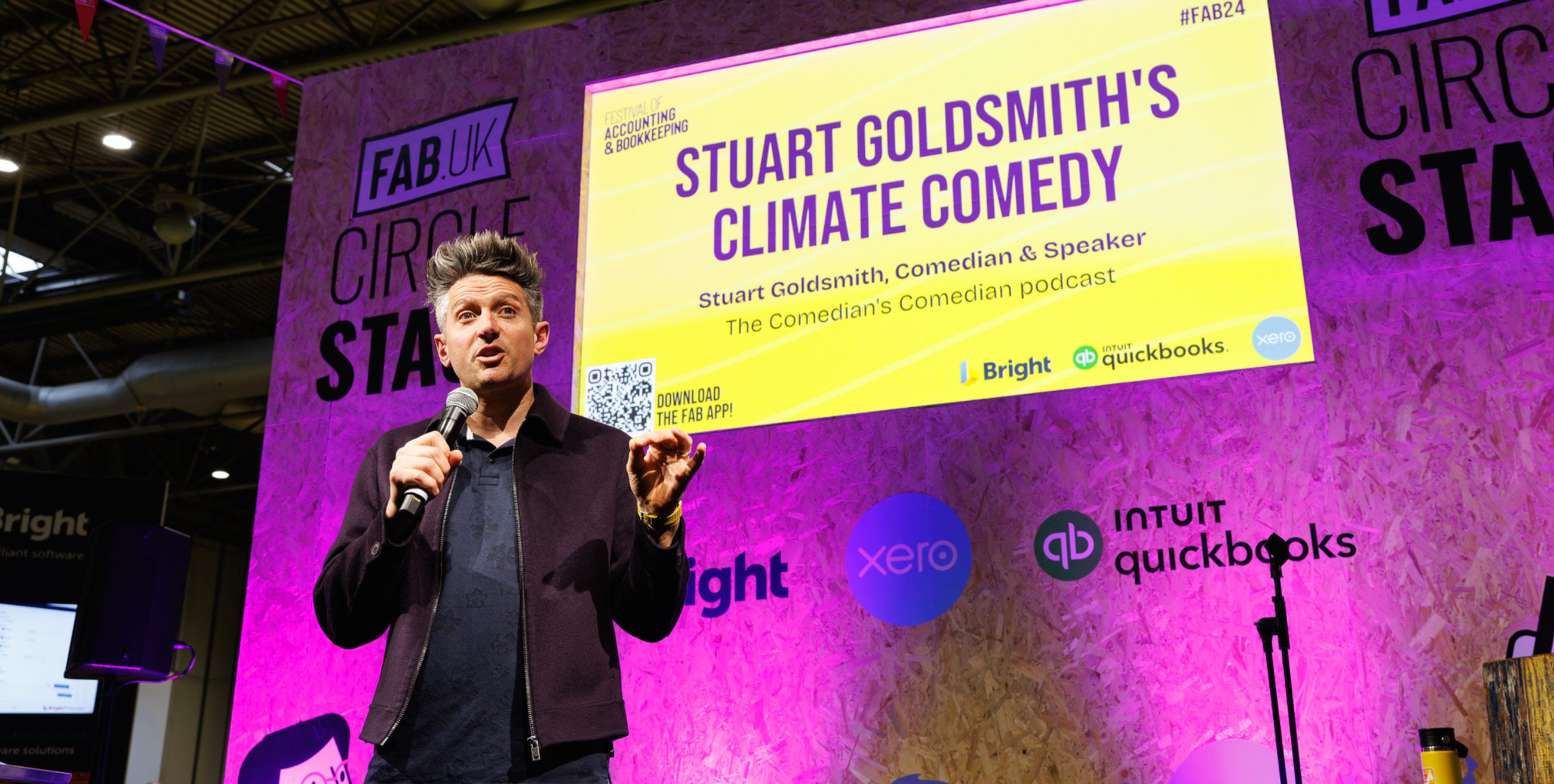
Fascination is one word for it. Most comedians, when they find material that dies, move on. Stuart moved in. He started writing more climate jokes, testing them in clubs, refining them through failure. Four years later, he performs climate comedy on the BBC, at corporate sustainability events, activist gatherings, and regular weekend club shows. He has built a new career from the silence that follows a joke about extinction.
This is Ocean Heroes. Each month, I write about someone who changed what’s possible for the sea. Scientists. Lawyers. Activists. Fishers. Artists. Indigenous leaders. Some are still working. Some we’ve lost. All of them have strived to leave the ocean different than they found it.
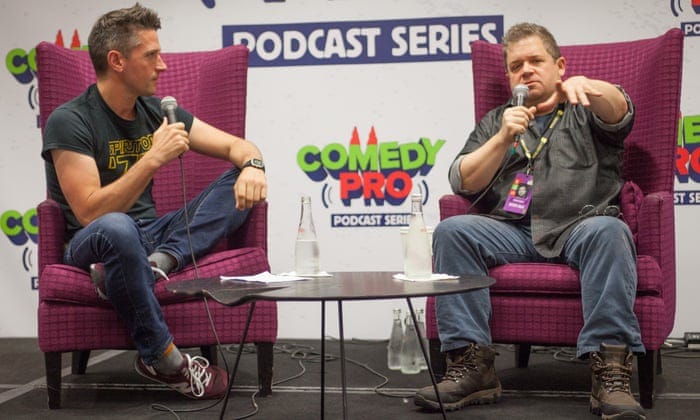
Stuart’s credentials for this peculiar calling are unusual. He trained at circus school. He worked as a court jester at Warwick Castle. As the street performer ‘Beautiful Stu’, he won the Street Performance World Championship by walking a tightrope while eating a packet of crisps. His podcast, The Comedian’s Comedian, has amassed over 25 million downloads across 500 episodes of in-depth interviews with comics about their craft. He has performed at Live at the Apollo.
None of that prepared him for climate. He had to figure that out himself.
The Craft of Climate Comedy
Climate communication has two dominant modes: guilt and despair. We are told we should feel bad about flying, eating meat, buying things wrapped in plastic. We are shown graphs of rising temperatures and maps of melting ice. The implicit message is always the same: you are part of the problem.
It is not working particularly well. Emissions keep rising. Public attention drifts. The people who most need to hear the message have learned to tune it out.
Stuart thinks comedy might offer a different way in.
‘Comedy has a quasi-magical ability to address the elephant in the room,’ he says. ‘It’s all about the unspoken truths, and there are lots of them in climate - things we’d rather not say. That means there’s a huge amount of pressure built up, which we’re all walking around feeling most of the time, and that’s great juice for the pressure-release valve of a joke.’
What does that look like in practice? He walks me through a joke he is particularly proud of:
‘Climate is full of contradictions. Earlier this year I flew to America to speak at a climate conference; I know that’s bad. But it’s better I think than flying to America and not speaking at a climate conference. Like you’ve all done.’
The structure is classic misdirection. The audience expects self-flagellation, then finds themselves implicated instead. But the mechanics matter less than the effect. Climate discourse is paralysed by hypocrisy anxiety. People stay silent because they fear being called out for their own carbon footprint. Stuart’s approach disarms that defence by starting with his own imperfection.

‘My approach is always to skewer my own hypocrisies first,’ he explains, ‘and in doing so open up a space where I can playfully condemn my crowd for theirs.’
The result is not absolution. It is permission. Permission to talk about climate despite flying occasionally, despite eating meat sometimes, despite being compromised in all the ways modern life makes us compromised. Permission to care imperfectly, which is the only way any of us can care at all.
Does Comedy Actually Change Anything?
The obvious objection: laughter is a pressure valve. People laugh, feel better, go home, do nothing. If anything, climate comedy might make things worse by letting audiences discharge their anxiety without acting on it.
Stuart is honest about the limits of evidence.
‘I believe comedy changes behaviour, though I can’t prove it,’ he admits. ‘Comedy changes people, people change the world.’
The research offers cautious support. Studies in health communication have found that humour can lower defensive responses to threatening information - the psychological barriers that make people reject messages about smoking or unsafe sex also apply to climate. A 2021 study in the journal Environmental Communication found that satirical climate content increased viewers’ sense that climate change was important and that they could do something about it, compared to straightforward news coverage. The effect was modest but measurable.
The mechanism seems to be attention. Humour gets past the defences that earnest messaging triggers. It creates engagement where lecturing creates resistance.
Not everyone in the climate movement welcomes this. There is a strand of activist thought that views humour as fundamentally inadequate to the scale of the crisis, and that making people laugh about extinction domesticates it, makes it familiar, drains the urgency. Stuart’s counter is implicit in his work: that urgency without engagement is useless, that a message no one can bear to hear is no message at all. Whether that trade-off is worth it depends on what you believe communication is for.
Stuart’s own answer is practical rather than philosophical. His goal is not to solve the crisis with punchlines. It is simpler and perhaps more useful: to get people talking.
‘My biggest mission is to get more ordinary people talking about the climate. Feeling like they’re able to actually have conversations despite whatever feelings of guilt or complicity or shame or despair that they may have experienced. Comedy is brilliant for that.’
Resilience and Failure
His podcast has given him an unusual education in bouncing back. Comedians, he has learned, are specialists in failure. They drive to distant towns, stand alone on stage in front of strangers, tell jokes that rarely work the first time, get heckled, endure silence, bomb, and then do it again the next night.
‘Comedy is based on trying and failing, time and time again, and cultivating the ability to bounce back,’ Stuart says. ‘That’s a learnable quality.’
He now teaches this to climate professionals in a session he calls ‘Climate Crowdwork’, exploring strategies for being heard and coping when it feels like no one is listening. The parallel is not accidental. Climate advocates face constant rejection. Policies stall. Public attention wanders. The emotional toolkit comedians develop for surviving a bad night might be exactly what the movement needs.
Why Ocean Heroes?
Stuart’s work is climate-focused, not ocean-specific. So why include him in this series?
The distinction is artificial. Climate is ocean. The sea absorbs roughly a quarter of the carbon dioxide humans emit and captures over 90 percent of the excess heat. Ocean acidification, coral bleaching, marine heatwaves, shifting fish populations… these are not separate from the climate crisis. They are the climate crisis, expressed in salt water.
Stuart knows this. The ocean surfaces in his material in unexpected ways.
‘One of my earliest climate jokes was about microplastics in the ocean, and I have a newer routine about kelp farms,’ he tells me. ‘To contrast that, an early failure was a bit about ocean acidification. I just couldn’t explain it AND keep their hopes up, within the confines of a short gag.’
Then he mentions whale carbon: the way great whales absorb CO2 through their lives and carry some of it to the seafloor when they die. ‘That blows my mind,’ he says, ‘if not my blowhole.’
He is referring to what marine scientists call the ‘whale pump’. The role great whales play in ocean carbon cycling through their feeding, defecation, and eventual deaths. A 2010 study in PLOS ONE estimated that before industrial whaling, whale populations sequestered nearly 200,000 tonnes of carbon annually through their carcasses alone. Restoration of whale populations is now recognised as a legitimate climate intervention.
Like most people who don’t work in whale research, Stuart did not know the full science behind it. He just thought whales and carbon was interesting. That instinct, finding the surprising connections, making the invisible visible, is exactly what climate communication needs more of.
The Climate Venn Diagram
When I ask what advice he would give to readers who want to use their own skills for the planet, Stuart points me to Dr Ayana Elizabeth Johnson’s concept of the ‘climate Venn diagram’: the intersection of what you are great at, what you love doing, and what the climate needs.
‘I went nuts for that and it changed my life,’ he says.
He pauses, then adds: ‘She did go on to say on a podcast that a lot of people decide their climate work will be “telling other people about the climate crisis”, which is faintly embarrassing for me. But I do think talking about it more is our most powerful personal action, plus I have literally no other skills and I’m quite good at talking, so I’ll have to live with the shame.’
Closing Reflection
The climate movement has a communication problem. The facts are clear, the science is settled, the stakes could not be higher, and still, emissions rise. Public concern fluctuates with news cycles. The people who most need to change their behaviour have learned to tune out the warnings.
Part of the problem is tone. Decades of messaging built on guilt and fear have not delivered the transformation we need. The psychology is clear: when people feel attacked, they defend. When they feel hopeless, they disengage. When they feel judged for their imperfections, they stop listening.
Comedy offers something different. It is not a solution, Stuart would be the first to say so. It will not decarbonise the economy or restore whale populations or stop the acidification of the seas. What it can do is open doors that earnest messaging keeps closed. It can create the conditions for conversation. It can give people permission to care despite their contradictions.
What keeps him going? Sometimes his kids, wanting a bright future for them. Sometimes obligation to the people already suffering climate shocks. Sometimes, he admits, sheer bloody-mindedness.
The climate movement could use more of that. More people willing to walk into the silence that follows a difficult joke. More people willing to fail, adjust, and try again. More people using whatever skills they happen to have… circus training, podcast interviewing, the ability to make a room full of strangers laugh, in service of a planet that desperately needs new ways of being heard.
Stuart Goldsmith is not going to save the ocean. Neither is anyone else, alone. He is doing something most of us struggle to do. He’s making people talk about the crisis without making them want to leave the room.
That is worth celebrating.
Stuart Goldsmith performs climate comedy at corporate events and public shows. His podcast, The Comedian’s Comedian, is available wherever you get podcasts. To find out more about his resilience keynotes and climate sessions, visit stuartgoldsmith.co.uk
You can also create a message that identifies the financial benefits of taking action. Either way humour has to be a good way of breaking device on the topic.
Love him!