


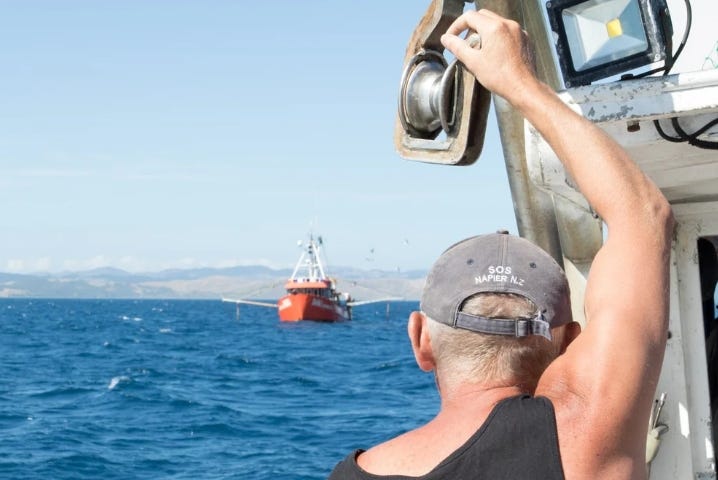
New Zealand’s Government said its Fisheries Amendment Bill would make fisheries decisions faster and more certain, and that sustainability remained the bottom line. Under the Bill, a Minister could set annual catch limits up to five years ahead. It would also give anyone wanting to take a fisheries decision to court 20 working days to file their case, and put footage from cameras on fishing boats beyond the reach of the Official Information Act, the law that lets anyone ask for government information. The Bill lapsed when Parliament shut down for the election on 1 October 2026.
New Zealand controls about 4 million square kilometres of sea, and within it the country manages 642 fish stocks. A stock is a species in a particular area, so one species can be several stocks. Around 350 are fished regularly, and they vary hugely in their biology and importance.
Shane Jones, the Minister for Oceans and Fisheries, ultimately makes decisions such as how much fish can be caught, and the advice he does, or doesn’t, follow comes from Fisheries New Zealand, part of the Ministry for Primary Industries (MPI). Fisheries New Zealand informed Jones that there was one general process for setting catch limits, but with limited resources, only 20 to 30 stocks go through the sustainability-setting process each year. It argued that the system was too slow to respond when changes were needed, whether that be to increase catches when stocks were abundant, or reduce them when sustainability risks emerged.
Jones set out the Government’s position when consultation opened in February 2025. “Sustainability will always be the bottom line in fisheries management,” he wrote, and he wanted catch limits to rise more quickly when stocks were doing well and fall more quickly when they were not.
With this Bill, the Minister could set catch limits several years in advance or approve what the Bill calls a “management procedure”, a set of rules agreed in advance that would allow MPI’s chief executive to adjust them later without starting the whole process again. That wouldn’t necessarily mean that a catch limit was fixed regardless of what happened, as monitoring would continue and the Minister could in fact change course if new information changed the picture.
The overall goal was to reduce the number of times the system had to regularly restart, which would give Fisheries New Zealand more resources to deal with other stocks, and fishing businesses could have more certainty about what they could catch. Jones said in June that the Bill wouldn’t be progressed before the next election.
The 54th Parliament was dissolved on 1 October, and the Bill lapsed before MPs had finished considering it. New Zealand voted on 7 November, with the official election results due on 27 November. The new Parliament can bring the Bill back, but it has not yet met. The proposed deadline for court challenges and the exemption for camera footage remain proposals, rather than law.
Who had access?
In March 2026, a Greenpeace Aotearoa campaigner called Jones “the seafood industry’s puppet” and wrote that he was promising “commercial fishing donors the world” to fund his campaign for re-election. Jones told Radio New Zealand in 2024 that his views on the importance of the fishing industry predated both his political career and any money he received, and he called suggestions that donations had tainted his judgement “factually incorrect but politically predictable”.
When I started looking at this story, I expected a story about political influence. Industry proposals were taken into the policy process, but what I didn’t find, in the Cabinet papers, ministerial briefings, Forum records and correspondence I reviewed, was anything linking a donation to one of those requests and then to a ministerial decision. Indeed, those records can show how proposals moved through government, but they aren’t, on their own, a record of political donations.
Jones set up the Seafood Industry Forum in February 2024, bringing senior figures from commercial fishing together with Fisheries New Zealand, with Te Ohu Kaimoana also represented. It holds and protects the fishing rights returned to Māori under a 1992 settlement with the Crown, on behalf of iwi, New Zealand’s Māori tribes. Alastair Cameron, Director of Primary Sector Policy at MPI, told me the Forum had been asked to “help identify opportunities to grow the commercial fisheries sector”, while a subgroup was established to “help develop and test options” addressing operational and regulatory cost pressures.
The subgroup was meant to meet every one or two weeks, and its terms said it had “no decision-making authority” while giving it a role in developing and testing operational, regulatory and legislative options. Lisa Futschek, chief executive of Seafood New Zealand, which represents the country’s commercial fishing sector, told me that “overall, industry involvement helped inform the development of proposals”, but “it did not determine the outcome”. By September 2024, a Forum document was referring to a “potential Fisheries Amendment Bill”, while other agendas show the subgroup working on changes to catch limit setting and other parts of the fisheries system.
Te Ohu Kaimoana gave me more detail in a written response received on 23 September. It backed faster fisheries decisions, including where information about a stock was limited, but said its responsibilities went beyond commercial fishing interests. They included rights arising from the Māori Fisheries Settlement and obligations under Te Tiriti o Waitangi, the 1840 treaty between Māori and the Crown. It wanted decisions to “demonstrate how iwi perspectives have been considered and reflected, not simply consulted on”.
I wanted to know who else had been given any access comparable to this before the public consultation began. Cameron told me that from September 2024 MPI had also engaged with organisations representing iwi/Māori interests, recreational fishers, environmental groups and other government agencies on proposals ahead of public consultation. Jamie Fowler of WWF New Zealand told me that chief executives from the major environmental NGOs were given an initial update in early November 2024, and WWF was then invited to a one-hour pre-briefing later that month, where officials shared high-level proposals and tested options. WWF gave feedback but said it was not invited to any further workshops, working groups or meetings before public consultation opened.
Chelsea McGaw of Forest & Bird, one of New Zealand’s most prominent environmental organisations, told me that it wasn’t given a formal role in developing the reforms. She said Forum access would have provided “more definitive information”, while what it received was “piecemeal, high-level” and generally lacked dates or detail. The Environmental Law Initiative (ELI), a public interest environmental law group that has brought fisheries cases through the courts, told me it couldn’t find any record of being consulted on the Bill or possible changes in this area.
On 24 September, Cameron named more of the organisations MPI had spoken to in late 2024, including FishServe, the Rock Lobster Industry Council, LegaSea, the Sports Fishing Council and NIWA, the government’s water and atmospheric research institute. He also described discussions at a quarterly meeting with environmental organisations and a further briefing attended by WWF. Cameron confirmed that the Forum and its subgroup were “the only stakeholder structure specifically set up for this purpose”: developing and testing options to address the commercial sector’s operating and regulatory costs. MPI said that agendas and minutes from the other meetings had generally not been proactively released.
Twenty working days
If you need to ask a court whether a decision, such as a catch limit, was made lawfully, judicial review is the process for asking. One such case involves the New Zealand rock lobster, which eats kina, a type of sea urchin, while kina eat kelp. Off Northland’s east coast, rock lobster numbers fell, kina multiplied, and large areas of kelp forest disappeared, leaving kina barrens that are less biologically diverse than the kelp forests they replace.
In November 2022, the High Court found two catch decisions made by the then Oceans and Fisheries Minister, David Parker, unlawful, and ordered the 2022 decision to be reconsidered. His successor, Stuart Nash, signed the replacement decision in March 2023, and in February 2025 that decision was found unlawful too. Officials had given Nash four options, and the judge in the 2025 case found none was based on the best available information and none could achieve the objective Nash had set himself.
The geography was part of the problem here. On the east coast, rock lobster numbers had fallen so low that they were no longer keeping kina under control, whilst commercial fishing had largely left that side of the fishery. Meanwhile, on the west coast, where more than 90% of the commercial catch was being taken at the time, the same problem hadn’t developed. A wholesale cut across the whole fishery would, therefore, fall mainly on those commercial fishers in the west, far from the area where rock lobster numbers most needed to recover. The judge found that the option that Nash chose did in fact damage the interests of commercial operators without, at the same time, delivering any environmental benefit. The Minister has appealed parts of that judgment and, according to ELI, the Court of Appeal heard the appeal on 16 and 17 September 2026, but as of 16 November, ELI’s case listing still described the Court of Appeal judgment as pending.
As part of this investigation, I wanted to know what bringing one of those cases actually involved, and Reto Blattner of ELI told me they began by reviewing Parker’s March 2021 decision to leave Northland’s rock lobster catch limit at 203 tonnes before filing proceedings around 12 November that year. “There was a lot of work during that period of 7 months-ish,” he said, including building relationships with local Māori kinship groups, working with experts and having barristers review the claim. When Parker set the following year’s limit in March 2022, reducing it to 193 tonnes, ELI added that decision to the case.
I then put that period beside 20 working days. The court case wouldn’t have to be finished in 20 working days, but the challenge would have to be filed by then, and before that you need to know there is a challenge to be made, gather the information, and get enough of a case together to file it. That can include asking the government for the documents behind a decision, and an Official Information Act (OIA) request can take up to 20 working days for a decision, and longer if the deadline is lawfully extended, while the challenge to Nash’s replacement was filed five months after his decision.
Jones preferred a maximum of 20 working days, and at the Bill’s first reading on 31 March 2026 he said that fisheries litigation should take place within “manageable guardrails” and not become a “free-for-all”. The 20 working day proposal, according to officials’ own analysis in the Regulatory Impact Statement, came after the February to April 2025 public consultation had concluded, and the same statement records MPI warning that 20 working days might not allow comprehensive gathering and analysis of the relevant information; MPI officials had previously recommended three months for decisions about catch limits and six months for other sustainability measures.
The Parliamentary Commissioner for the Environment also recommended three months for decisions about catch limits, while Seafood New Zealand said it had neither proposed nor advocated for 20 working days and was unaware of another industry participant that had. It called the period too restrictive and warned that it could push people into filing protective cases before they knew whether they had one.
Despite its place at the Forum, Te Ohu Kaimoana opposed the deadline too. “We did not support the 20-day timeframe to restrict judicial review applications,” it told me. It backed a “bespoke framework” that would account for the different decisions and circumstances involved in fisheries management.
The Minister’s final policy recommendations, including the 20 working days, were subsequently agreed by Cabinet, and anyone needing more time than that, would have to apply to the High Court for an extension within those same 20 working days.
The cameras
In Fisheries New Zealand’s update for April to June 2026, cameras were operating on 224 commercial fishing vessels, with the footage used to check what fishers report catching and returning to the sea.
Back in 2012, MPI put cameras on six commercial set net fishing vessels as part of a pilot looking at Hector’s dolphin captures. Hector’s dolphins are found only in New Zealand and are classified as Nationally Vulnerable, and when the footage was reviewed, it showed something the official record didn’t: two Hector’s dolphins being caught, with only one of those captures logged as required.
That history wouldn’t change under the Bill, as fishers would still report their catch and Fisheries New Zealand would still use cameras to check those reports, but what would change is one route available to people outside Fisheries New Zealand who want access to camera footage. As it stands, camera footage can be requested under the OIA, which does not mean it will be released because MPI can refuse, but it needs to explain why, and the person asking can ask the Ombudsman to review that decision.
The Fisheries Amendment Bill would remove camera recordings from that process altogether. Proposed section 227H says: “Nothing in the Official Information Act 1982 applies to camera recordings.” Footage could still be released in specific circumstances, but the OIA route of request and review would close.
The Bill would also create three offences around how camera recordings are disclosed and passed on, each carrying a maximum fine of NZ$50,000. The Ministry of Justice advised that NZ$5,000 to NZ$10,000 would be more appropriate, while MPI had initially proposed NZ$10,000, but Jones sought the NZ$50,000 maximum; Seafood New Zealand said that figure may be excessive.
The Government says the footage “poses significant privacy and commercial sensitivity concerns for fishers” and should be held securely and used only for limited purposes, but the Privacy Commissioner separately told MPI that the case for an exemption on privacy grounds hadn’t been made. Futschek told me that “the question for us has always been what additional public benefit is achieved through access to the footage itself”, while Chief Ombudsman John Allen said the change was not justified because the OIA already provides protections for information that should not be released, warning that the measures risked “undermining the OIA, and lowering trust and confidence in both the fishing industry and in government.”
There was also an OIA dispute underway while the camera proposals were being developed. An MPI briefing in June 2025 recorded that ELI had complained to the Ombudsman about MPI refusing to release camera footage, and a provisional opinion was expected within weeks. I asked the Ombudsman’s office what came of that complaint. Its reply on 5 October apologised for the delay but gave no substantive answer. I still can’t establish whether an opinion was issued or how the complaint ended.
Where the time comes from
Normally, before Cabinet agrees to any changes like this, officials are required to assess it, looking at what problem it solves, what the options are, and who it affects. This process is overeen by the Ministry for Regulation.
The 20 working day judicial review limit and the camera offence and penalty provisions were added after public consultation had closed, and at the Ministry for Regulation’s request, Cabinet was told the proposals “do not meet Cabinet’s impact analysis requirements”. Cuwan van der Wat at the Ministry for Regulation told me its Regulatory Impact Analysis team only became aware of the proposals in late July 2025, when MPI sought advice on how to proceed because there was not enough time to prepare the required analysis.
That assessment was later done for the camera offence and penalty provisions, in what is referred to as a Supplementary Analysis Report, and was judged to meet the standard only partly, because of the lack of consultation. Van der Wat said: “Satisfying the SAR requirement does not negate the previous instance of non-compliance.”
I also asked where the 20 working days had come from. MPI didn’t identify who first proposed it, Seafood New Zealand said it had neither proposed nor advocated for it, and Jones’ office didn’t answer that question before my deadline.
Through the evidence available and the conversations I’ve had, it’s clear to me that Fisheries New Zealand is stretched. It can’t review everything every year, and things like judicial reviews take time and money, so I can understand why a government would want to make parts of the system quicker. If you’re in a situation where you’ve got limited staff, limited funds, and hundreds of stocks to oversee, the attraction of speeding things up is obvious, but what I really struggle with is how they are doing it.
Industry had a regular place in the process while these reforms were being built. WWF got an update and a one-hour meeting, Forest & Bird got information it described as piecemeal and high-level, and ELI couldn't even find a record of being consulted on the Bill or possible changes in this area. Cameron told me the Forum and its subgroup were the only structure MPI set up to develop and test options on the industry’s costs. Jones’ own preferences make this more complicated. On the 20 working days, he went further than his own officials had recommended, and the industry body didn’t want it either. The same with the camera penalty: Justice advised NZ$5,000 to NZ$10,000, MPI proposed NZ$10,000, and Jones sought NZ$50,000.
Sometimes delay really is a waste of time, but sometimes it is there for a reason.
After researching and writing this investigation, what I’m left with is this… if you need to make the system quicker, how do you decide which delays are getting in the way and which ones are stopping you from getting it wrong?
Thanks to everyone who supports Ocean Rising with a paid subscription. Investigations like this take a huge amount of time, particularly when working through hundreds of pages of documents, chasing answers and checking the details. Your support gives me the time to do that properly, as well as the inspiration to do more, and I really couldn’t do it without you. And finally, thanks for your patience while these stories come together, and for making this work possible.