


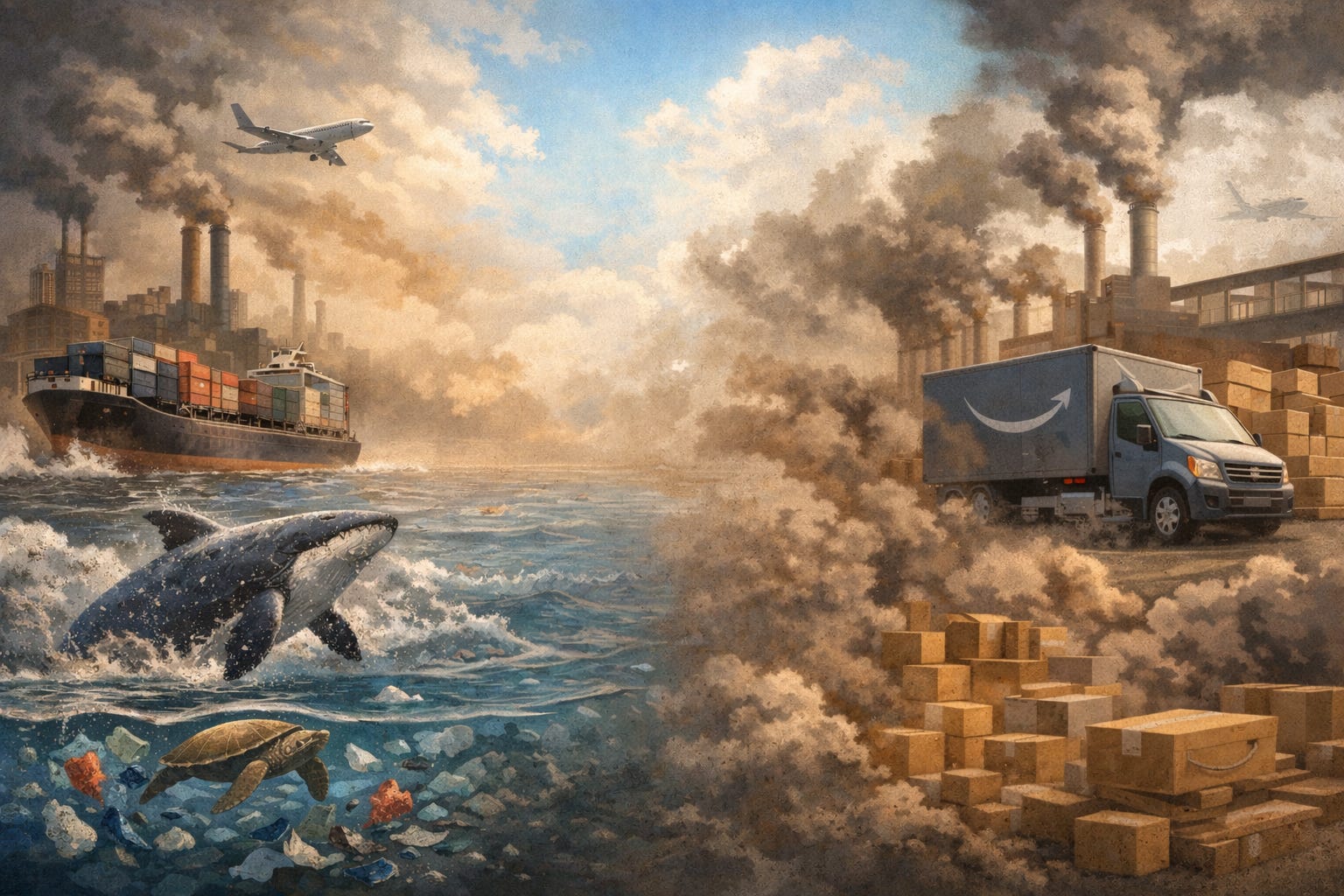
In December, the Bezos Earth Fund announced $24.5 million for marine conservation in the Eastern Tropical Pacific. The coverage was warm. Another billionaire doing good things for the ocean.
I wanted to look at the numbers.
Amazon, the company that made Jeff Bezos wealthy enough to give it away, recorded a carbon footprint of 68.25 million metric tonnes of CO₂ equivalent in 2024. The US Environmental Protection Agency estimates the social cost of carbon, the estimated damage each tonne of CO₂ does to health, agriculture, sea levels, and more, at between $51 and $190 per metric tonne, depending on methodology. At the higher figure, Amazon's 2024 footprint carries an estimated social cost of approximately $13 billion. At the lower figure, roughly $3.5 billion.
A note on methodology: no one sends Amazon a bill for $13 billion. The social cost of carbon is the government’s best estimate of the damage each tonne causes. It is used to weigh costs and benefits in regulation. The figure is contested. Some economists say it is too low; others call the methodology speculative. What it offers is a way to make the grant legible against the footprint.
The Bezos Earth Fund’s marine conservation grant is $24.5 million.
That is less than 0.2% of the higher figure. Less than 0.7% of the lower one.
The grant is earmarked for ocean protection. Consider, then, what Amazon’s supply chain puts into the ocean, and the air above it.
The Supply Chain
Amazon has an estimated 38% share of the US e-commerce market. According to the Pitney Bowes 2024 Parcel Shipping Index, Amazon Logistics shipped 5.9 billion parcels in the United States alone in 2023, giving it a 27% share of US parcel volume. That makes Amazon the largest delivery company in the country, ahead of both UPS and FedEx.

A September 2024 report by Stand.earth Research Group, the Clean Mobility Collective, and Ship It Zero attempted to quantify what that dominance means for emissions. The report estimates that since Amazon announced its Climate Pledge in September 2019, the company’s US shipping and delivery emissions have grown from 3.33 million metric tonnes of CO₂ to 5.84 million metric tonnes in 2023.
Amazon disputes this methodology. A company spokesperson called the report inaccurate, saying it relies on ‘assumptions and unverified information.’ Amazon does not disclose transportation emissions at the level of granularity the advocacy report attempts, making independent verification impossible. What follows are the report’s estimates, which should be read as such.
Air freight: The report estimates Amazon increased its US air freight emissions by 67% between 2019 and 2023. As of June 2024, Amazon operated 93 planes with eight airline partners. The company has announced plans to acquire 200 aircraft by 2028.
Heavy-duty trucks: Emissions from Amazon’s heavy-duty trucks grew an estimated 51% over the same period. These trucks account for 37% of each package’s carbon output in the report’s model.
Last-mile delivery vans: Emissions from Amazon’s delivery vans grew an estimated 195% between 2019 and 2023. The company has pledged to deploy 100,000 electric delivery vans globally by 2030. By the end of 2024, Amazon reported 31,400 electric vans in its fleet. The advocacy report argues this target fails to account for projected parcel volume growth; by 2030, they estimate Amazon will need approximately 400,000 delivery vehicles to meet demand.
Maritime shipping: Amazon’s US inbound and domestic marine shipping emissions increased an estimated 26% between 2019 and 2023.
Amazon points to a different metric: carbon intensity. This measures pollution per dollar of sales, so if Amazon grows but pollutes less per package, intensity falls. The company claims a 40% reduction since 2019.
The difficulty: climate targets are set in tonnes, not ratios. A company that doubles in size while pollution rises 50% has reduced intensity but increased its contribution to the atmosphere. Amazon’s absolute emissions rose 6% in 2024 alone, and remain 33% above the 2019 baseline when the Climate Pledge was announced.
The two metrics describe different truths. The atmosphere registers the tonnes.
The Communities
The Stand.earth report includes a detail that rarely appears in corporate sustainability discussions: where the emissions land.
Maritime shipping pollution does not distribute evenly. Ships idle at port while waiting to unload. The communities adjacent to those ports breathe what comes out of the stacks.
A 2018 study published in Nature Communications modelled the global health burden of shipping emissions, estimating that port and coastal communities bore a disproportionate share of the approximately 400,000 annual premature deaths attributed to ship exhaust before cleaner fuel regulations took effect in 2020.
Seattle-Tacoma is Amazon’s home port.
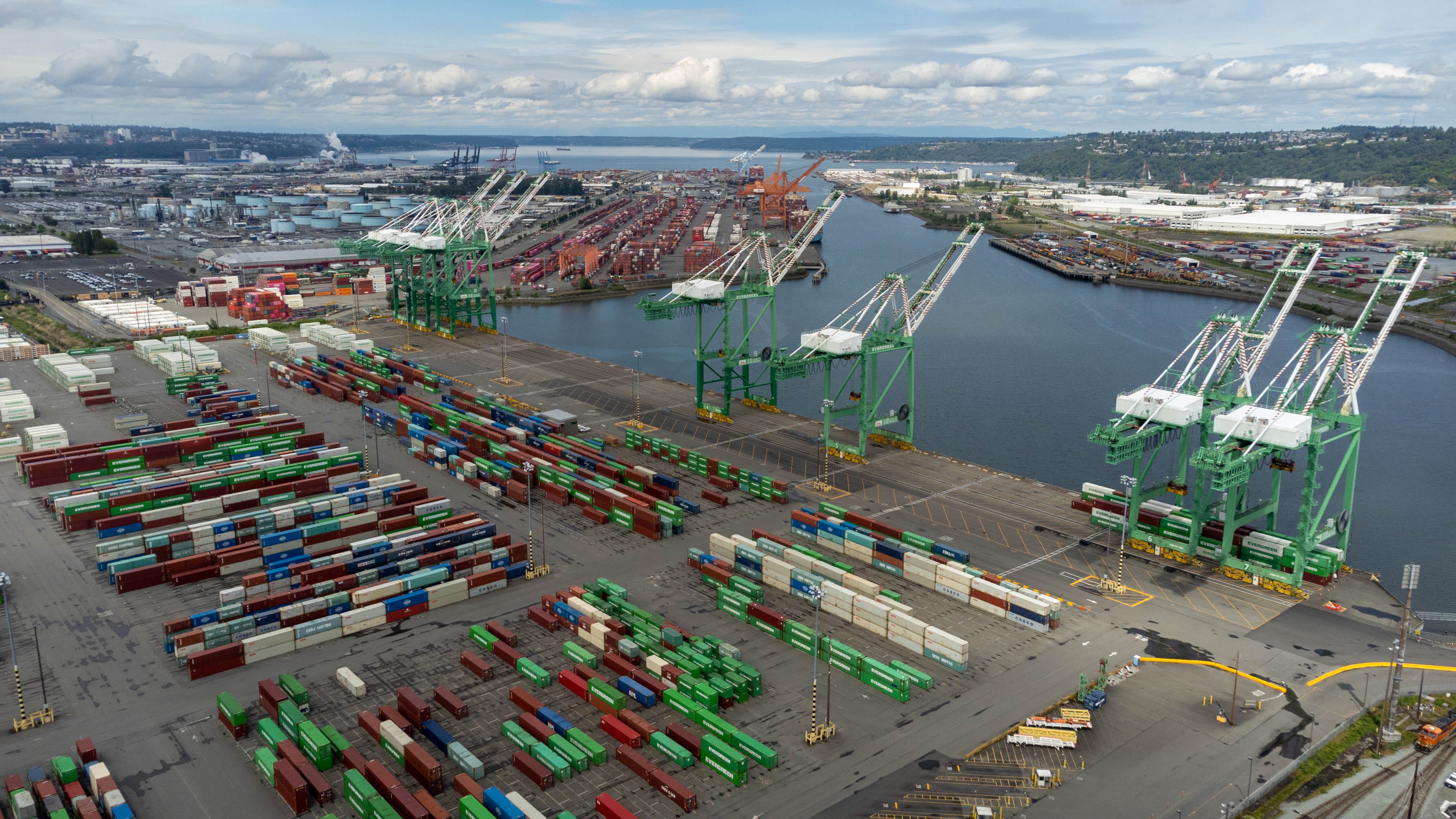
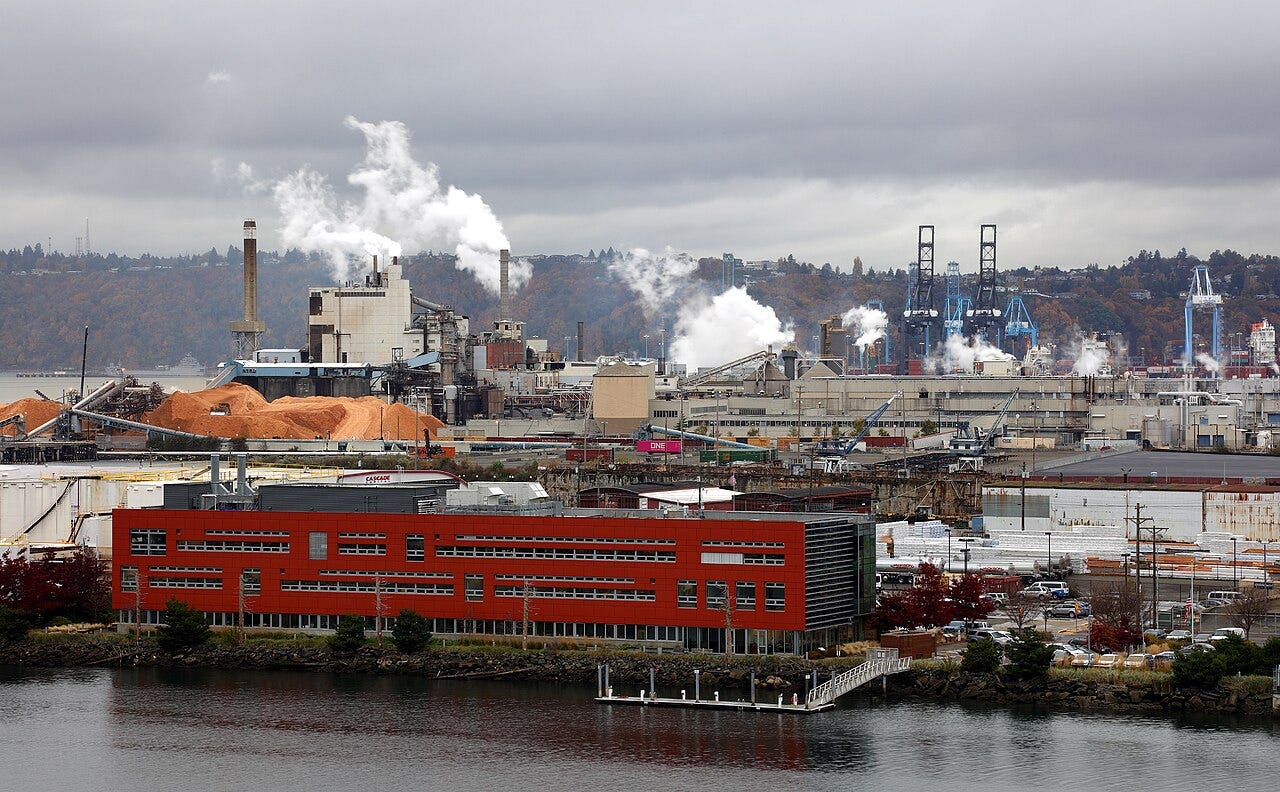
People are dying younger in the neighbourhoods next to this port. I asked Amazon about its emissions trajectory. I asked the Bezos Earth Fund about the relationship. What I found is below.