


I am working on a long-form investigation into deep-sea mining, to be published in June.
A couple of weeks ago, I wrote about one strand of that story in the Deep Brief: the dark oxygen hypothesis. In my coverage, I reported that the hypothesis has been challenged, that independent researchers have failed to replicate it, that peer-reviewed rebuttals exist, and that a $5.2 million independently funded expedition will investigate it further this year.
I noted the criticism. I quoted a deep-sea ecologist at the Natural History Museum calling the scientific back-and-forth ‘normal science.’ I included the GEOMAR findings that contradicted the original results.
I ended the article with a question: the science is contested. Shouldn’t we resolve it before we act on it?
That question triggered a response.
The Exchange
Michael Clarke, Environmental Manager at The Metals Company (TMC), commented on my LinkedIn post sharing the article. He argued that I had failed to mention the full body of criticism, including multiple preprint rebuttals and a peer-reviewed synthesis paper in Frontiers in Marine Science.
‘It was a fair point. My coverage was a roundup, not a literature review, but the criticism was broader than I had represented. I said so in my reply.
I noted that the $5.2 million follow-up is independently funded by the Nippon Foundation. I mentioned that Andrew Sweetman, lead author of the original dark oxygen paper, is joining GEOMAR’s cruise later this year to compare methods directly.
Clarke’s reply was unequivocal.
‘The science isn’t contested, it’s flawed,’ he wrote. ‘Not being thermodynamically feasible is conclusive in my book. Unless Sweetman et al. are now rewriting the laws of physics. Anyone with a basic grounding in science can see this.’
Another commenter, a chief legal officer in the renewables sector, added: ‘While ‘clicks’ may be sexy and drive traffic, it is a shame the science itself is not.’ He compared questioning the rebuttals to denying gravity.
Then Clarke went further.
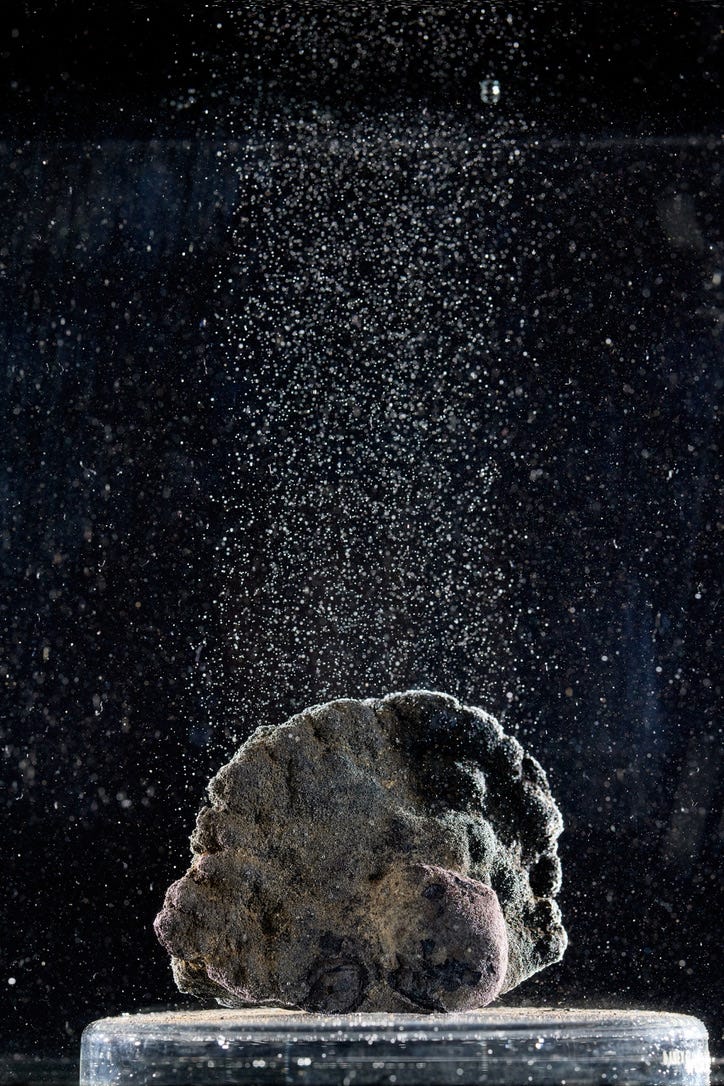
Responding to the image above published by Nature, credited to Geiger Laboratories at Northwestern University, Clarke wrote:
‘Totally fake! At best this is air being released from the porous surface of a dried nodule, as worst an AI generated fabrication.’
He described my coverage as exhibiting ‘reckless disregard for the facts’ and constituting ‘bias reporting’ that ‘perpetuates such misinformation.’
At that point, this stopped being a LinkedIn comment thread.
It became part of the investigation.
I Checked Everything
Before writing anything further, I contacted three parties.
I wrote to Nature, asking them to confirm the provenance of the image Clarke had called fake.
I wrote to Professor Franz Geiger at Northwestern University, whose laboratory produced the image, asking him to confirm what it depicted.
I wrote to The Metals Company, asking whether Clarke’s statements represented the company’s official position.
Professor Geiger responded within hours. He confirmed the image originated from his laboratory. He provided the original source: it first appeared in a Science Friday article on 2 August 2024 with the caption ‘A dry polymetallic nodule releasing air bubbles after being dropped into water.’
He noted that news reporters have full discretion over caption text, while the image rights holder controls the photograph and credit line. He copied Davide Castelvecchi, the Nature journalist who had written the caption for their coverage.
Nature‘s Senior Communications Manager confirmed separately that the image used in their 2026 story was supplied by Professor Geiger of Northwestern University. She noted their news team had verified this.
The Metals Company did not respond to my press inquiry.
Those are the facts.
