


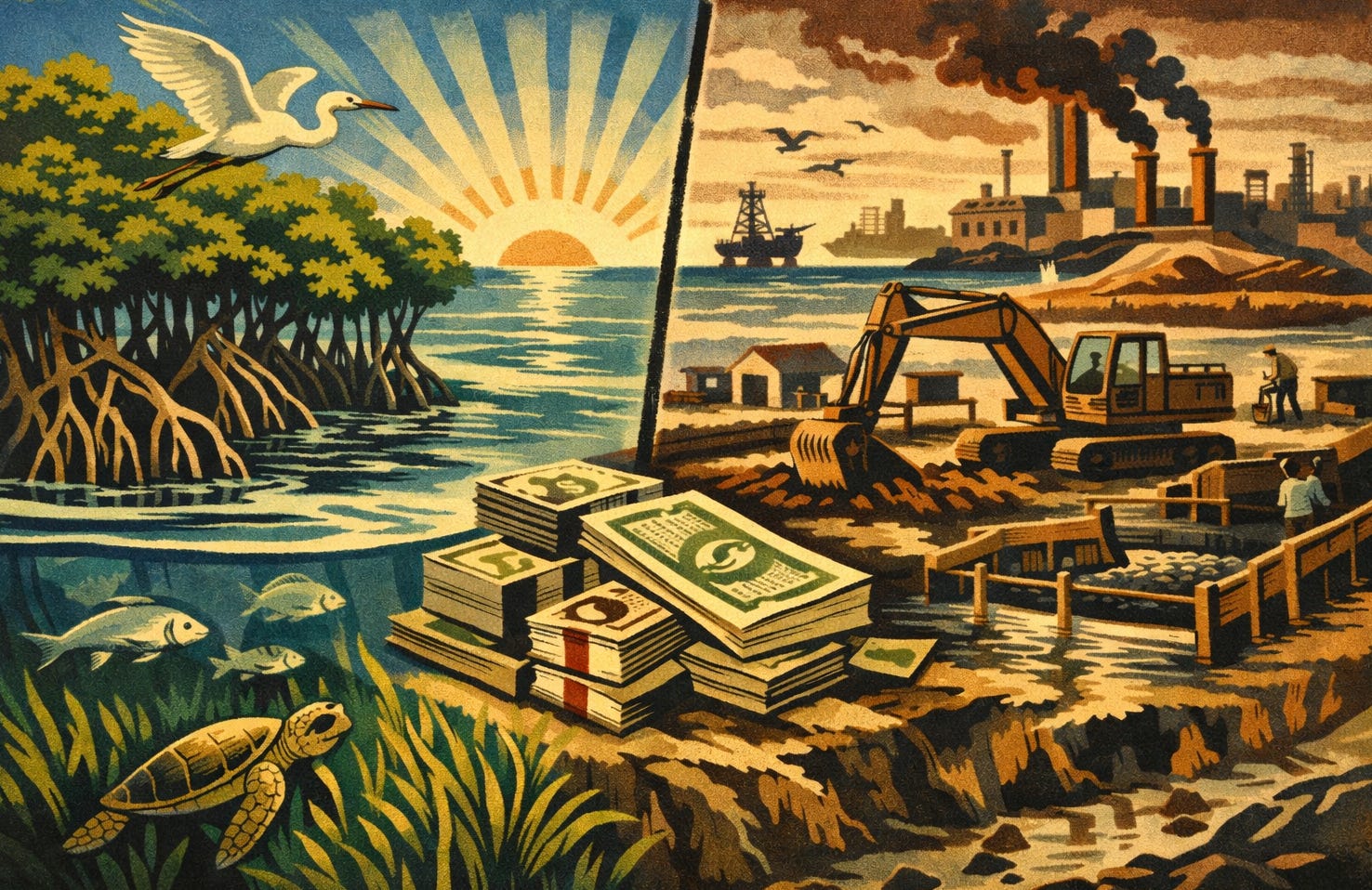
You will hear the phrase ‘blue carbon’ more in the next 12 months than in the past decade. It will appear in corporate sustainability reports, government climate pledges, carbon credit brochures, and conference keynotes.
Blue carbon is real. The science matters. The gap between what it is and what people claim it can do is becoming a serious problem.
Here is what you need to know.
The Science
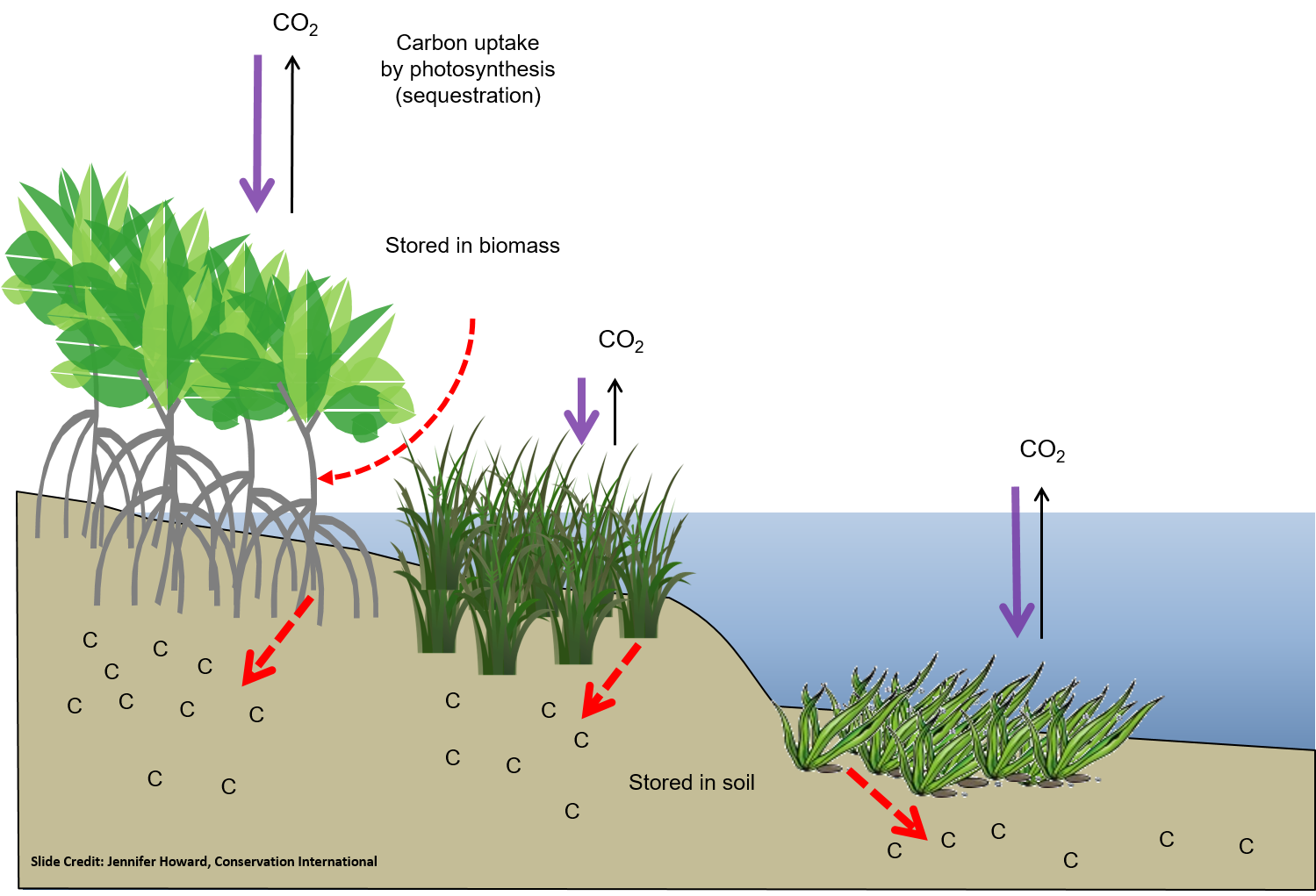
Blue carbon is carbon captured and stored by coastal and marine ecosystems. Three types of habitat do the heavy lifting: mangroves, seagrass meadows, and tidal salt marshes.
These ecosystems are small. Coastal habitats cover less than 2% of total ocean area. Seagrass meadows occupy less than 0.2% of the ocean floor. They are also spectacularly good at locking carbon away.
Per unit area, these coastal habitats can sequester carbon at rates several times greater than terrestrial forests. Seagrass meadows, covering a sliver of the ocean floor, account for an estimated 10% of the carbon buried in ocean sediments each year, according to one widely cited study.
The key phrase there is ‘per unit area.’ Nobody should confuse a salt marsh with the Amazon. The point is not that blue carbon replaces forests. The point is that destroying these small, dense carbon stores has outsized consequences.
Most of the carbon in these systems is not in the plants you can see. It sits underground, in sediments that can be metres deep and accumulate over thousands of years. Think of a salt marsh as a carbon vault. Centuries of deposits, compressed into dark soil beneath the waterline.
Destroy the marsh, and you open the vault. That carbon re-enters the atmosphere.
The Destruction
This is already happening at scale.
Global mangrove area decreased by more than a fifth between 1985 and 2020, according to a 2025 study in Geophysical Research Letters. The good news is that annual loss rates have slowed significantly, falling from 1% to 3% per year in the late twentieth century to roughly 0.3% to 0.6% today, driven by conservation efforts and policy changes. The bad news is that the total area already destroyed is enormous, and losses continue to accelerate in parts of Southeast Asia and West Africa.
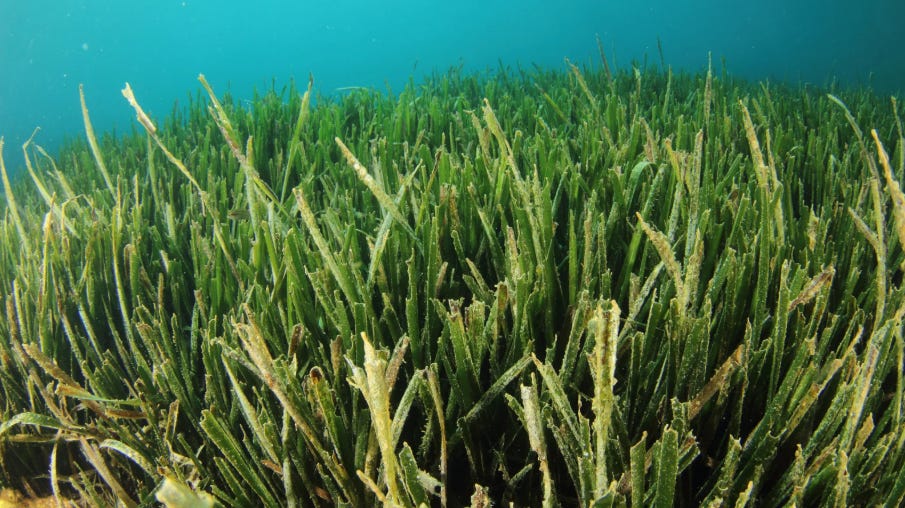
Seagrass meadows tell a similar story. A comprehensive global assessment published in Proceedings of the National Academy of Sciences found that 29% of known seagrass extent has disappeared since records began in 1879, with losses accelerating since the 1980s. Monitoring data remains patchy, and the true extent of seagrass loss is likely worse than what has been measured. Tidal marshes have lost an estimated 25% to 50% of their historical cover, according to assessments compiled by Crooks, Duarte, and others, with regional losses far higher.
The drivers are familiar. Coastal development. Aquaculture, particularly shrimp farming. Dredging. Pollution. Port expansion. The same pattern plays out from Southeast Asia to the Caribbean: habitats that took millennia to build their carbon stores are ripped up in months.
When these systems are destroyed, the vault opens. Stored carbon re-enters the atmosphere, and in many regions the rate of destruction continues to outpace protection.
The Market
That stored carbon has a price now. It can be measured, certified, sold as a credit, and bought by a company that wants to offset its emissions elsewhere. This is the voluntary carbon market: a system where companies choose to buy carbon credits, not because regulators require it, but because they want to claim climate action. Blue carbon entered this market by turning the carbon locked in mangrove sediments into a tradeable commodity.
Here is how it works. A project developer, which could be an NGO, a private company, a government agency, or a community group, designs a project to protect or restore a coastal ecosystem. They estimate how much carbon that ecosystem will store over a set period. An independent auditor checks the estimate. A registry, the largest being Verra, issues credits based on the verified number. Each credit represents one tonne of carbon dioxide either removed from the atmosphere or prevented from reaching it. Those credits are then sold to buyers, often through brokers or exchanges, and the money is supposed to flow back to fund the project.
In theory, the market saves the mangrove.
The practice is messier, and the problems are structural.
The project developer chooses the methodology for estimating carbon savings. The developer also pays the auditor who checks the estimate. The registry that issues the credits earns fees for each one issued. At every stage, the financial incentive points toward issuing more credits, not fewer. No single regulator oversees the system. There is no equivalent of a financial services authority checking the receipts. The Integrity Council for the Voluntary Carbon Market has introduced quality benchmarks, but participation is voluntary and enforcement is limited.
How much money reaches the ecosystem or the community protecting it varies enormously. Project developers, methodology consultants, auditors, registries, and brokers all take a cut. For some forest carbon projects, investigations have found that only a fraction of credit revenue reaches local communities. Whether blue carbon projects perform better is an open question. The data to answer it barely exists.
The voluntary carbon market has a credibility problem that predates blue carbon entirely. A peer-reviewed study published in Nature Communications in 2024, led by researchers at the Max Planck Institute, analysed over 2,300 carbon credit projects across all major sectors. The researchers estimated that fewer than 16% of credits issued represent real emissions reductions. For wind power projects, the figure was zero. For cookstove projects, 11%. For avoided deforestation, 25%. A separate study in the same journal found that the 20 largest corporate offset buyers sourced 87% of their credits from projects carrying a high risk of not delivering real, additional emissions reductions.
Blue carbon enters this market as the newest product on the shelf.
According to the carbon ratings agency BeZero Carbon, mangrove projects account for 99% of blue carbon credit issuance to date. Seagrass and salt marsh projects barely feature, largely because the measurement methodologies are less developed and the costs of verification are higher.
If blue carbon credits overwhelmingly represent one ecosystem type in one certification system, the market is not pricing blue carbon. It is pricing mangroves.
The measurement challenge is fundamental. Carbon stored in coastal sediments is genuinely difficult to quantify. Stocks vary enormously even within the same habitat type. A recent study in Nature Communications found that soil carbon losses from disturbance ranged from negligible to nearly 70%, depending on the type and severity of the disturbance. A 2025 synthesis published in One Earth found that methodological differences across blue carbon studies can produce estimates differing by up to tenfold. Two research teams measuring the same marsh could produce wildly different numbers. Both could be following accepted methods. Credits are being sold against numbers that the science has not yet agreed on how to measure.
Then there is the question of whether a project makes a difference beyond what would have happened anyway. In carbon market language, this is called ‘additionality,’ meaning someone pays to protect a forest that was genuinely at risk, not one that was never going to be cut down. This is not a theoretical concern. MIT Technology Review and ProPublica documented cases where the Massachusetts Audubon Society received carbon credits for conserving forests that were never in danger, and companies including Shell and Phillips 66 bought those credits as part of their offset programmes. The same risk applies to coastal ecosystems. A mangrove protected by national legislation does not need a carbon credit to survive. Selling one for it is not conservation.
Permanence is another problem. A restored seagrass meadow can be destroyed by a future storm, a change in water quality, or a policy reversal. The carbon it stored gets released. The credit that was sold against it does not get recalled. Unlike a factory that can be rebuilt, an ecosystem does not come with a warranty.
None of this means blue carbon credits are inherently fraudulent. Some projects are rigorous, well-monitored, and deliver genuine conservation outcomes alongside carbon benefits. Pakistan’s Delta Blue Carbon project had generated roughly $40 million in revenue from mangrove restoration credits by mid-2023, according to Pakistani officials. The project has restored over 70,000 hectares of degraded mangroves in the Indus Delta and received formal Article 6 authorisation from the Pakistani government, meaning the credits cannot be double-counted against Pakistan’s own climate targets. Kenya’s Mikoko Pamoja project is a community-led initiative where 117 hectares of protected mangrove generate around 2,000 tonnes of carbon credits annually, with proceeds reinvested in local development.
These projects work because the conservation is real, the measurement is transparent, and the money reaches the communities doing the protecting. The question is whether this is the model the market rewards, or whether it gets drowned out by cheaper credits from projects that look good on a spreadsheet and deliver nothing on the ground.
The early signs are not encouraging.
What is Actually at Stake
The case for protecting coastal ecosystems does not depend on the carbon market. It never did.
These habitats shield coastlines from storms and flooding. Mangrove ecosystems alone prevent an estimated 15 million additional people from being flooded annually, according to a 2020 study in Scientific Reports. A follow-up study published by the same research team in the World Bank’s 2024 Changing Wealth of Nations report valued mangrove flood protection at $855 billion globally, a figure that has grown as more people and infrastructure crowd onto vulnerable coastlines.
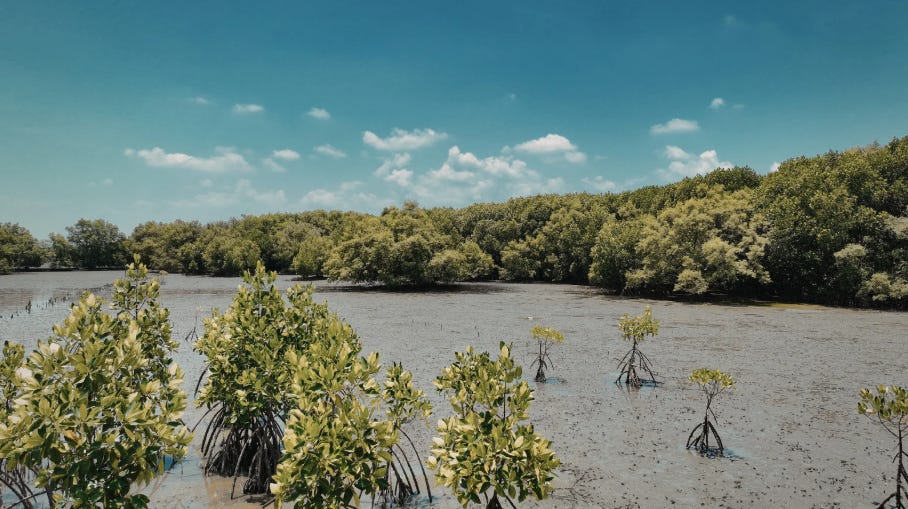
They filter pollutants from coastal water. They serve as nurseries for commercially important fish species. They support biodiversity, including species found nowhere else. They sustain the livelihoods of coastal communities that have depended on them for generations.
These are not carbon benefits. They are the reasons these ecosystems exist and the reasons their destruction matters. Carbon storage is an additional argument for protection. It should not be the primary one. When the carbon credit becomes more important than the ecosystem, the incentive structure is broken. A project that generates credits while the surrounding coastline continues to degrade is not a climate solution. It is a product.
What Needs to Change
The most effective blue carbon intervention is the one nobody wants to fund: stopping the destruction of habitats that already exist. Every hectare of mangrove converted to a shrimp farm is a vault opened. Protection is cheaper than restoration, faster than restoration, and more certain than restoration. It is also less photogenic, harder to brand, and does not generate credits for anyone.
Where destruction has already occurred, restoration matters. It is also harder than anyone selling blue carbon credits wants to admit. Projects frequently fail because the conditions that caused the original degradation, polluted water, disputed land ownership, industrial pressure, were never addressed. Restoring seagrass in water that is still polluted does not work. The carbon benefits take decades to accumulate. It is still worth doing, but it requires honesty about timescales and difficulty that the carbon market is not designed to reward.
The accounting is not ready. Standardised, independently verified methodologies for measuring blue carbon across all three ecosystem types are essential before this market can function with integrity. The IPCC’s 2013 Wetlands Supplement provided initial guidance on coastal wetland carbon accounting. A new methodology report, expected in 2027, will expand that guidance to cover ecosystem types not previously included.
International frameworks including the Kunming-Montreal Global Biodiversity Framework have set targets for coastal ecosystem protection. Article 6 of the Paris Agreement has begun to create rules for how carbon credits transfer between countries. The gap between these commitments and what is happening on the ground remains vast. Until the measurement science catches up and the governance tightens, buyers should treat blue carbon credits with the same scepticism they would apply to any new financial product where the receipts have not been checked.
The Bottom Line
Blue carbon is real science applied to an urgent problem. Coastal ecosystems store vast quantities of carbon. They are being destroyed at alarming rates. Protecting them is both a climate imperative and a conservation necessity.
It is also a term being absorbed into a market that has already failed to deliver on its promises elsewhere. The voluntary carbon market has a documented track record of overstating impacts. If blue carbon follows the same path, the ecosystems it was meant to protect will pay the price.
The ocean needs better governance, better data, and better accountability for the institutions profiting from its protection and its destruction alike.
That is what blue carbon actually means. Everything else is noise.
Ocean Rising investigates ocean governance failures and the institutions responsible for them. Next month, I am investigating who is buying blue carbon credits in the voluntary market, what they are actually getting for their money, and what happens to the ecosystems after the credits are sold.
Great article. Honestly, I was pretty horrified when I first started hearing about climate projects asking the ocean to do MORE for us. I feel like it has done more than its fair share of the work, it has absorbed so much carbon since industrialisation, hence ocean acidification and warming. That's why we now grow oceans on land to capture the carbon, I genuinely felt bad for the already existing oceans 🌊✨️
I had no idea how little those carbon credits actually offset. Definitely need better management and implementation for increased impact.