


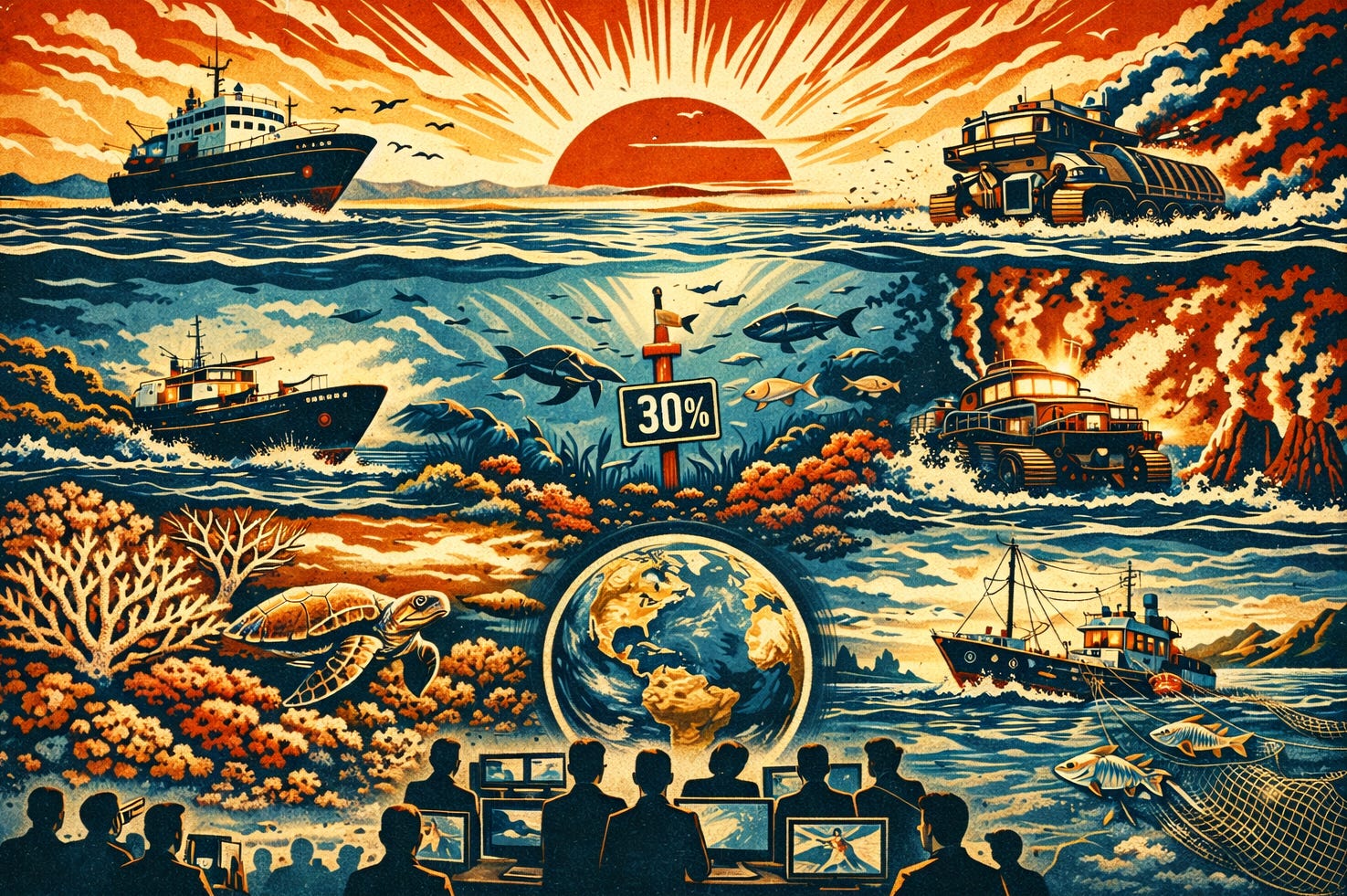
Every year, people ask me the same question, is there any good news?
I get it.
The ocean stories that break through are almost always disasters. Bleaching events. Plastic islands. Another whale washed up dead. It feels like the ending is already written, and paying attention just means watching the collapse in higher definition.
I don’t buy that. Not because I’m an optimist. I’m not. But I’ve seen what happens when enough people pay attention at the right moment. I’ve watched governments back down when they realised voters were watching. I’ve seen laws that seemed impossible pass within a few years because the pressure became unbearable.
2026 is full of those moments. Decisions that will lock in whether the ocean gets protected or carved up. Some will make the news. Most won’t. They’ll happen in conference rooms you’ve never heard of, decided by officials whose names you’ll never know.
Here’s what matters, why it matters, and what’s at stake if we get it wrong. Or right.
1. The High Seas Finally Get a Law
On 17 January 2026, the High Seas Treaty becomes international law. This is massive. For the first time ever, there’s a legal framework to protect the 61% of the ocean that sits beyond any country’s control.
Think about that. More than half the ocean has had no rules. Countries could talk about protecting it, but there was no way to actually do it. No body to approve a marine protected area. No requirement to check if an activity would cause damage before it started. Nothing.
The treaty fixes this. It lets countries create protected areas in international waters. It forces environmental assessments before harmful activities begin. It sets up rules for sharing the benefits when companies find useful genetic material in deep-sea organisms. It requires wealthy nations to help poorer ones participate in ocean science.
The treaty comes into force in January. But that’s just the start. Later in 2026, the first Conference of the Parties will meet to build the actual institutions: the scientific body that reviews proposals, the systems for sharing information, the money for implementation. Treaties are just words until you build the machinery to enforce them.
I’ve seen enough treaties to know that ‘entering into force’ means nothing on its own. The real test comes when someone proposes a protected area that threatens a powerful fishing fleet, or when a company demands to know why its project got blocked. That’s when we find out if this thing actually works.
If this goes right: Protected areas start appearing in international waters within two years. Harmful projects get stopped before they start. The 30x30 target, protecting 30% of the ocean by 2030, becomes genuinely possible for the first time. The high seas stop being a free-for-all.
If this goes wrong: The institutions get starved of funding. Nothing meaningful gets protected. Flag states keep registering vessels with zero oversight. The high seas stay lawless in practice, just with more paperwork. We miss the only real chance we’ve had to govern the majority of the ocean.
2. The 30x30 Promise Gets Tested
In October, countries meet in Armenia for COP17, the biodiversity conference. This is where they have to show their homework on the promise they made in 2022: protect 30% of land and ocean by 2030.
The promise sounded good. The reality is messier. Right now, about 8% of the ocean has some kind of ‘protection.’ But protection doesn’t always mean protection. Plenty of marine protected areas still allow industrial fishing, bottom trawling, even drilling. Conservationists call them ‘paper parks.’ They exist on maps but not in the water.
Only about 3% of the ocean is properly protected, where extraction is actually banned.
To hit 30% by 2030, countries need to protect an area roughly the size of Africa. In four years. And it needs to be real protection, not lines on a map that change nothing.
COP17 is where the excuses run out. Countries will be asked: what have you actually done? The BBNJ Treaty gives new tools for protecting the high seas. Some countries are moving fast. Others have done almost nothing. This is the accountability moment.
If this goes right: Countries turn up with real plans and real commitments. New protected areas get announced, including in the high seas. The definition of ‘protected’ gets tightened so industrial extraction doesn’t count. Fish stocks start recovering. Ecosystems get room to heal. By 2030, a third of the ocean is genuinely off-limits to destruction.
If this goes wrong: Countries show up with statistics that look good but mean nothing. ‘Protected’ keeps including areas where trawlers still drag nets across the seabed. The target gets technically met while the ocean keeps dying. Another global promise joins the pile of failures. And the next generation asks why we bothered making commitments we never intended to keep.
3. Deep-Sea Mining: Do We Destroy What We Don’t Understand?
Four kilometres down, the ocean floor holds metals worth trillions. Cobalt. Nickel. Manganese. They sit in nodules on abyssal plains that haven’t been disturbed for millions of years. Hydrothermal vents nearby host life forms that exist nowhere else on the planet.
Some companies want to mine these metals. They say we need them for electric car batteries, for the green transition. They argue it might cause less damage than mining on land.
Scientists say we have no idea what we’d be destroying. These ecosystems are barely studied. Many species found at proposed mining sites are completely new to science. If we wreck them, they won’t come back for centuries. Maybe ever. Sediment plumes from mining could spread across huge areas, smothering everything in their path.
The International Seabed Authority (ISA) has been trying to agree on mining rules for years. They’re deadlocked. Over 40 countries want a pause or a ban. The EU says no mining until science proves it’s safe. BMW, Volvo, Google, Samsung have all said they won’t use deep-sea minerals.
But some companies are pushing ahead anyway, trying to mine under individual country sponsorship without waiting for international agreement.
The ISA meets again in 2026. A deal is unlikely. The real question is whether the growing coalition for precaution can hold the line.
Here’s what I find clarifying about this one. The case for mining rests on guesses about future demand that might be completely wrong. Batteries are changing fast. Recycling is improving. The metals might not even be needed by the time they’re extracted. But the case against mining rests on something we know for certain: ecosystems that take millions of years to develop don’t bounce back on human timescales.
When you’re not sure what will happen but the damage is permanent, waiting isn’t weakness. It’s the only sane option.
If this goes right: No mining permits get issued. The ISA agrees that extraction can’t start until independent science proves it won’t cause irreversible harm. A precedent gets set: when we don’t know enough, we don’t gamble with things we can’t replace.
If this goes wrong: A company starts mining under national sponsorship, outside any international agreement. Others follow. A race to the seafloor begins. Ecosystems that have existed for geological ages get obliterated for metals that end up not being needed. We destroy what we never even catalogued. And we set the precedent that extraction always wins.
4. The Ocean Keeps Heating. The Reef Faces Judgment.
The ocean has absorbed over 90% of the extra heat from climate change. That’s why the atmosphere hasn’t warmed even faster. The ocean has been protecting us.
But it’s paying the price. And it’s running out of capacity.
2026 will likely be another record-breaking year for ocean temperatures. More marine heatwaves. More coral bleaching. More dead zones where oxygen has dropped so low nothing can survive.
The Great Barrier Reef has now bleached six times in nine years. 2016. 2017. 2020. 2022. 2024. 2025. The hits keep coming faster, with less time to recover between them. This year, severe flooding also hit more than 700 kilometres of reef, sending sediment and pollutants far offshore onto coral already stressed by heat.
In July 2025, UNESCO’s World Heritage Committee ordered a full review of Australia’s management of the reef. They flagged four areas where Australia is falling short: cutting climate pollution, improving water quality, preparing for climate-driven disasters, and managing fisheries sustainably. Australia must submit a new State of Conservation report by February 2026. Later in the year, the Committee will decide whether to place the reef on the ‘in danger’ list.
This isn’t just about one reef. It’s a test of whether international accountability means anything when climate change is the threat. Australia can’t control global emissions on its own. But it can control whether it keeps approving coal and gas projects while claiming to care about the reef.
That’s what UNESCO is really asking. Can you say you love something while helping destroy it?
We all know the answer. The question is whether anyone will say it out loud.
If this goes right: Australia arrives at the 2026 review with a credible plan. Emissions targets are strengthened toward the 90% cut by 2035 that scientists say is needed. No new fossil fuel projects get approved. Water quality funding is locked in, with a realistic pathway to meet targets this decade rather than in 90 years. Destructive fishing practices are phased out. The reef gets a few cooler years to recover. UNESCO sees genuine progress and holds off on the ‘in danger’ listing. The precedent is set: international accountability can work.
If this goes wrong: Australia submits a report full of aspirations and not much else. Emissions targets stay weak. New coal and gas projects keep getting approved. Water quality targets remain decades away. The World Heritage Committee concludes that Australia has failed to act on the four areas it flagged: climate, water, disasters, fisheries. The reef gets listed as ‘in danger.’ Other countries take note: if the world’s richest nations won’t protect their most iconic ecosystems, why should anyone else? Bleaching events stack up with no recovery time. The reef that once supported 64,000 jobs and brought in billions in tourism becomes a cautionary tale. And eventually, there’s nothing left to list.
5. Fishing Rules Get Tighter (In Some Places)
Overfishing is one of the biggest ongoing assaults on the ocean. We’re taking fish faster than they can reproduce. Trawlers drag weighted nets across the seabed, destroying everything in their path. Illegal fishing operations work in the dark, unreported and untracked.
In 2026, the rules are tightening. In some places.
The EU now requires smaller fishing vessels to carry tracking devices. Digital systems will follow fish through the supply chain from catch to plate. It’s getting harder to launder illegal catch into legitimate markets.
Regional fisheries bodies are starting to coordinate with the new High Seas Treaty. Some are developing environmental plans for sensitive seabed areas. Countries are designating new marine protected areas to meet 30x30 targets. Major new MPAs were announced across the Pacific and Indian Oceans in 2025.
But enforcement is patchy. Mediterranean fish stocks are still severely overexploited. Governments still hand out billions in subsidies for destructive fishing. Illegal, unreported, and unregulated fishing remains a massive industry.
The infrastructure for accountability is being built. Slowly. Whether the political will follows is another question.
This is where progress is quietest and matters most. Treaties get headlines. Tracking devices don’t. But the difference between a protected area that works and one that exists only on a map comes down to whether anyone knows what’s happening inside it. The technology is finally catching up. The politics hasn’t.
If this goes right: Tracking becomes the global standard. Illegal catch can’t find a market. Fish populations inside protected areas start bouncing back. Sustainable fishing stops being a niche and becomes normal. Coastal communities that depend on healthy fish stocks see their futures stabilise. The ocean starts feeding people properly again.
If this goes wrong: Enforcement stays weak. Tracking gets adopted but never monitored. Protected areas remain paper parks. Industrial fleets keep stripping the ocean while small-scale fishers get squeezed out. More stocks collapse. The protein source for over a billion people becomes unreliable. Food prices spike. Fishing communities that have sustained themselves for generations find there’s nothing left to catch.
The Year Ahead: A Calendar of Pressure Points
These five issues don’t exist in isolation. They connect to a calendar of summits, deadlines, and decisions that will shape the ocean throughout 2026.
Not every ocean event matters equally. Some are talking shops. Others are moments where real pressure gets applied, where accountability gets demanded, where the direction could actually shift.
This is the list worth watching. I’ll be tracking all of it.
January
1 January: New Decade Advisory Board takes over for second half of UN Ocean Decade
17 January: BBNJ High Seas Treaty enters into force
February
1 February: Australia’s Great Barrier Reef report due to UNESCO
7 February: Plastics treaty negotiations resume
22-27 February: Ocean Sciences Meeting, Glasgow
March
2-6 March: European Ocean Days, Brussels
April
30 April: Mid-Atlantic speed zones for North Atlantic right whales close
May
16 May: New Pacific salmon fishing rules take effect
June
3-4 June: Island States Ocean Summit, Tokyo
8 June: World Oceans Day
16-18 June: Our Ocean Conference, Mombasa, Kenya
Ocean Impact Summit, Indonesia (date to be confirmed)
July
3 July: Conference on International Ocean Governance, Berlin
UNESCO World Heritage Committee decides on Great Barrier Reef ‘in danger’ listing (date to be confirmed)
August
International Seabed Authority resumes deep-sea mining negotiations (date to be confirmed)
September
27 September-2 October: IWC70 whaling commission meeting, Australia
October
5-7 October ICOE-OEE 2026 ocean energy conference, The Hague
19-30 October: Convention on Biological Diversity COP17, Yerevan, Armenia
November
9-20 November COP31 climate conference, Antalya, Turkey
1 November: Mid-Atlantic speed zones for North Atlantic right whales reopen
17-20 November: World Conference on Marine Biodiversity, Bruges, Belgium
December
First BBNJ Conference of the Parties (late 2026, location to be confirmed)
What Happens Next
Five big issues. A calendar of decisions. Twelve months where the direction could tip either way.
The ocean doesn’t care about our conferences. It doesn’t read treaties. It responds to physics and chemistry: how much heat we trap, how much carbon we emit, how much we take, how much we poison. The choices made in 2026 won’t show up immediately. They’ll show up in 2040, in 2060, in the lives of kids being born right now.
That can feel paralysing. It shouldn’t.
I started Ocean Rising because the stories that matter weren’t being told. Or they were being told too late, after the decisions had already been made and the damage was locked in. My job is to watch the rooms where this stuff gets negotiated, read the documents nobody covers, and tell you what’s actually happening while there’s still time to change it.
I’ll be covering each of the five big issues in depth as they unfold. When the High Seas Treaty institutions get built, when the ISA meets, when UNESCO delivers its verdict on the reef, you’ll hear about it here first, with the context you need to understand what it means and who’s responsible.
And I’ll be tracking everything else on that calendar too. The conferences, the deadlines, the quiet regulatory shifts that don’t make headlines but change everything. All of it.
I’ll be across this so you don’t have to be.
Share this with someone who should be paying attention. The ocean’s problems aren’t caused by a lack of solutions. They’re caused by a lack of pressure on the people who could implement them.
The window is still open. It won’t stay open forever. What happens next depends on whether enough people are watching.
I’ll make sure you are.
- Luke
Thank you for this report.
Thanks Luke, been putting BBNJ out as much as possible. My most keen observation, and this extends to all corners of the climate crisis, is that advertising, costly it may be, is the fastest most efficient method to truly wake up/fire up, whatever 'UP' the public, specially in the complacent wealthy North. If BBNJ fails then little hope for the rest.